



The Cryptocurrency Divergence: Bitcoin’s Bearish Drift Amid Wall Street’s Resilient Rally
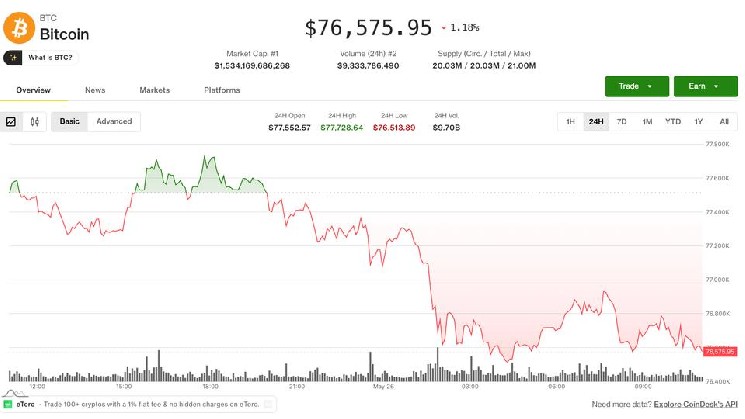
At a time when traditional financial markets are signaling robust risk-on sentiment, the cryptocurrency market is telling a starkly different story of localized fatigue and technical vulnerability. On Tuesday, Bitcoin traded at approximately $76,600, marking a quiet 0.8% decline since midnight UTC and swiftly neutralizing a brief, optimistic run toward the $77,800 mark on Monday. This downward rejection is particularly troubling for technical analysts as it threatens to establish yet another lower high within a larger, persistent bearish market structure that has plagued the flagship cryptocurrency since its October local peaks, contributing to a total decline of over 7% across the past fortnight. Strikingly, this digital sluggishness is not a reflection of macroeconomic headwinds or broader geopolitical instability, as Wall Street indices painted a contrasting picture of optimism; both S&P 500 and Nasdaq 100 futures logged gains exceeding 0.5%, demonstrating that the capital bottlenecks currently choking crypto-asset valuations are native to the ecosystem rather than a byproduct of global economic contractions.
Ethereum’s Persistent Slump and the Fragmented Altcoin Landscape
The underlying weakness within the digital asset ecosystem is even more pronounced when examining Ethereum, which continues to suffer from a lack of institutional momentum and structural buy-side pressure. Trading at a depressed $2,098, Ether has shed more than 10% of its market capitalization over the past two weeks, remaining locked in the lower-middle half of the trading channel it carved out between February and April, with no immediate indications of a trend reversal or reclaim of former support levels. This broader market malaise has resulted in an incredibly fragmented altcoin landscape, where generalized class rallies have been replaced by isolated, narrative-driven skirmishes. While artificial intelligence and computational infrastructure protocols have emerged as notable areas of resilience, legacy alternative tokens have faced severe selling pressure, as shown by privacy-focused assets like Zcash, which registered a quick 7% drop from its midnight baseline, highlighting a structural shift in investor preferences away from early-generation utility protocols.
Navigating the Quiet Storm: Derivatives Data Reveals Selective Capital Allocation
Analyzing the inner workings of the crypto derivatives market provides deep insight into current investor sentiment, revealing a landscape that possesses quiet stability rather than outright panic. Over the last 24 hours, overall cryptocurrency futures trading volume dropped by 10% to approximately $130 billion, while aggregate notional open interest hovered relatively unchanged around the $126 billion threshold, and liquidations contracted by 21% to a muted $126 million. This combination of declining transaction volume and steady open interest underscores a highly cautious, post-holiday consolidation phase where retail leverage is low and institutional players are choosing to sit on their hands. Instead of a broad capital expansion across the entire spectrum of digital assets, options and futures traders are engaging in highly selective, asset-specific positioning, driving capital into high-conviction protocols like Chainlink, Shiba Inu, and Near Protocol, while simultaneously fleeing volatile plays such as Zcash, Stellar, and Hype.
Inside the NEAR Protocol Phenomenon: Dynamic Scaling, Upgrades, and Institutional CVD Dominate
Amid this generalized market stagnation, Near Protocol has emerged as a distinct outlier, proving that fundamental technical upgrades and network utility can still command substantial capital inflows during a broader market slowdown. Having surged by a historic 58% during the weekly interval ending May 24, NEAR registered an additional 14% gain to touch $2.82, recapturing multi-month highs last witnessed in November of last year. This impressive rally has been deeply supported by an aggressive integration of dynamic scaling upgrades, quantum-safe cryptographic defenses, and advanced user-privacy layers, which in turn catalyzed a major derivatives migration as open interest exploded to a record 309 million tokens from just 182 million token units the prior week. Crucially, NEAR has captured the strongest positive 24-hour Cumulative Volume Delta among its layer-1 peers, proving that active buyers are aggressively stepping in with market orders to secure immediate allocations rather than passively resting bids in the limit books, while a healthy, mildly positive funding rate suggests that this upward trajectory remains fundamentally stable and free from structural risk.
Hedging Downside and Volatility Dampening: A Deeper Dive Into Bitcoin and Option Dynamics
While specific altcoins enjoy localized demand, a look at Bitcoin futures reveals a systematic deleveraging process designed to mitigate structural risk. Bitcoin’s futures open interest has experienced a notable cooldown, retreating to 711,000 BTC from a peak of 793,000 BTC registered earlier this month, signaling a voluntary reduction of exposed collateral as traders reassess market direction. Simultaneously, the 30-day implied volatility indexes for both Bitcoin and Ethereum continue to slip lower—a surefire sign of systematic volatility selling, where market makers and institutional desks write options contracts to capture yield rather than bidding up protection out of fear. Nevertheless, risk-aversion is quietly building beneath this calm exterior, as evidenced by a surge in trading volume for defensive Bitcoin put options on the Deribit exchange, concentrated heavily between the $70,000 and $76,000 strike prices, while Chainlink bucked the broader cooling trend by registering an open interest spike up to 42.96 million tokens with an annualized funding rate of 8%, pointing to a premium on oracle networks.
The Return of Speculative Niches: The Ascent of AI, DeFi Resilience, and the Elusive Altcoin Season
Ultimately, the current architecture of the cryptocurrency market suggests that capital is actively rotating away from passive index exposure and into highly specialized thematic sectors. On Tuesday, CoinDesk’s Computing Select Index was the market’s best-performing benchmark, climbing 1.9% since midnight and registering a 24-hour gain of 2.7%, heavily supported by artificial intelligence powerhouses like Fetch.ai, which added 4.8%, and Render, which jumped 7.2%. This speculative appetite was further reflected in the DeFi Select Index’s 1.3% advance, indicating that active market participants are taking on risk in decentralized finance applications while the major layer-1 assets struggle to establish direction. However, this niche outperformance has done little to lift the wider ecosystem; regulatory scrutiny continues to weigh heavily on privacy-focused assets such as Monero and Dash, both of which slid by 1.5% alongside Zcash, leaving CoinMarketCap’s Altcoin Season Index at a modest 35 out of 100, which confirms that while specific technological narratives are thriving, the broader market remains far from a widespread, retail-driven capital expansion.