



The Great Liquidity Migration: Why Digital Gold is Losing Ground to Sovereign Debt, Physical Commodities, and the New Space Race
The Grand Correction: Bitcoin Retreats from Peak Amid Broad Market Re-evaluation
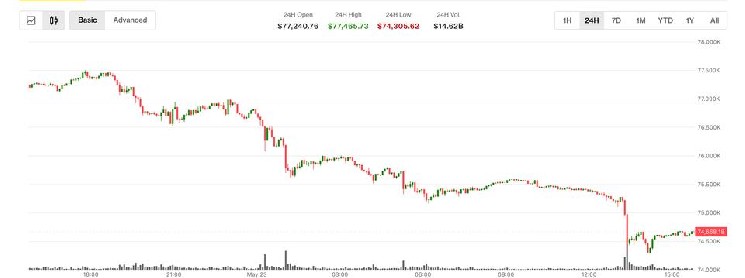
The digital asset market is experiencing a profound transition as speculative enthusiasm faces a sober macroeconomic reality. Bitcoin, the undisputed bellwether of the cryptocurrency ecosystem, has suffered a sharp decline, plunging to $74,305 on Saturday to hit its lowest valuation since April 20, according to data provided by CoinDesk. This sudden downswing represents a drop of over 3% within a 24-hour window and a painful 10% retracement from its previous peak of over $82,500 achieved on May 6. For months, the primary narrative driving the cryptocurrency market was one of unstoppable institutional momentum, propelled by the introduction of regulated investment vehicles. However, the recent price correction has exposed the fragile underpinnings of this rally, proving that even the most resilient digital assets are not immune to the gravitational pull of global monetary adjustments and shifting investor sentiment. As the initial euphoria surrounding the asset class cools, market participants are forced to reassess their risk exposures, transitioning from aggressive speculation to a defensive posture focused on liquidity preservation and capital conservation. This correction is not merely a localized event within the altcoin and blockchain ecosystem; rather, it is a clear reflection of a broader global systemic shift, signaling that the era of effortless liquidity and uncritical risk-taking is giving way to a more calculated, risk-averse era of capital allocation.
The Yield Paradigm: How Soaring Sovereign Bond Treasury Yields Dampen Crypto Liquidity
At the heart of Bitcoin’s recent struggles is a fundamental realignment of the global macroeconomic landscape, marked by a significant surge in U.S. Treasury yields and a parallel rise in government bond yields across developed economies. For much of the post-pandemic era, ultra-low interest rates and aggressive central bank asset purchases forced investors out of traditional instruments and into high-beta, zero-yielding alternative assets like cryptocurrencies in search of meaningful returns. Today, that dynamic has completely reversed; with the federal funds rate sitting at multi-decade highs and persistent inflationary pressures keeping sovereign yields elevated, cash and short-term laboratory instruments have suddenly become highly attractive, yielding reliable, risk-free returns. When institutional investors can capture guaranteed yields of 4.5% to 5% on short-duration U.S. government paper, the investment thesis for holding a highly volatile, non-yielding digital asset like Bitcoin becomes significantly harder to justify. This systemic re-pricing of risk is draining the marginal liquidity that previously fueled the speculative crypto run-up, redirecting capital into safe-haven sovereign debt markets. As long as inflation remains stubborn and central banks message a “higher-for-longer” interest rate narrative, the macroeconomic wind will continue to blow directly against speculative digital frontiers, making the cost of capital too high for many hedge funds and asset managers to maintain large, speculative long positions in cryptocurrencies.
Institutional Flight: The Mass Exodus of Capital from U.S. Spot Bitcoin ETFs
The rapid shift in investor sentiment is most clearly visible in the sudden turnaround of U.S.-listed spot Bitcoin exchange-traded funds (ETFs), which have transformed from the primary drivers of market growth into significant sources of selling pressure. During the past week alone, institutional and retail investors pulled an astonishing $1.26 billion from these spot Bitcoin ETFs, representing the single largest week of net outflows the investment vehicles have experienced since their highly anticipated launch in January. This dramatic exodus of capital comes on the heels of another difficult week, which saw approximately $1 billion in redemptions, bringing the cumulative two-week drain from these funds to more than $2.26 billion. The speed and scale of these redemptions suggest that the institutional capital that entered the crypto market earlier this year may not be the committed, long-term “HODLers” that blockchain advocates had anticipated; instead, much of this money appears to be highly sensitive to interest rates and short-term momentum, eager to exit at the first signs of market stress. This massive deleveraging process has created a challenging feedback loop: as ETF redemptions force fund managers to sell underlying spot Bitcoin on the open market, it pushes spot prices lower, triggering further algorithmic stop-losses and retail panic, which subsequently drives more ETF outflows. The dream of Wall Street-backed stability for digital assets has met the harsh reality of capital market volatility, leaving many to wonder if the ETF-driven bull market has officially reached its peak and run its course.
The Geopolitical Shift: Escalating Middle East Tensions Drive Speculators Toward Physical Commodities
While digital assets face significant headwinds, the geopolitical landscape is driving a powerful reallocation of speculative capital toward traditional, physical commodities. The continuing instability in the Middle East, specifically the escalating tensions involving Iran and the potential threat of supply disruptions through the Strait of Hormuz—the world’s most critical maritime oil transit choke point—has forced global macro funds to re-prioritize real-world resource security over digital abstraction. Consequently, commodities such as crude oil, copper, and sulfur are experiencing massive inflows of speculative capital, as markets work to price in the geopolitical premium of shipping disruption and manufacturing supply chain strain. This trend has highlighted a crucial flaw in the popular Bitcoin thesis: under conditions of genuine geopolitical crisis and threatened global supply lines, capital frequently flees the unproven “digital gold” paradigm and returns to raw, physically indispensable materials that keep the physical economy running. Industrial metals like copper, crucial for the expanding green energy grid and AI data center infrastructure, along with basic chemical building blocks like sulfur, are capturing the speculative attention that previously drove crypto. In this environment of tangible, physical risk, investors are prioritizing supply-chain resilience and inflation-hedging commodities over digital lines of code, leaving Bitcoin to suffer from a lack of critical narrative support when it is needed most.
The SpaceX Alternative: Pre-IPO Derivatives Capture Speculative Capital
Beyond sovereign debt and physical commodity markets, speculative capital within the digital space is also being diverted into innovative financial products linked to the private space sector, specifically SpaceX’s much-anticipated initial public offering (IPO). Space Exploration Technologies Corp., led by Elon Musk, has long been a crown jewel of private-market technology investing, and the prospect of its transition to public markets has triggered a wave of speculative interest. In a fascinating convergence of decentralized finance and traditional venture capital, several blockchain-based, pre-market derivative platforms have launched synthetic trading markets tied to SpaceX’s pre-IPO performance, allowing traders to bet on the eventual valuation of the aerospace giant before it officially debuts on public exchanges. These derivative instruments have rapidly gained popularity, attracting millions of dollars in trading volume from retail and institutional participants who are eager to capture early exposure to SpaceX’s highly lucrative Starlink satellite constellation and Mars exploration program. This migration of capital away from established cryptocurrencies and into pre-IPO derivative contracts highlights a broader trend: speculative investors are becoming increasingly selective, abandoning purely speculative altcoins and generalized crypto bets in favor of tangible, high-growth industrial and technological enterprises. The allure of participating in the commercialization of space has temporarily overshadowed the appeal of decentralized ledgers, drawing vital liquidity out of the broader digital asset pool.
Looking Ahead: Deciphering the Future Dynamics of the Digital Asset Ecosystem
As the dust settles from this major market correction, the path forward for Bitcoin and the broader digital asset space will be determined by how quickly the market can adjust to this new macroeconomic regime. While the current outlook appears challenging due to the triple pressure of elevated bond yields, persistent ETF outflows, and competing physical commodity trends, experienced market observers note that such shakeouts have historically been healthy for the long-term viability of the industry. The elimination of highly leveraged speculative positions and weak-handed interest-rate-sensitive capital could pave the way for a more stable and sustainable accumulation phase, where Bitcoin is valued less as a speculative vehicle and more as an alternative decentralized currency network. The key support levels to watch in the coming weeks lie around the mid-$70,000 threshold, where historical purchasing patterns suggest strong buyer interest may re-emerge to shore up the market. Meanwhile, the integration of digital assets with traditional finance continues in the background, as developers and financial institutions build the infrastructure necessary for tokenized real-world assets and regulatory-compliant DeFi applications. Ultimately, Bitcoin’s current correction is a reminder that the path to global adoption is rarely linear; it is a highly volatile journey shaped by global macroeconomics, international geopolitics, and investor appetite for risk in a constantly changing world.