


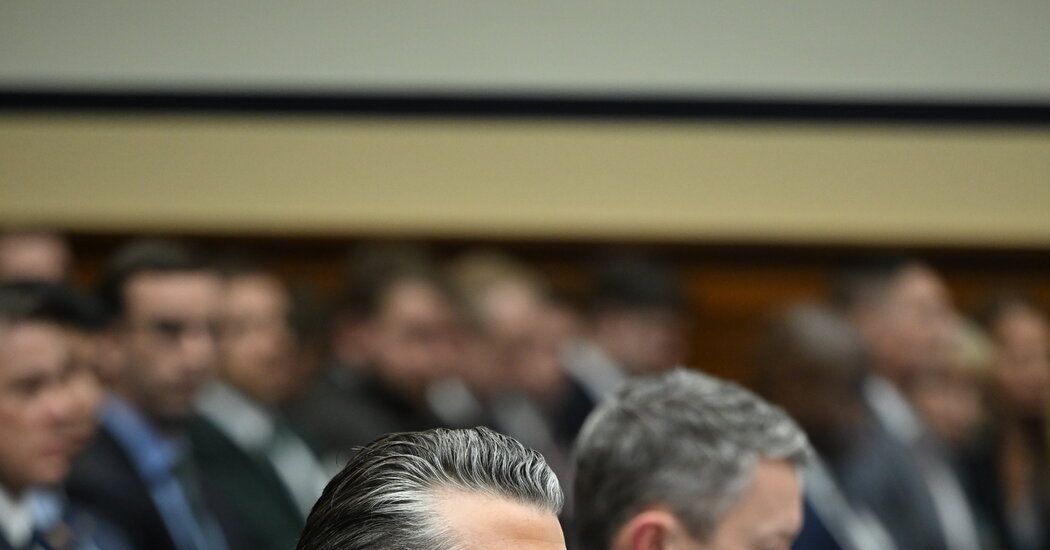
In an atmosphere thick with tension on Capitol Hill, Defense Secretary Pete Hegseth stepped into a routine budget hearing that quickly exploded into a heated debate over the ongoing war in Iran. Scheduled as a standard review of the Pentagon’s massive $1.45 trillion funding request, the session instead became a battlefield where Hegseth didn’t hold back, railing against lawmakers from both sides of the aisle for what he saw as their “reckless, feckless, and defeatist” questioning of the conflict. It’s hard to imagine a more charged scene—Republicans who had been silent on oversight for weeks suddenly facing a firestorm, all while polls screamed that the American public overwhelmingly disapproved of this unauthorized operation dragging on the Middle East.
Hegseth’s opening salvo set the tone right from the start, before a single question was even asked, painting Congress as the biggest threat to national security. He spoke with the kind of blunt aggression that reminded folks of a general in the heat of battle, not your typical bureaucratic exchange. Democrats poked at the lack of a real war plan, and things got downright personal; Hegseth’s belligerence was so over-the-top that even the Republican chairman, Mike Rogers from Alabama, had to step in and remind everyone to respect the time limits. It’s the kind of moment that makes you wonder about the folks running things—if a five-hour grilling turns into a shouting match, where’s the actual leadership?
Beneath all the fireworks, some sobering truths came out about the human and financial toll of this war. The Pentagon finally coughed up a cost estimate: $25 billion so far, mostly eaten up by bombs and missiles, which is a far cry from the $200 billion they initially eyed or even the $11 billion burned through in the first six days. And the lives lost? Fourteen American service members dead, according to General Dan Caine, chairman of the Joint Chiefs—numbers that hit home like a gut punch when you think about families mourning. Democrats like Adam Smith from Washington hammered home the point that over a dozen countries were now entangled, with civilian and military casualties piling up, and no clear path forward. “Where is this going?” Smith demanded, echoing a question on every American’s mind who dreads another quagmire in the region.
Hegseth and Caine assured everyone that Iran was weaker than it had been in decades, decimated by U.S. strikes, yet they dodged specifics on endgames, timetables, or total costs, arguing you don’t tip off the enemy—even after crushing their military and seizing key waterways. Critics smelled cover-up, with John Garamendi from California accusing Hegseth of outright lying and incompetence from day one, tallying up losses against questionable gains. Hegseth fired back like a man in the ring, accusing Garamendi of cheering for the enemy and insisting the American people backed the mission. Outside, protesters chanted “war criminal” as Hegseth arrived, turning the Capitol into a protest zone that felt more like wartime than peacetime discourse. Meanwhile, President Trump weighed in on social media before dawn with a macho post: a photo of himself wielding an automatic rifle against a backdrop of explosions, urging Iran to “get smart soon.” Trump later told Axios he preferred a naval blockade to bombing, calling it more effective, adding yet another layer to this chaotic saga.
Not all eyes were on the drama; some Republicans stood by Hegseth, praising his leadership and the war as a step toward forcing Iran into real peace talks—no nukes, ever. They shifted focus to lighter but critical topics like AI in the military, ramping up support for troops, and bracing against China. But bipartisan cracks showed: Republicans like Don Bacon from Nebraska blasted Hegseth’s firings of top brass—Navy Secretary John Phelan and Army Chief Randy George—calling them unwise, while Austin Scott from Georgia worried about alienating Democrats whose votes were crucial for funding. With weapons stockpiles running critically low after diverting hardware to the Middle East, Chairman Rogers warned of a dangerous gap in U.S. readiness, pointing out how the industrial base lagged in replenishing arsenals. It was a rare moment of agreement: the war was winning battlefield gains but straining resources, forcing even allies to admit the need for unity to avoid a complete breakdown.
Looking ahead, the 60-day mark in the war looms as a potential turning point, where even GOP stalwarts might demand more transparency on objectives and troop exits. Inside the hearing, Hegseth dubbed it “an astounding military success,” confidently telling Seth Moulton from Massachusetts, “Absolutely, we’re winning.” Yet, the reality feels murky—a fragile cease-fire, dueling blockades, and no firm deal on Iran’s nuclear program or leadership changes. It’s a portrait of a nation divided, leaders posturing, and a conflict that costs billions while promising peace but delivering uncertainty. In the end, Hegseth’s showdown wasn’t just about budgets; it was a mirror reflecting America’s fatigue with endless wars, where politicians debate while soldiers bleed, and the public waits for someone to end the cycle. You can’t help but feel a human tug—of loss, of pride, of frustration—as the gears of power grind on.