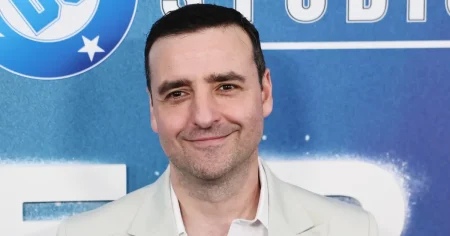




John Mayer, the acclaimed musician whose soulful guitar riffs and heartfelt lyrics have captivated millions, found himself in the spotlight once again during a lively event at HISTORYTalks in Philadelphia on April 17. At 48, Mayer has always walked that fine line between pop stardom and thoughtful introspection, often weaving personal reflections into his performances. This particular appearance marked the 250th anniversary of the United States, a milestone that no doubt stirred thoughts of the nation’s history and its current turbulent state. It was here that Mayer revisited his 2006 hit, “Waiting on the World to Change,” using a simple analogy to grapple with the frustrations of the present day. He likened the situation to being locked out of your car: some urge you to smash the window and force an entry, while others advise patiently waiting for roadside assistance like AAA. Mayer, with his characteristic wit, admitted that after writing the song two decades ago, that metaphorical AAA still hasn’t arrived. It’s a moment that feels deeply human, capturing the exasperation of a generation tired of inaction in the face of systemic change. As he stood on stage, guitar in hand, Mayer wasn’t just performing; he was engaging in a quiet rebellion against the chaos, reminding his audience that sometimes, the urge to act impulsively clashes with the wisdom of endurance. Fans in the crowd, many of whom have followed Mayer’s journey from breakout acoustic sensations like “Your Body Is a Wonderland” to more political undertones in later work, nodded along, perhaps seeing echoes of their own dilemmas in his words. This wasn’t Mayer the celebrity pontificating; it was Mayer the observer, sharing a slice of vulnerability in an era where political divides run deeper than ever.
When an audience member requested that Mayer play “Waiting on the World to Change” that evening, it opened the door to a candid discussion about the song’s legacy. Mayer, ever the honest storyteller, admitted that the track had drawn criticism for coming across as too passive. “It is a good idea. Sound and responsible,” he said, defending the notion of waiting for genuine change rather than embracing haste. This response resonated on a profound level, as Mayer reflected on how society often dismisses patience as weakness in a world that demands instant results. For many listeners, the song had been a balm during uncertain times, but critics saw it as an excuse for apathy. Mayer’s willingness to own this nuance showed his growth as an artist; he’s no longer the young songwriter worried about pleasing everyone. Instead, he’s embracing the complexities of his work, much like how people in their own lives balance activism with realism. Think about it—we all face those moments where smashing through a problem feels tempting, but Mayer’s analogy hints at the dangers: shattered glass everywhere, history stained with rash decisions. By sharing this, he humanized the song, turning it into a mirror for the audience’s own frustrations with bureaucracy, political gridlock, and the slow grind of progress. It’s not just a tune; it’s a conversation starter, proving that music can bridge the gap between personal reflection and collective action, as Mayer himself might say, with a shrug and a smile.
Released on August 1, 2006, as part of Mayer’s third studio album, Continuum, “Waiting on the World to Change” arrived at a pivotal moment in music history. The album itself was a departure, blending bluesy rock with pop sensibilities, and critics were quick to dissect it. The New York Times called the song a “lovely and anger-free ode to a vaguely dissatisfied generation,”.n” capturing that pre-social media ennui where discontent simmered without boiling over. Yet, Pitchfork took a sharper tone, dubbing it a “preaching of non-action and civic apathy with the gravitas of an infomercial but only a fraction of the soul.” These reviews highlight Mayer’s skill in tapping into universal feelings—frustration with systemic issues without resorting to rage. The lyrics paint a picture of youthful disillusionment: “Me and all my friends, we’re all misunderstood, said we’d stand for nothing less than progress,” but ultimately conclude with waiting rather than revolting. It’s a melody that lingers, invoking memories of post-9/11 America, Iraq War protests, and the rise of social media as both a tool for change and a echo chamber. Mayer’s guitar, acoustic and emotive, carries the weight of that era’s quiet protests. People who bought the album back then probably hummed it while watching the news; today, it feels prophetic in an age of viral outrage. Humanly speaking, Mayer’s extension of the waiting metaphor suggests he’s been mulling over how far we’ve progressed—or not—in those intervening years, making the song not just timeless but eerily relevant to ongoing debates about when to wait and when to push back.
While Mayer has largely steered clear of overt political statements in his career, he’s not been shy about his opinions when asked, revealing layers of a man who values nuance over slogans. Having campaigned for former President Barack Obama, Mayer embodies the thoughtful progressive vibe of artists who support causes without shouting from rooftops. His approach feels authentic, like a friend weighing in on a heated dinner table debate rather than a pundit on a podium. This avoidance of hardline stances has allowed him to connect with diverse fans, from conservatives enjoying his soulful solos to liberals nodding at his subtle nods toward issues like climate change and social justice in songs like “Love on the Weekend.” Yet, it’s his reluctance to dive into political fray that makes his rare insights all the more impactful. During interviews, Mayer often stresses the importance of empathy, a trait that shines through in how he navigates fame. Fans might recall his personal struggles—battles with embarrassment, as he once called it—that fueled his music, making him relatable in a celebrity world full of facades. By not turning every stage into a soapbox, Mayer invites listeners to ponder their own beliefs, fostering a sense of shared humanity where disagreements simmer rather than explode into division.
One of his most notable political musings came in a January 2024 episode of the “Conan O’Brien Needs a Friend” podcast, where Mayer offered a surprisingly velvety assessment of current President Donald Trump. Delving into Trump’s speaking style, Mayer remarked, “If Donald Trump weren’t saying the things he was saying, and he was saying things that are benign, he’d have a lovely speaking voice.” It’s a comment that could disarm critics, focusing on the rhythm over the rhetoric. Mayer elaborated on Trump’s teleprompter readings, noting how the president reacts to the words as if discovering them for the first time, adding a layer of unpredictability that fascinates him. He points out the “binary” quality—those emphatic “Oh yeah, they should be” moments that punctuate his delivery. This isn’t endorsement or condemnation; it’s an artistic ear tuned to cadence, much like how Mayer listens to jazz legends. Fans who know Mayer as a voice coach (he once collaborated with pop giants) might see this as a professional observation, humanizing Trump beyond the headlines. It sparks conversations about charisma versus content, reminding us that even leaders are performance artists at heart. Mayer’s take avoids partisanship, instead highlighting how speech shapes perception, encouraging listeners to separate the melody from the message. In a polarized climate, such objectivity feels refreshing, a nod to Mayer’s belief in understanding over judgment.
In wrapping up his reflections that night in Philadelphia, Mayer tied the bow on his commentary with a deft flourish, calling his own remark “incisive” amid the nation’s 250th anniversary celebrations. This self-awareness underscores his evolution from the earnest boy wonder of the mid-2000s to a seasoned musician unafraid to poke at societal sores with humor and humility. “Waiting on the World to Change” wasn’t just a song resung—it was reinterpreted through the lens of today’s political storms, urging audiences to question when patience turns to complicity. Mayer’s analogy of waiting for AAA resonates as a call for resilience, reminding us that true change often dawdles while desperation tempts shortcuts. By humanizing the debate, he transforms abstract turmoil into relatable dilemmas, much like how his music often turns personal heartaches into shared anthems. For fans, this moment reinforced Mayer’s place not just as a performer, but as a cultural touchstone, bridging generations through introspection. As he presumably launched into the song afterward, the crowd might have felt a collective exhale, united in the hope that someday, that roadside assistance would finally arrive. In the grand tapestry of American discourse, Mayer’s quiet wisdom serves as a thread of sanity, proving that even pop idols can illuminate the path forward with grace and a guitar in hand.