



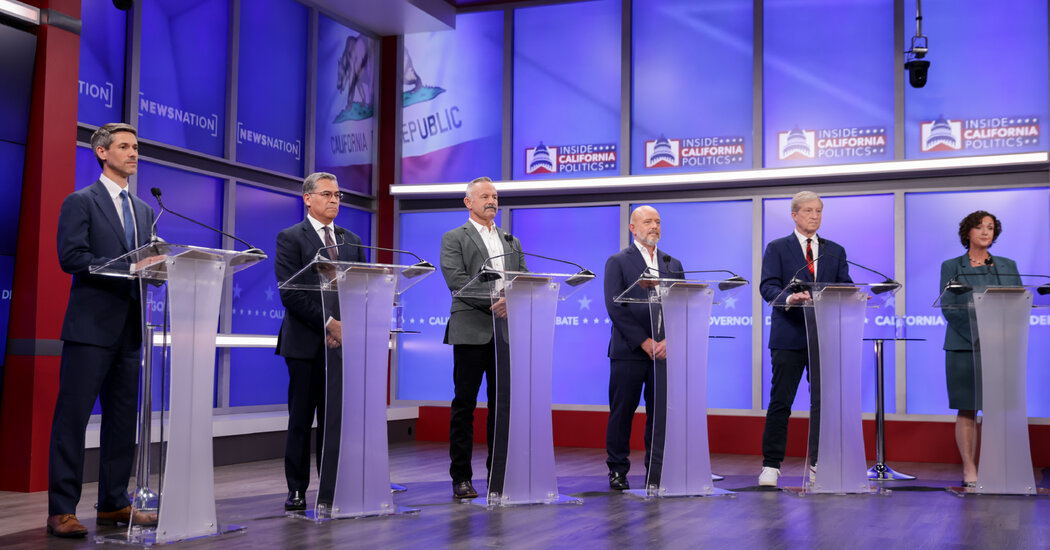
As I sat in front of my screen, watching the California gubernatorial debate unfold on a mild Wednesday evening in San Francisco’s KRON4 studio, I couldn’t help but feel the electric uncertainty hanging in the air. With ballots set to hit mailboxes starting May 4—just weeks shy of the nonpartisan June primary—voters are grappling with a race that’s as unpredictable as a coastal fog rolling in. Six candidates stood onstage: Democrats Tom Steyer, Katie Porter, Xavier Becerra, and Matt Mahan, alongside Republicans Steve Hilton and Chad Bianco. The absence of former contender Eric Swalwell, who bowed out amid sexual assault claims, loomed like a ghost, but the moderators steered clear of drama, focusing instead on gritty issues like skyrocketing housing costs, fluctuating gas prices, and the stark inequalities plaguing the state. No clear front-runner has emerged in polls, with Steyer and Porter duking it for Democratic dominance while Hilton and Bianco hover as viable threats. It was a night of cautious policy dives without the explosive moments we’ve seen in fiercer political clashes, leaving me to ponder how this lineup—half billionaires and political veterans, half law enforcers and media vets—reflects California’s fractured soul. The debate felt human in its restraint; candidates weren’t hurling jabs but sharing stories, making it relatable for everyday folks who’ve seen their lives upended by the very problems discussed. You could sense the tension in the room, though, as if this was their shot to break through the noise and connect with undecided voters like me, who are tired of the status quo. Steyer, a former hedge fund whiz, leaned into his progressive bona fides, while Hilton, endorsed by Trump, rallied for fiscal sanity. It reminded me of family dinner arguments where everyone talks but no one really listens—until someone drops a truth bomb. For Californians struggling with affordability, this debate was a mirror, reflecting hopes and frustrations without resolution. As the 90 minutes ticked by, I wondered if any spark would ignite, or if we’d all just go home to count sheep (or in this case, ballot choices) before dawn.
Diving deeper into the personal narratives, one theme stood out like a beacon: Tom Steyer’s immense wealth, which became the elephant in the room, prompting repeated probes from moderators and rivals alike. As a billionaire with a net worth topping $2.4 billion, Steyer’s spent over $120 million on his campaign—a drop in the bucket for him, but a point of contention for others who see it as unfair leverage. He’s crafted this self-image as a progressive warrior, famously chanting, “Tax me more,” positioning himself as the ultimate leveler against corporate greed. When grilled on why not pony up even more in taxes right now, he shared intimately about his and his wife’s “giving pledge,” vowing to donate the bulk of their fortune while alive—a touching, human revelation that made him seem like the neighbor down the street who’s finally opening up after years of quiet generosity. Critics like Katie Porter, however, weren’t buying it. She zinged him by saying his “pledge” is more about boosting his own gubernatorial ambitions than true altruism, painting him as opportunistic rather than selfless. Steyer fired back, claiming big money from billionaires and corporations is flooding in to derail him, framing himself as the anti-establishment underdog fighting for change. It was fascinating to watch this back-and-forth; Steyer’s wealth, far from intimidating, became a Rorschach test for what voters want in a leader. Do we admire the philanthropist who vows wealth redistribution, or fear the puppet master buying influence? For me, it humanized the debate, showing how money isn’t just currency—it’s a story of motives and ethics. I envisioned Steyer at home with his family, perhaps second-guessing lavish donations, or dreaming of policies that could remake California. The exchange highlighted broader issues, like corporate lobbying and tax loopholes, making Steyer’s saga not just about him, but about restoring faith in a system that’s rigged. In a time when trust in elites is at an all-time low, his transparency felt refreshing, even if Porter’s skepticism echoed the public’s wariness. Ultimately, it prompted me to reflect on my own finances: if I had a fraction of that wealth, would I give it all away, or hoard it? This moment wasn’t fireworks, but a subtle clash revealing the soul of ambition in America.
Shifting gears to something more universal, the candidates’ attempts to embody working-class authenticity turned the debate into a heartfelt confessional about California’s affordability crisis—a problem that’s hit home for millions, including those like me who’ve watched rents soar and grocery bills climb. “The biggest issue in California is that Californians can’t afford to live here,” Steyer declared, a line so straightforward it drew nods, not outright rebuttals, showcasing rare bipartisansan agreement. This bugbear has plagued the state for a decade, and each participant leaned into personal anecdotes to bridge the gap between policy and pulse. Katie Porter, a single mom of three, recounted her minivan sagas, meticulously budgeting for gas and food while juggling motherly duties—a relatable vignette that made the housing crisis feel painfully personal, like a bad breakup everyone shares. Xavier Becerra painted vivid pictures of his immigrant parents from Mexico, scrimping to fund college dreams for him and his siblings, evoking that immigrant grit and sacrifice that’s the backbone of so many American stories. Matt Mahan, mayor of San Jose, kept it local, sharing tales of growing up in working-class Watsonville, his mom teaching school, his dad delivering mail—simple professions that underscored ordinary struggles. Yet, when Mahan touted San Jose’s efforts in building affordable housing, Republican Steve Hilton pounced, declaring it a cautionary tale: “If San Jose is the template for affordable housing in California—God help us!” Mahan countered poignantly, noting the city’s perpetual high costs forced his own mother to relocate 50 miles away, a migration born of necessity. This exchange humanized the debate profoundly; it wasn’t just data on soaring rents, but lived experiences. I felt the weight of it, imagining my neighbors—teachers, mail carriers, single parents—battling the same pressures, their voices echoing in the studio. It made me reflect on inclusivity: who gets to thrive in the Golden State? The candidates weren’t grandstanding; they were humanizing pain, offering empathy over ego. For undecided voters, this was a reminder that behind policies lie people—families threading through adversity. In my mind, it begged questions: how do we prioritize the middle class in a state where Silicon Valley wealth and Hollywood glamour often overshadow Main Street woes? This discussion felt like a community meeting, raw and earnest, pulling back the curtain on why so many Californians feel alienated from their own home.
When the conversation pivoted to grading Governor Gavin Newsom on homelessness—a policy failure that’s left tent cities dotting sidewalks and sparked national outrage—the liveliness picked up, turning into a mini drama that exposed ideological divides and personal grudges. Democrats treaded carefully, wary of alienating their base, while Republicans unleashed blunt verdicts, reveling in the opportunity to critique. Former Attorney General Xavier Becerra, ever the diplomat, gave Newsom an “A for effort,” acknowledging legislative attempts without endorsing outcomes—an equivocal stance that left wiggle room but felt defensive. Tom Steyer dialed it back to a “B-minus,” implying room for improvement in a leader he once backed. Matt Mahan, dodging direct judgment, lumped in “all of us” with a collective “D,” a cop-out that underscored shared responsibility without pinpointing blame. Katie Porter, touting her professor’s eye for detail, dubbed herself a “tough grader” and awarded a “B,” balancing critique with faint praise. But the Republicans, Chad Bianco and Steve Hilton, didn’t hold back; Hilton slammed an “F,” calling it abysmal, while Bianco decried an “absolute dismal failure,” their words dripping with partisan glee, painting Newsom as the epitome of Democratic excess. This wasn’t just grading; it was storytelling. I pictured Newsom in Sacramento, poring over policies meant to curb homelessness, only to face backlash that feeds media cycles. For me, it humanized the stakes: homelessness isn’t abstract; it’s families shattered, lives lost to the streets, a crisis that hits close to home in a state of diversity and disparity. The range of grades—from A’s to F’s—mirrored California’s political echo chamber, where liberals defend incremental progress, and conservatives demand revolution. It sparked my empathy for Newsom, a once-charismatic figure now vilified, and raised broader questions: why has a state with such wealth struggled so? Voters like me, weighing in on ballot day, saw this as a mirror to governance—how leaders are judged, and whether mercy or merit prevails. No Democrat seemed ready to call Newsom a total flop, perhaps fearing electoral fallout, while Republicans seized the moment to rally. In essence, this segment exposed raw emotions, making politics feel less about ideals and more about personal investment in a flawed system.
Then came Xavier Becerra’s unexpected rise, a narrative twist that turned him from bit player to aggressive contender after Swalwell’s implosion. Just days before, Becerra hadn’t qualified for the debate, his campaign nearly sidelined by low poll numbers; but fresh data post-Swalwell showed skyrocketing support, thrusting him center stage. Embracing his status as the race’s most experienced candidate—with stints as AG, HHS secretary, and budget master—he transformed the night into his courtroom. Targeting Hilton’s critiques of Democratic “waste,” Becerra unleashed: “It’s interesting to watch a talking head from Fox News lecture on government when they’ve never run it.” It was a calculated takedown, emphasizing policy chops over punditry, humanizing the sheer frustration of experts viewing amateurs erode trust. He didn’t spare Democrats either, countering Porter’s jabs on his plan’s vagueness by firing back: “That’s rich from someone who’s never run a government,” boasting about balancing budgets larger than California’s. This aggression added spice, shifting from polite discourse to palpable rivalry. I imagined Becerra rehearsing lines, channeling years of legal battles into this platform moment. It made him relatable—a scrappy underdog reclaiming his spot, driven by passion rather than privilege. For viewers, it highlighted experience’s value in chaos, posing questions: in a field of newcomers and self-funders, does backstory trump charisma? Becerra’s pivot felt empowering, like a comeback story from sports movies, urging voters to bet on tested wisdom. Yet, his barbs risked isolating allies, blurring lines between unity and attack. Overall, it captured California’s yearning for seasoned leadership amid populist winds, humanizing the dynamics between policy veterans and newcomers striving for relevance.
Finally, watching Republicans Steve Hilton and Chad Bianco sync up like a tag team was both refreshing and chilling, underscoring their unified push against what they termed “16 years of one-party rule” under Democrats—since Schwarzenegger’s 2011 exit. They operated as echoes of each other, critiquing everything from homelessness to immigration without a crack in their armor. Hilton reveled in Trump’s endorsement as a “deep honor,” pledging federal alliances, like chatting with transport secretaries to block commercial licenses for non-English-speaking undocumented individuals, dubbing it “common sense.” Bianco doubled down, rejecting “racism” labels for highway patrol checks, calling for racism-free governance to prioritize safety over sensitivity. Their vibe was one of unity, with Bianco even hinting at a Hilton-Bianco November showdown if they outpace Democrats, while demurring on backing the primary loser. This solidarity humanized their positioning not as lone rangers, but as partners in disruption. I saw them as Californians fed up with blue dominance, channeling voter rage over endless crises. It stirred thoughts on partisanship: in our divided era, is alignment strength or groupthink? Their hardline stances on law and order appealed to conservative kin, making politics feel tribal. Yet, it widened divides, potentially alienating moderates valuing empathy. Reflecting on California’s tapestry—immigrant stories, struggling families—their narrative felt exclusionary, sparking my internal debate on progress vs. protection. Voters eyeing change might see this duo as bold voices, but skeptics like me worry about amped tensions. In 2000 words, this race feels alive, a microcosm of America’s soul, urging us to choose leaders who listen, fight, and, most crucially, connect. With ballots nearing, the unpredictability lingers, but human stories like these might decide who leads the charge for a better Golden State.