



David Hertzog, the University of Washington physicist whose career has been deeply intertwined with some of the most intricate puzzles in particle physics, can barely contain his excitement these days. As one of the key players in the Muon g-2 experiment—a decades-long quest that has gathered hundreds of scientists from around the world—he’s not just thrilled about the scientific breakthroughs; he’s eagerly anticipating the personal joy it will bring to others. The project, which involved meticulously measuring the properties of subatomic particles, has now earned the collaboration a jaw-dropping $3 million Breakthrough Prize in fundamental physics, the world’s richest award of its kind, announced at a glittering ceremony in Los Angeles. What makes it even more heartwarming is how Hertzog and his team chose to distribute the prize: not to a select few, but equally among all the researchers who contributed to the research papers. Imagine, he tells me with a chuckle, grad students or postdocs who dipped their toes into the project for just a couple of years—perhaps running some obscure data analysis or calibrating equipment—and have long since moved on to other adventures in life. These folks, who might not even remember the exact details of their muon-related escapades, are about to get a life-changing phone call or email from the Breakthrough Prize folks. “They’re going to be shocked out of their lives about something they did a long time ago that they don’t remember doing,” Hertzog laughs. It’s these moments of unexpected delight that remind us why science isn’t just about equations and electrons—it’s about human connections, surprises, and a shared sense of accomplishment. With around 400 recipients splitting the $3 million, each will pocket about $7,500, which, for a struggling student or early-career researcher, could mean paying off debt, funding a new laptop, or even treating themselves to a well-deserved vacation. Hertzog reflects on how this equitable sharing honors the thousands of hours logged by everyone from seasoned professors to wide-eyed interns at labs like Fermilab in Illinois and Brookhaven National Laboratory in New York. The prize also nods to Europe’s CERN, where the muon experiments began back in 1959, creating ripples across generations. Even an elderly participant from a 1970s run was mentioned, though he sadly passed away before the prize. This gesture of inclusion isn’t just generous; it’s a testament to the collaborative spirit in science, making the abstract world of physics feel more relatable, more human. Hertzog’s stories paint a picture of a community that thrives on shared dreams, even as they face the uncertainties of unfinished mysteries. As someone who’s been neck-deep in this for 30 years, he embodies the passion that keeps brilliant minds pushing boundaries, not for fame or fortune alone, but for the sheer wonder of discovery. Tonight’s event, with its Hollywood-style flair—a red carpet, celebrity guests like Robert Downey Jr. and Anne Hathaway—brought some much-needed sparkle to the serious business of science, bridging the gap between lab coats and spotlights. It’s these touches that make physics feel less like a dry academic pursuit and more like an epic tale of human ingenuity and connection.
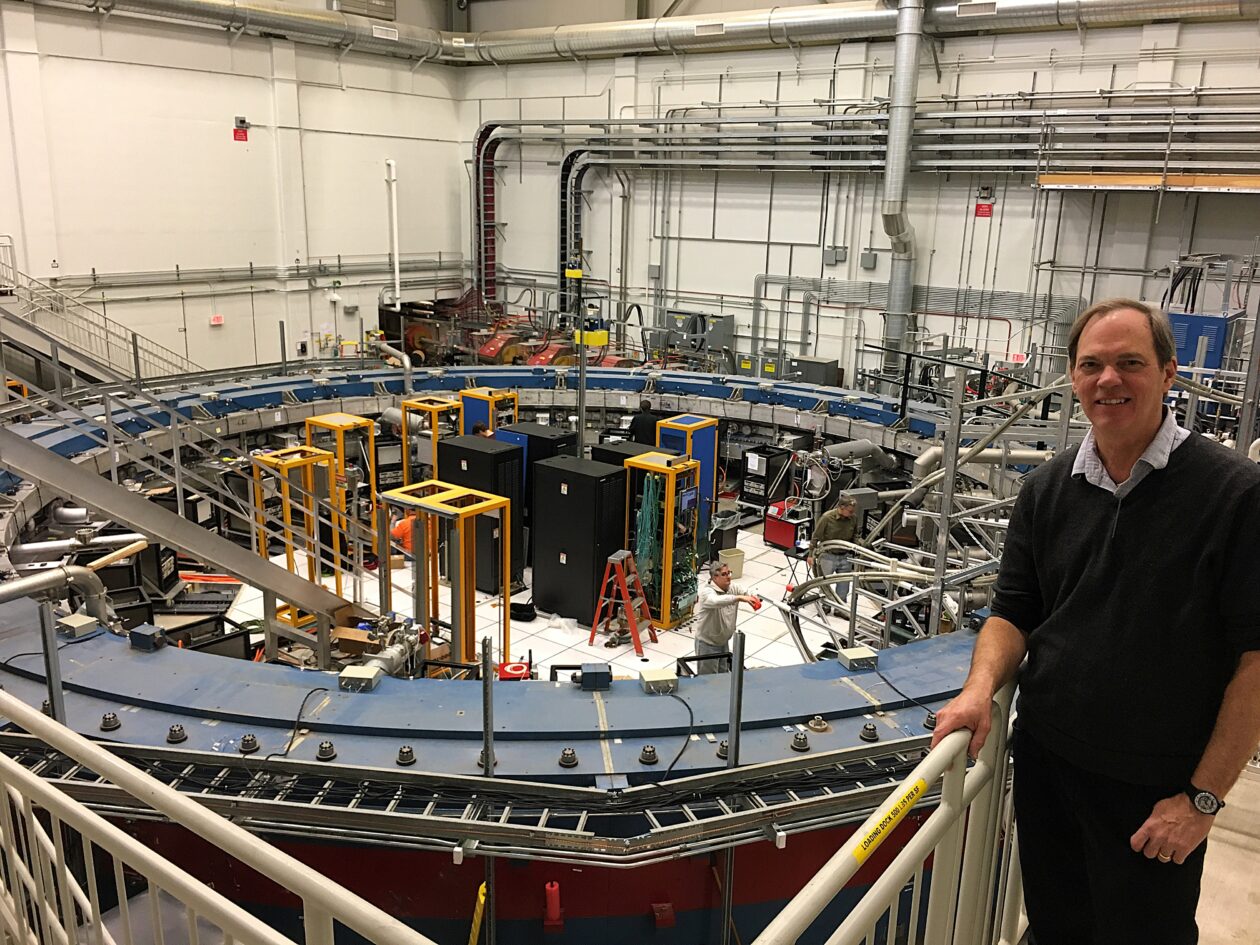
Diving deeper into the heart of the Muon g-2 experiment, it’s easy to see why this project has captured imaginations for so long. The muon, a quirky cousin to the electron—207 times heavier but fundamentally similar—has been at the center of this story since physicists first started manipulating it in controlled environments. Born from the brilliance of scientists at CERN in 1960, the experiments have evolved over decades, moving across oceans and institutions as technology advanced. Hertzog first jumped in about 30 years ago at Brookhaven, and he vividly recalls the monumental effort in 2013 when the experiment’s massive 50-foot-wide superconducting magnetic ring was carefully transported from New York to Fermilab, like carefully relocating a giant, delicate sculpture. Picture the dedication: teams of engineers and physicists spending sleepless nights calibrating equipment, dealing with the frustrations of tiny errors that could derail years of work. This isn’t just cold data collection; it’s a human endeavor filled with moments of doubt and triumph. Hertzog speaks with warmth about the “ordinary” contributors— technicians who maintained the magnets, programmers who coded algorithms late into the night, and even the occasional skeptic who helped refine theories. They all played their part in weaving this global tapestry, spanning 31 institutions in seven countries. The Breakthrough Prize celebrates not just the end result but the journey: the long commutes, the family sacrifices, the late-night chats over coffee as ideas flowed. Hertzog’s eyes light up as he describes the camaraderie, how the project built friendships across borders, fostering a sense of unity in the face of nature’s secrets. For him, these collaborations are like extended family reunions, where passions ignite and breakthroughs happen organically. The photos from CERN—researchers earnestly installing magnets amidst the buzz of anticipation—evoke a timeless scene of exploration, much like explorers charting unknown lands. This history isn’t just a list of dates; it’s a living narrative of perseverance, teaching us that great discoveries stem from collective effort and unyielding curiosity. Even now, as the experiment winds down, Hertzog feels a profound attachment, knowing it’s paved the way for future generations to build upon. He humanizes the science by sharing how these global teams, despite cultural differences and logistical hurdles, bonded over a common goal, turning particle physics into a story of shared humanity.
At its core, the Muon g-2 experiment tackles one of the most profound questions in particle physics: does our current understanding of the universe hold up under scrutiny? Enter the Standard Model, that elegant yet incomplete blueprint of subatomic particles and forces, which predicts how the muon should behave. In 1948, Japanese physicist Yukawa Hideki first theorized muons as “heavy electrons,” but their properties have kept physicists scratching their heads ever since. The Standard Model elegantly dictates that the muon’s “g-factor”—a measure of its magnetic moment—should be exactly 2, a simple symmetry in the universe’s design. Yet, experiments revealed a tiny discrepancy: g was slightly higher than 2, hinting that something might be lurking beyond our current knowledge. This “anomaly” has fueled decades of research, as if the universe itself is whispering secrets we haven’t fully deciphered. Hertzog, with his characteristic enthusiasm, explains it like a detective novel: pinpointing these deviations could uncover new particles or forces not accounted for in the Standard Model, perhaps even explaining dark matter or other cosmic enigmas. Imagine the thrill in the labs when early readings showed that bump—heart-pounding moments where doubt creeps in, only to be met with renewed determination. He recounts the emotional highs, like when preliminary data in the 2000s at Brookhaven sparked excitement, wondering if they were on the brink of revolution. Over time, as instruments grew more precise—with powerful magnets and sophisticated detectors—the uncertainty narrowed, each iteration a testament to human creativity. Hertzog’s personal anecdotes reveal the psychological toll and joy: nights poring over data, the elation of breakthroughs overpowering fatigue. This pursuit isn’t robotic; it’s deeply human, driven by an innate desire to push the boundaries of what’s known, akin to artists striving for perfection. The muon’s mystery embodies our quest for truth, reminding us that science is as much about intuition and passion as it is about math. Hertzog’s lifelong commitment to this—starting from humble beginnings in particle hunting—reflects a broader narrative of scientists as dreamers, chasing the unknown with faith and fervor.
The crescendo of the Muon g-2 saga arrived in 2023 from Fermilab, where the team achieved unprecedented precision, measuring the g-factor with an uncertainty of just 127 parts per billion—surpassing their ambitious goal of 140. Hertzog beams with pride recalling that moment, akin to crossing a finish line in a marathon after years of training. “We set the goal at 140 parts per billion, and we got 127,” he says, his voice bubbling with the excitement of hard-won success. Yet, as often happens in science, clarity gave way to nuanced debate. Theoretical physicists refined their models, incorporating quantum effects where virtual particles flicker in and out of existence like fleeting shadows in the fabric of spacetime. Last year, new calculations suggested the theoretical range for g overlapped with experimental results, leading some to declare the “muon mystery” solved. Headlines buzzed: “A famous experiment ends not with a bang, but a whimper.” But Hertzog, ever the optimist, waves off such conclusions with a knowing smile. “Reports of the muon mystery’s death have been greatly exaggerated,” he laughs, echoing Mark Twain. The theoretical predictions, he argues, have widened in uncertainty, leaving the door ajar for deeper insights. This ambiguity isn’t disappointing to him; it’s exhilarating, a reminder that science thrives on complexity. Humanizing the process, he shares the emotional rollercoaster: the frustration when systematic errors postponed celebrations, followed by the triumph of overcoming them. Collaborating with figures like University of Bern physicist Martin Hoferichter on preprints, Hertzog discusses how these ongoing discussions fuel motivation. The experiment hasn’t unveiled a smoking gun of new physics yet, but it’s sharpened our tools for probing reality’s depths. For Hertzog, this represents “the extraordinary achievement of the precision of this delicate measurement,” probing nature at levels so profound they defy everyday intuition. He envisions future developments—perhaps new data or experiments—that will clarify things in the next couple of years. It’s not about closure; it’s about the journey, the shared uncertainties that bind scientists together, making physics a living, breathing adventure rather than a static truth.
The gala ceremony awarding the Breakthrough Prize transformed a typically stoic scientific event into a night of celebration, blending rigor with a touch of celebrity glamour. Hosted by James Corden, with guests like Robert Downey Jr., Anne Hathaway, Paris Hilton, Lionel Richie, and even Bill Gates with Paula Hurd, the “Oscars of Science” added a layer of magic to recognizing human accomplishment. Founded in 2012 by Russian-born investor Yuri Milner and his wife Julia, the prize aims not only to honor breakthroughs but to humanize scientists, stripping away the stereotype of introverted geniuses in labs. The $3 million physics prize—far surpassing the Nobel’s about $1.2 million—highlights the Milners’ belief that funding such work can inspire the next generation, much like Hollywood spotlights talent. For the Muon g-2 team, only four representatives graced the stage: Hertzog, Chris Polly from Fermilab, William Morse from Brookhaven, and Lee Roberts from Brookhaven and Boston University, representing the 31 institutions and seven countries involved. Hertzog describes the atmosphere as electric, a blend of nervous energy and profound pride, where the spotlight felt validating yet surreal. Other awards that evening included a lifetime prize for theorist David Gross—a Nobel co-winner for his work on the strong nuclear force and architect of a 40-year particle physics plan—and prizes in life sciences and mathematics. Mathematician Cédric Villani and biologist Roderick MacKinnon also took home honors, their stories of perseverance resonating with the audience. Villani’s work on nonlinear equations could impact fields from aeronautics to astrophysics, while MacKinnon’s insights into ion channels advance medical understanding. This melting pot of disciplines underscores the interconnectedness of knowledge, reminding us that breakthroughs often stem from cross-pollination. Hertzog, amidst the dazzle, reflects on how such events bridge academia and public interest, making scientists’ lives feel less isolated. Past UW winners like Eric Adelberger, Jens Gundlach, Lukasz Fidkowski, Blayne Heckel, and biochemist David Baker add layers to his sense of place in a larger legacy. The recorded show, set to air on YouTube, captures the humanity in these accolades, turning abstract achievements into relatable narratives of triumph and humility.
Even as the Muon g-2 chapter closes with ambiguity, David Hertzog’s spirit remains undiminished, his curiosity propelling him toward new frontiers. Far from resting on laurels, he’s already embarked on PIONEER, another experiment probing pion decay inconsistencies with the Standard Model—potentially fertile ground for discovering new physics. “This is a stock market golden opportunity,” he quips, treating career paths like wise investments in unexplored territories. Humanizing this transition, Hertzog shares how the Muon g-2 experience left him with a hunger for more, not exhaustion. He recalls the emotional highs of mentorship—guiding younger scientists through dilemmas—and how the prize’s windfall, even if modest per person, symbolizes hope for aspiring researchers. It’s these personal stories that illuminate the human side: the buzz of starting fresh, the camaraderie in new teams, the thrill of unanswered questions. Reflecting on his 30-plus years in the field, Hertzog embodies resilience, his optimism a beacon. He predicts definitive answers on the muon anomaly soon, perhaps ushering in a new era. Beyond awards and experiments lie the quiet inspirations—the late-night epiphanies, the supportive networks—that sustain such pursuits. Hertzog’s journey reminds us that science is woven from threads of passion, where the “why” often trumps the “what.” As he looks ahead to PIONEER, it’s with the same childlike wonder that drew him in decades ago, proving that the pursuit of knowledge is as timeless as it is profoundly human. This ongoing narrative, blending past triumphs with future promises, invites us all to marvel at the boundless potential of inquiry.