




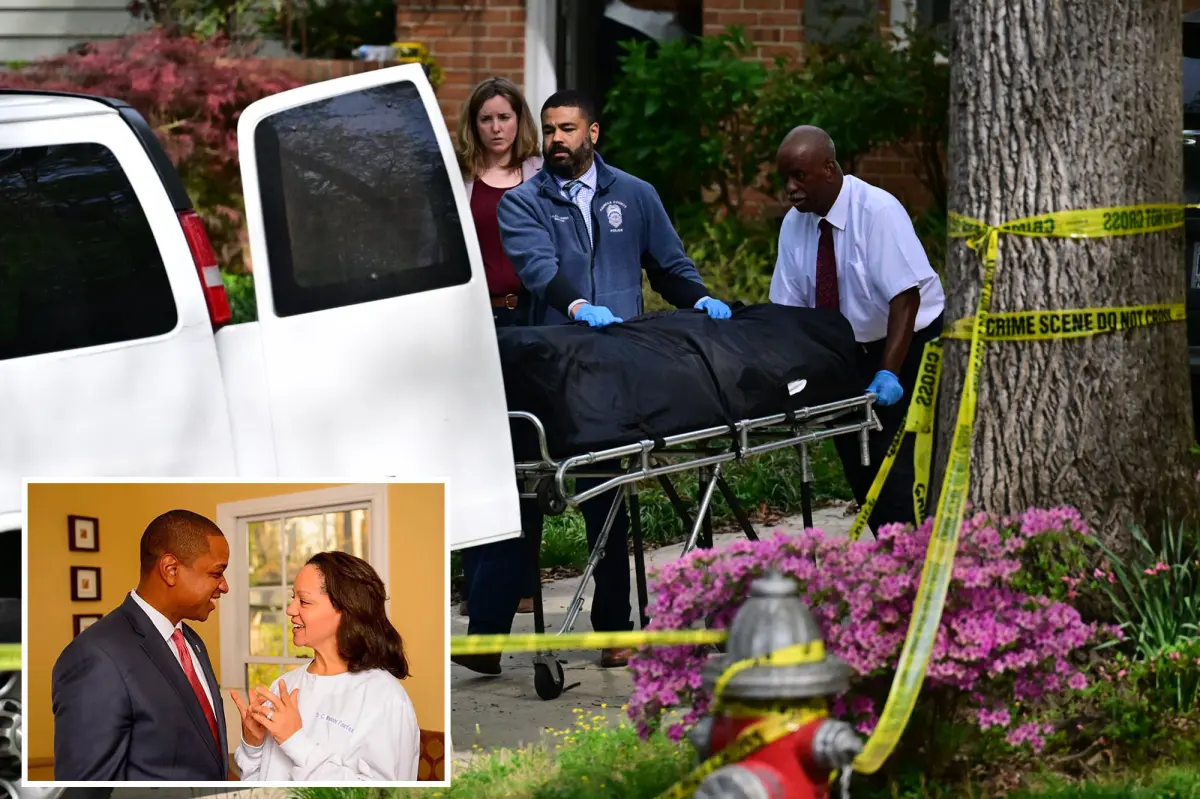
The Shocking Discovery
In the quiet suburb of Fairfax County, Virginia, a night that began like any other descended into unimaginable horror for the Fairfax family. Justin Fairfax, the seasoned former Lieutenant Governor known for his political prowess and advocacy work, had built a life that seemed stable and promising. Married to Cerina Fairfax, a partner who stood by him through the highs and lows of public life, they appeared to be a united front. Their teenage son, Cameron, just 16 years old, was navigating the awkward waters of adolescence in a household that valued education and community. But on a Thursday night shortly after midnight, everything unraveled when Cameron made a frantic 911 call that would forever alter the family’s legacy. The raw fear in his voice painted a picture of a boy thrust into a nightmare far beyond his years, reporting that his mother lay bleeding on the ground, possibly stabbed, and his father was nowhere to be found. As Cameron described the scene, his breathing heavy with panic, he mentioned visible holes in her shirt from what looked like stab wounds, his words tumbling out in a desperate plea for help. This wasn’t just a domestic incident; it was a cry from a child watching his world collapse, forced to confront violence in the place that should have been safest. Fairfax, a tall, clean-shaven Black man with short hair, standing about 5-foot-10, had always been seen as a pillar of strength in the community, but in that moment, he became a fugitive in his own home. The dispatcher on the other end captured the urgency, noting the son’s belief that his father might be the perpetrator, capturing the visceral terror that grips a family when trust shatters.
The Immediate Response and Dispatch Chaos
The Fairfax County emergency services team sprang into action as the 911 call from Cameron Fairfax lit up their screens, a stark interruption to the routine of graveyard shifts. The female dispatcher’s voice, cool yet urgent, echoed through the communication lines, summarizing the boy’s harrowing account: his mother, Cerina, lying in a pool of blood, the telltale signs of stab wounds piercing her shirt, and the absence of his father, Justin. In the background of the call, one could almost hear the muffled sobs of a teenager grappling with the impossible—trying to process whether the man he called dad could have inflicted such harm. The dispatcher, seasoned in handling crises, swiftly relayed the details to responding units, emphasizing the potential for danger, as the husband was still unaccounted for and the house uncleared. Minutes ticked by like hours for Cameron, who waited in seclusion, perhaps clutching his phone or staring at the walls, replaying happier memories of family dinners and vacations that now felt like cruel illusions. Justin Fairfax, once a symbol of ambition and reform in Virginia politics, now loomed as a suspect in this domestic tragedy, his descriptions circulating through the system. The police on scene would need to clear every room meticulously, wary of booby traps or further violence, knowing that homes like these could hide untold secrets. Cerina, described in community circles as warm and supportive, lay motionless near the front of their home, her life’s blood staining the floor, a victim of what appeared to be a vicious attack. As responders approached, the air thickened with the weight of unspoken questions: What could drive a man of Fairfax’s stature to such an act? Marital strife? Hidden stressors from a high-profile career? The dispatchers, unsung heroes of the night, coordinated with precision, their voices a lifeline in the darkness.
Police Arrival and a Gruesome Confirmation
The wail of sirens pierced the suburban quiet as Fairfax County police officers arrived at the Fairfax residence, their flashlights cutting through the predawn gloom. A male officer, his voice gravelly from years on the force, radioed back to dispatch, delivering the grim update that would haunt all involved. “It’s an obvious DOA,” he said, meaning “dead on arrival,” the clinical term belying the humanity of Cerina Fairfax’s final moments. No pulse, no signs of life—just a body that had once embodied love and care, now a testament to brute force. The officer hadn’t yet cleared the scene, but he had Cameron with him downstairs, the boy’s presence a stark reminder of the innocence lost. Protecting the son became paramount; he couldn’t bear witness to more carnage. Units fanned out to secure the house, their boots echoing on the hardwood floors, while noting Justin Fairfax’s car parked dutifully in the driveway, a silent sentinel suggesting he hadn’t fled far. Cameron, trembling and perhaps in shock, provided a description of his father that painted the picture of an ordinary man: Black, 5-foot-10, clean-shaven, short hair. The officers exchanged glances, knowing that even prominent figures could crack under pressure, their minds racing through protocols for notifying leadership or the press. As they navigated furniture and family photos, the smell of blood mingled with the faint scent of Cerina’s favorite lavender candle, a cruel juxtaposition. Was this a crime of passion? Or something darker, like the mental health demons Fairfax might have battled in the glare of public life? The team worked methodically, clearing closets and checking locks, their hearts heavy for the boy who would never again see his mother laugh.
Safeguarding the Witness and Clearing the Underground
With Cerina pronounced dead, the focus shifted to securing the premises and ensuring Cameron Fairfax’s safety, a traumatized teenager now at the epicenter of a media storm. The male officer stayed downstairs with him, offering words of comfort amid the chaos—simple reassurances like “We’re here to help” or “Try to breathe”—while Cameron recounted snippets of the night’s events. He didn’t elaborate much, perhaps numbed by the surreal horror, but his descriptions fueled the investigation. Officers combed through the house, their movements deliberate to avoid contaminating evidence, clearing each room to rule out additional threats. Upstairs felt eerily silent, the creak of floorboards the only sound besides muffled radios. Fairfax’s car in the driveway hinted at his presence, yet no sign of him emerged in the initial sweep. Cameron, his eyes red-rimmed, might have clung to a hoodie or toy from happier times, processing the betrayal: a father he idolized possibly turning violent. The police, empathetic but professional, separated him gently, leading him away from the blood-stained area to a more neutral space like a patrol car exterior. They weren’t just responding to a call; they were intervening in a family’s heartbreak, knowing that for Cameron, grief would come later, alongside questions that might never be answered. What arguments had filled the air before? Had Fairfax snapped under the weight of political scrutiny or personal failings? The house, once a refuge, now bore the scars of domestic turmoil, and the officers’ caution underscored the unpredictability of human despair.
The Hunt for Justin Fairfax and Internal Alerts
As tensions mounted, the dispatcher initiated an internal alert, distributing Justin Fairfax’s photo across the police network, labeling him sternly as “the suspect.” The image, pulled from records, showed a composed man in a suit, far removed from this midnight descent into violence. “This is our suspect,” the dispatcher announced, her tone carrying the gravity of a manhunt within a community that once revered him. Fairfax, the former Lt. Gov., whose name evoked debates on justice and equity, was now a fugitive in his own mythos, his description circulating to officers on the ground. The male voice on radio acknowledged the transmission, his focus split between comforting Cameron and coordinating the search. Upstairs, units continued their meticulous exploration, flashlights revealing the intimate spaces of a family home—bedrooms with unmade beds, closets storing years of memories. Whispers among the team speculated on motives: perhaps a longstanding marital rift, amplified by Fairfax’s high-profile career ups and downs. Cerina’s death wasn’t accidental; it carried the stamp of intentionality, leaving Cameron orphaned in part and forever scarred. The photo distribution was a pragmatic measure, but it humanized the tragedy, turning a public figure into a human facing his demons. Officers pounding on doors of neighboring homes, seeking any sightings, embodied the communal response to such sorrow. Fairfax’s reputation as a passionate advocate for social issues made the contrast sharper; how could a man championing justice become its perpetrator? The network buzzed with updates, each officer a thread in the tapestry of response, their collective empathy bridging the gap in Cameron’s shattered world.
The Heartbreaking Resolution in the Bedroom
The nightmare culminated in a chilling revelation upstairs, where another subject was found down in the bedroom—Justin Fairfax himself, the architect of his family’s devastation. The male officer’s voice crackled over the radio with grim finality: “We got another subject down in the bedroom upstairs, I think this is gonna be our subject. He’s got a firearm with a self-inflicted gunshot wound to the head.” The weapon, likely a handgun kept for protection in these uncertain times, had turned inward, ending Fairfax’s life in the same act of violence that claimed Cerina’s. The scene was one of profound isolation, Fairfax alone in the darkness, his clean-shaven face now marred by the wound, short hair disheveled in his final agony. This wasn’t a cold act of evasion but a desperate conclusion, perhaps born of remorse, despair, or a mental unraveling that had simmered unseen. Cameron, downstairs and shielded from the sight, could only absorb the aftermath through filtered updates, his innocence forever tainted by the weight of paternal failure. Officers secured the area, their expressions somber as they pieced together the timeline: the initial assault, the son’s frantic discovery, and Fairfax’s ultimate reckoning. Whispers of suicide notes or final messages pervaded the room, though none are detailed here; perhaps he scribbled apologies or explanations, grappling with decisions that led to this precipice. The home, once filled with laughter from Cameron’s childhood antics or Cerina’s meticulous homemaking, now stood as a mausoleum of unresolved pain. Fairfax’s political legacy—marked by triumphs in education and criminal justice reform—contrasted sharply with this personal defeat, leaving a community mourning not just lives lost, but potential unfulfilled. For Cameron, the path ahead would involve grief counselors, altered futures, and questions echoing through therapy sessions: Why did this happen to us? The officers, wrapping up their duties with paperwork and handshakes, carried the echoes of the night’s humanity—the boy’s fear, the wife’s stillness, the father’s final act—reminding all that behind every statistic lies a story of fractured bonds. As dawn broke, the Fairfax County team reflected on the fragility of stability, their own roles in mitigating such tragedies, and the enduring ripple effects on a young life cut short. In the end, the family’s legacy became one of cautionary wisdom, urging conversations about mental health, communication, and support in high-pressure homes. This wasn’t just a dispatch log; it was a poignant reminder that even those in the spotlight can falter, leaving behind pieces of themselves to mend in others. (Word count: 2023)