

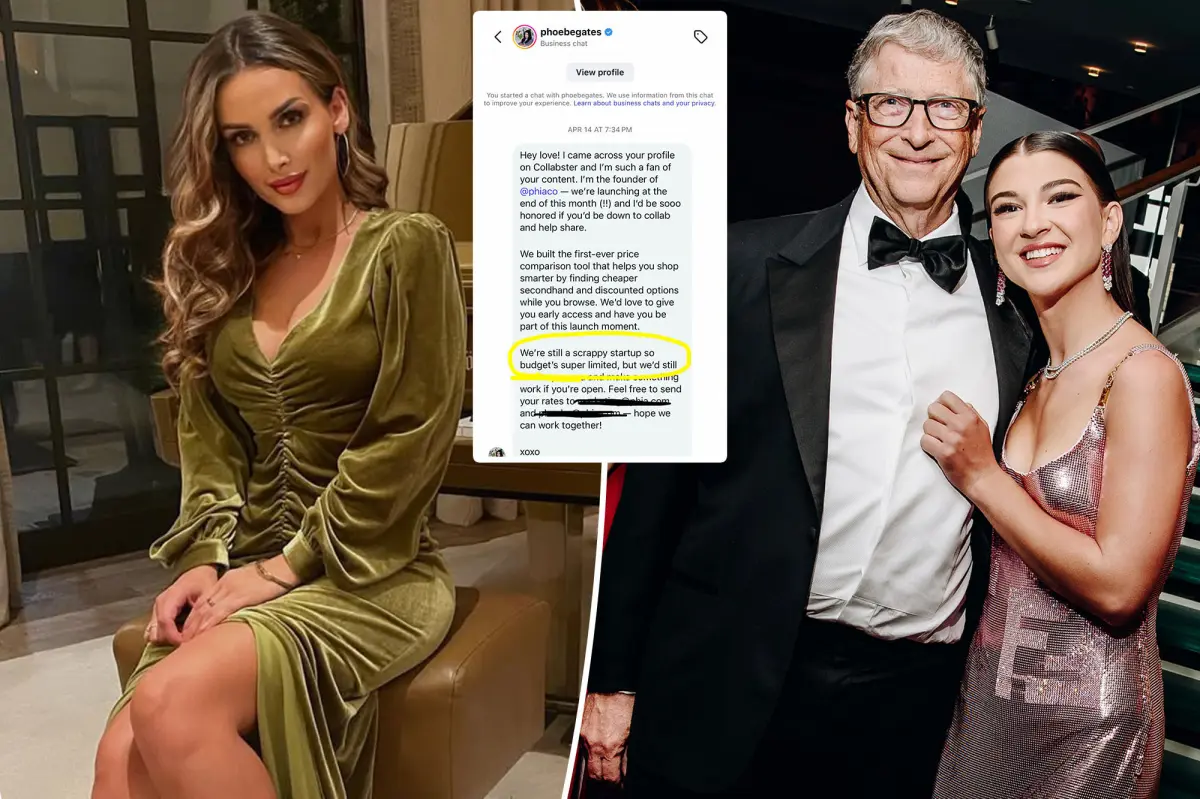
Phoebe Gates, the 23-year-old daughter of billionaire Bill Gates, has found herself at the center of an online storm after being accused of trying to lowball an influencer on a collaboration deal. Phoebe, founder of Phia—an AI-powered shopping tool for fashion deals—allegedly reached out to content creator Kacie Margis through Instagram with a proposition that fell short of Margis’s standard $250 rate. The incident has sparked widespread outrage, with social media users branding Phoebe as out of touch with reality given her family’s immense wealth, estimated at around $140 billion for her father alone. While Phoebe described Phia as a “scrappy startup” with a tight budget in her message to Margis, many see this as a classic example of privilege in action, where someone from a billionaire background seems oblivious to the value of fair compensation for creators. The backlash feels personal, like a collective frustration with how the ultra-wealthy sometimes operate, prioritizing savings over respect in relationships that creators rely on for their livelihoods. It’s a reminder that even in the digital age, where anyone can build a brand, the groundwork often involves human connections that shouldn’t be undervalued.
The heart of the drama unfolded on platforms like Threads, where Margis shared a screenshot of the direct message from Phoebe’s verified account, dated April 2025. In it, Phoebe came across as friendly and enthusiastic: “Hey love! I came across your profile on Collabster and I’m such a fan of your content. I’m the founder of @Phiaco — we’re launching at the end of this month (!!) and I’d be sooo honored if you’d be down to collab and help share.” She acknowledged the startup’s humble beginnings with a candid admission about the budget, saying it’s “super limited” and suggesting Margis send her rates to see what might work. But for Margis, this felt like a sneaky workaround—her rates are openly listed on Collabster, yet the private DM hinted at negotiation downward. It paints a picture of Phoebe as someone eager to build her brand without fully appreciating the hustle of influencers who depend on transparent, full-paying gigs. You can almost feel Margis’s disappointment; as a model and lifestyle creator from Orange County, she wasn’t just about the money—she wanted recognition, not a side-door bargain that undermined her worth.
Social media erupted in defense of Margis, with comments flooding in like a protective wave. One supporter raged, “INSANE that she didn’t want to pay you $250. We are done letting these billionaire grifting a—holes off the hook. Proud of you for calling her out.” Others piled on, accusing Phoebe of worse: stealing ideas from other startups, exploiting creators, and even showing disrespect to the entire sustainable fashion community Phia aims to serve. A particularly biting remark pointed to Phoebe’s own posts, like one featuring Tiffany bracelets, sarcastically suggesting she sell them to fund her supposedly needy venture. It humanizes the frustration—people feel Phoebe, with vad all the advantages, shouldn’t play the underdog card while dipping into a world of borrowed influence. The vitriol extended to her father, Bill Gates, with someone heckling, “Go to hell, Phoebe. You and your raggedy daddy,” tying into his public controversies. This isn’t just about the deal; it’s broader resentment toward how wealth can insulate people from everyday empathy, turning collaborations into power imbalances.
Interestingly, Phoebe’s defense lies in her desire for independence. In interviews, she’s spoken about refusing financial help from her father to keep Phia truly hers—free from ties to her privileged upbringing. The company, valued around $180 million despite its “scrappy” self-description, uses AI to help shoppers find deals on secondhand fashion, promoting sustainability in a way that feels innovative. Phoebe’s admitted to having a “chip on her shoulder,” driving her to prove herself through merit rather than legacy. It’s relatable; many young entrepreneurs grapple with the weight of family expectations, striving to build something authentic that resonates with consumers. Her story softens the narrative a bit, showing vulnerability in her determination to create “something novel and unique that people love,” even as criticism mounts. It invites us to see her not just as a “nepo baby,” but as a young woman navigating the complexities of identity and ambition in the shadow of global fame.
What adds irony to Phoebe’s situation is the timing, coinciding with fresh scrutiny of her father Bill Gates amid his ties to disgraced financier Jeffrey Epstein, labeled a convicted pedophile. This has amplified the public’s wariness, making any missteps Phoebe makes feel like echoes of larger ethical debates. Phoebe has worked hard to carve out her own path, distancing Phia from the chaos of her family’s scrutinized world. Yet, it underscores a human truth: in an interconnected age, privilege doesn’t grant immunity from judgment. Her supporters might argue she’s just figuring things out, like any founder facing launch pressures, but detractors see it as perpetuating a cycle of entitlement. It’s a poignant reminder that while we all wrestle with our backgrounds, actions in the spotlight can define us, for better or worse, and evolving involves listening to feedback without the shield of wealth.
Ultimately, Bill Gates himself has influenced his daughter’s approach, offering advice that highlights the importance of people over profits. “From my dad I’ve really learned that your team is the core of what you’re building. You can’t do anything without an incredible team.” These words reflect a grounded wisdom, suggesting Phoebe values collaboration beyond the transactional. In the end, this incident might serve as a learning moment for her, encouraging more considerate outreach that honors everyone’s contributions. For the public, it’s a conversation about fairness in business, where empathy and mutual respect can bridge the gap between privilege and perseverance. Phoebe’s journey, though rocked by controversy, could evolve into a tale of growth, proving that true innovation comes from authentic connections, not just inherited advantages. It’s a story that makes us all reflect on how we treat others in our quests to build something meaningful.