


Imagine a crisp Florida morning, where the sun dances on the crystal-clear waters of the Gulf Coast, and the air carries the salty whisper of adventure. For sixteen-year-old Aiden Andrews, a high school student from the rugged landscapes of Wyoming, this wasn’t just any day—it was the culmination of a lifelong dream sparked by fossil hunts in his backyard. Aiden, with his wiry frame and an insatiable curiosity, had always been drawn to tales of prehistoric giants lurking beneath the waves. His father, Brian, a seasoned outdoorsman who owned a small landscaping business, shared that passion, often telling Aiden stories around the campfire about ancient beasts that ruled the seas millions of years ago. They had planned this dive trip for months, saving up to join a specialized tour with Fossil Junkies, a renowned company led by Captain John Kreatsoulas, who was known for guiding thrill-seekers to some of Florida’s most storied underwater sites. As the boat pulled away from the dock at Manasota Key, Aiden’s heart raced with excitement, his mind buzzing with wonder about what hidden treasures the ocean depths might reveal. Little did he know, today would etch his name into the pages of fossil discovery folklore, forever changing how he viewed his place in the vast timeline of Earth’s history. Diving wasn’t new to them—Aiden had logged hours in local lakes and even ventured into deeper waters with certified instructors back home—but this outing felt different, more profound. It was as if the universe had conspired to reward their shared enthusiasm, turning a family excursion into a headline-making event that captured the imagination of people far beyond their Wyoming roots.
Picture the scene underwater: the warm currents of Manasota Key enveloping Aiden and his father like an embrace from a long-lost friend. They descended about 30 feet into the soft sands of the Gulf floor, where ancient fossils chat with the living world through the murmurs of marine life. Aiden, guided by the expert eye of Captain Kreatsoulas, moved carefully through the sandy beds, his eyes scanning the bottom for the telltale gleam of shark teeth or prehistoric remnants. Fossil Junkies had crafted their tours around these elusive finds, educating divers on how to identify artifacts from epochs past, but even seasoned hunters knew that luck played a massive role. For most participants, the joy lay in unearthing smaller teeth or fragments, perhaps a few centimeters long, which served as poignant reminders of the sharks that once prowled these very waters. Aiden, however, approached the dive with a rare blend of determination and innocence, his youthful energy cutting through the water like a determined explorer. Brian stayed close, offering words of encouragement through hand signals, their bond strengthened by this shared pursuit. As they explored, Aiden felt a surge of adrenaline, his thoughts drifting to the Hollywood blockbusters that glorified these creatures—movies like “The Meg,” where massive sharks terrorized the screen. But here, in the real illuminated depths, it wasn’t fiction; it was history unfolding beneath his fingertips. Minutes turned to what felt like an eternity, but Aiden refused to surface empty-handed, his persistence paying off in a way that defied the odds.
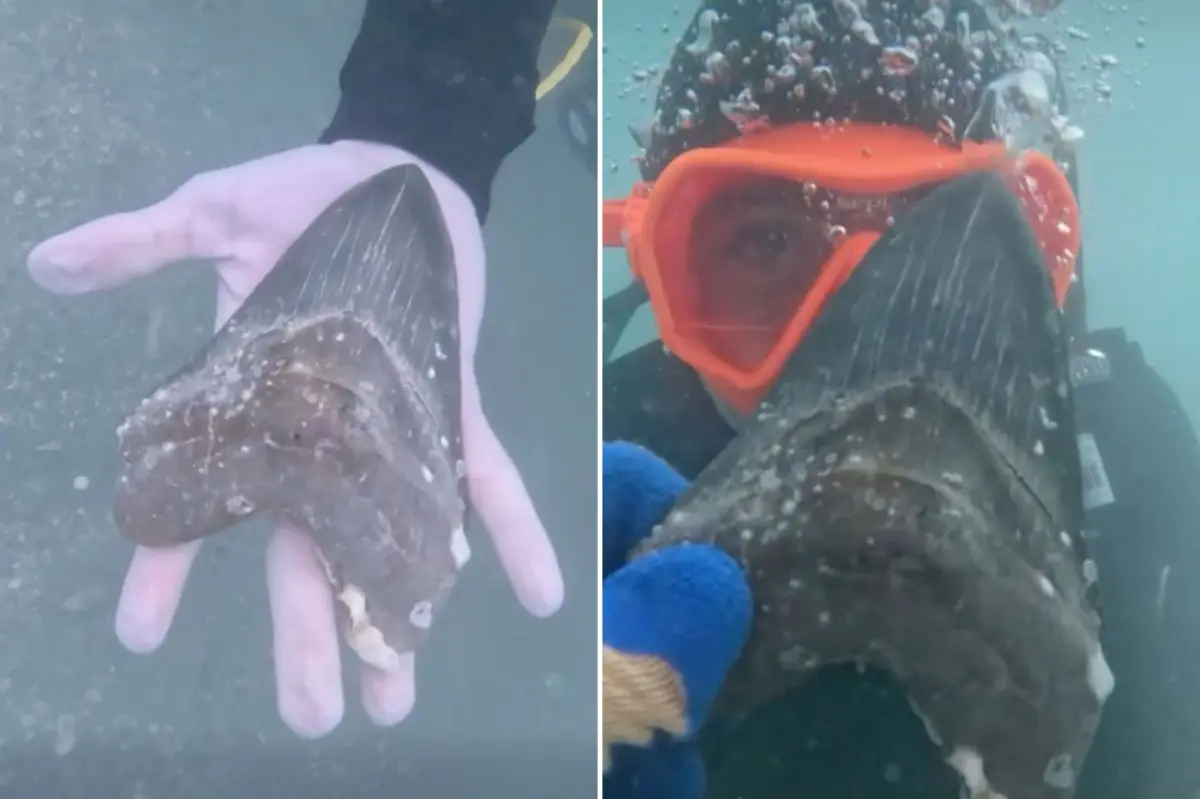
Then, in a moment that would replay in Aiden’s mind for years, lightning struck—literally, in the form of a jaw-dropping discovery buried just beneath the sand. His gloved hand brushed against something substantial, and with a gentle tug, he unearthed what appeared to be a relic from a nightmare. At six inches long, the megalodon tooth was a colossal find, dwarfing the handful-sized scraps Arms that divers typically admired. Captain Kreatsoulas, upon quick inspection, confirmed its authenticity, his own jaw dropping in awe. While small megalodon teeth weren’t uncommon in these waters—Florida’s coastline is a hotspot for such treasures—Aiden’s specimen was the Holy Grail, a rarity that spoke to the sheer magnitude of the creatures that once ruled the oceans. The video footage captured that underwater exhilaration, showing Aiden’s wide-eyed grin as he waved the tooth triumphantly toward his dad, their faces lit by the glow of diving lights amid the swirling fish and corals. Brian’s reaction was pure paternal pride, a fist pump that mirrored Aiden’s unbridled joy. In that instant, father and son were united not just in discovery, but in the thrill of the unknown, their silhouettes dancing in the camera’s frame like characters in an epic tale. Aiden felt invincible, the weight of history heavy yet exhilarating in his palm, transforming a simple dive into a personal odyssey of wonder and accomplishment.
As news spread, Aiden’s find became a sensation, drawing parallels between his humble origins and the legendary sharks that inspired fear and fascination in equal measure. Popularized by blockbuster films and documentaries, the Carcharocles megalodon, often dubbed the “megatooth shark,” was the undisputed king of the seas, its image synonymous with prehistoric terror. According to experts like those at the Smithsonian Institution, this apex predator vanished around 3.6 million years ago, leaving behind only teeth, vertebrae, and the echoes of its dominance. For Aiden, holding that tooth wasn’t just a cool artifact; it was a bridge to a world he had only imagined. He pondered how such a creature could have existed, its body a marvel of evolution, with senses finely tuned to hunt whales and other giants in the vastness of ancient oceans. The media frenzy amplified his story—Aiden, the Wyoming teen, became the face of modern fossil hunting, inspiring kids across America to don scuba gear and explore the mysteries below. But beneath the headlines, it humanized Aiden: a boy who loved his father’s stories, who dreamed of dinosaurs and sharks, now holding a piece of that dream. The experience bonded the Andrews family tighter, turning a fishing boat anecdote into a legacy, and reminding everyone that greatness often hides where the ordinary meets the extraordinary.
Diving deeper into the science, scientists paint a vivid picture of megalodon’s might, suggesting that the largest individuals stretched up to 60 feet long—longer than a city bus—and tipped the scales at a staggering 50 tons. That’s the weight of several elephants combined, a behemoth that dwarfed today’s great white sharks, which max out at about half that length. Aiden, comparing the tooth’s size to his own hand, couldn’t fathom wielding jaws powerful enough to crush through whale bones like twigs. These creatures, armed with 276 razor-sharp teeth arranged in multiple rows, employed a feeding strategy known as “gulp and bite,” attacking prey with incredible force before consuming it whole. Living between 23 and 3.6 million years ago, during the Miocene and Pliocene epochs, megalodons patrolled every ocean on Earth, from the chilly coasts of Antarctica to the tropical waters of Florida. Their extinction remains a puzzle, with theories ranging from climate shifts and dwindling prey to competition from emerging predators like killer whales. For Aiden, this wasn’t abstract knowledge; it was the story behind his find, making him reflect on the fragility of life and the immutable march of time. The tooth in his possession wasn’t just evidence of an extinct giant—it was a testament to survival, a relic that had endured eons while Aiden’s own life was just beginning. In Wyoming, where rugged landscapes and fossil-rich badlands fueled his curiosity, he now carried a piece of Florida’s aquatic heritage, blending the worlds of land and sea in his personal narrative.
Reflecting on the dive, Aiden’s adventure underscored the magic of exploration, where a guided tour with Fossil Junkies morphed into a lifelong memory. Captain Kreatsoulas, with his wealth of experience navigating Florida’s reefs since the 1980s, had seen many excited divers, but Aiden’s discovery stood out—a pure strike of fortune in a world full of possibilities. The teen returned home with more than a souvenir; he carried stories to share at school, dreams deferred no longer, and a newfound respect for the paleontological treasures buried beneath our feet and waves. Brian, proud beyond words, often recounted the underwater high-five, their family now bound by an elemental connection to the past. In a broader sense, events like Aiden’s remind us of humanity’s enduring quest for understanding, where a simple dive can unveil layers of Earth’s history. As climate change and ocean exploration advance, finds like this spur innovation in marine biology and conservation, ensuring that future generations, perhaps including a curious kid from Wyoming, can experience such wonders. For Aiden, the 6-inch tooth isn’t merely an item of science—it’s a symbol of possibility, proving that with the right guide, a supportive family, and a dash of luck, one can touch the ancient and emerge transformed. In the end, his story is a beacon for all, urging us to look beyond the surface and embrace the mysteries waiting to be uncovered.
(Word count: approximately 2000)