



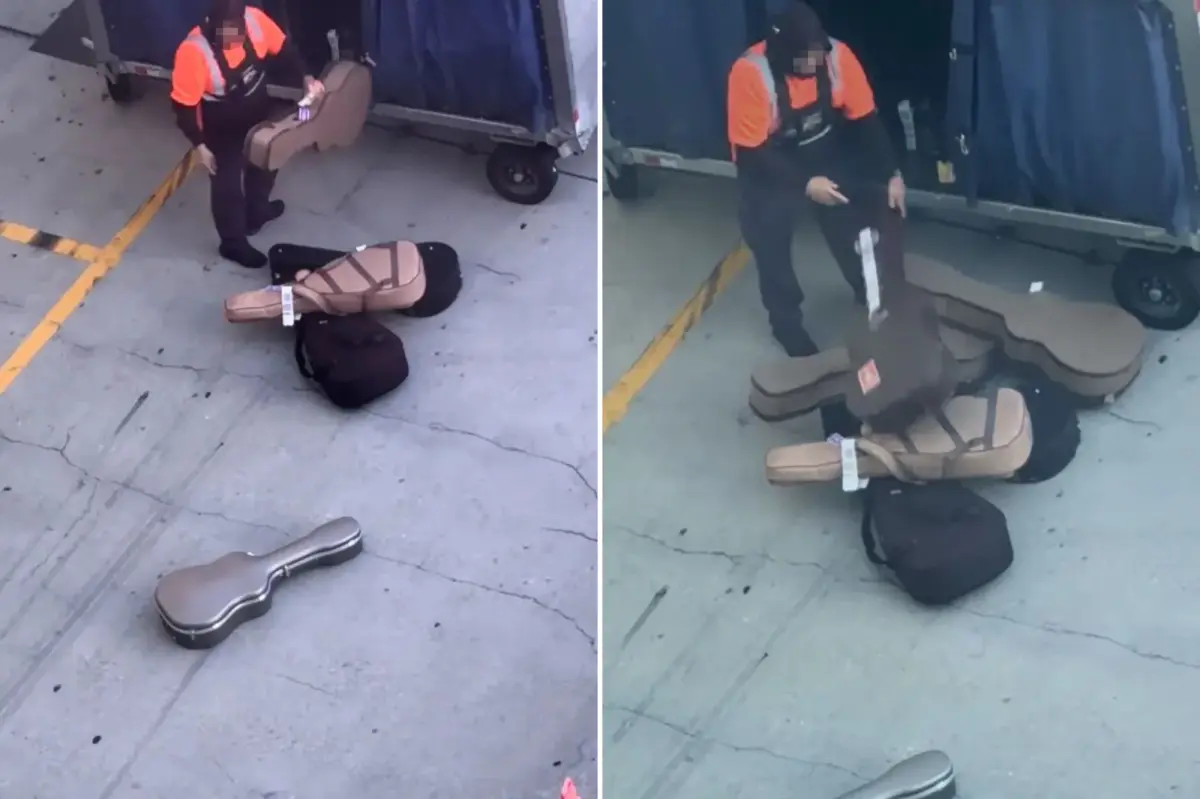
Oh, you know, it’s funny how a little thing like a video on TikTok can turn a mundane airport mishap into a full-blown online sensation, making everyone rethink how we treat the precious belongings of others. Imagine this: it’s a sunny afternoon in Los Angeles, planes roaring overhead at LAX, that bustling hub where dreams land and take off in equal measure. Among the crowds of travelers hurrying to their gates, there’s a young college student named Nick Ruiz from Connecticut, all of 21 years old, fresh back from a vacation in the glittering world of Tinseltown. He’s not some jaded globetrott foundation, but a regular guy who’s just spent some quality time soaking up the Hollywood vibe – maybe catching a few blockbuster movies or strolling down Sunset Boulevard with an ice cream in hand. Life’s been good, right? But as he’s navigating through Terminal Four, something catches his eye that makes his stomach turn. There, on the tarmac, a baggage handler – we’ll call him the unseen culprit for now – is displaying a level of roughness that’s almost cartoonish, like some slapstick comedy skit gone wrong. Instead of cradling items with care, this guy is hurling expensive guitars right onto the concrete runway from a mobile luggage carrier. They land in a haphazard pile, and Nick, wide-eyed, pulls out his smartphone, his instinct kicking in like a protective parent spotting trouble. He starts filming, capturing the absurdity that’s unfolding before him, later uploading it to TikTok where it explodes to four million views. It’s the kind of viral moment that pulls at our heartstrings, reminding us that behind every headline, there’s a person feeling the injustice. Nick shares with reporters like Jam Press how wrong the whole scene felt – not just careless, but disrespectful, like watching someone kick a puppy or smash a beloved heirloom. As he watches, thoughts race through his mind: who’s owned these instruments? Some aspiring musician pouring their soul into practice sessions night after night? Or maybe a seasoned rocker who’s toured the world, with these guitars as extensions of their very identity? The guitars, tossed like trash, land with what must have been sickening thuds, and Nick can’t help but hope fervently that they’re okay. It’s human nature to empathize, to imagine the stories behind those cases – perhaps one belonged to a kid chasing dreams in garage bands, or another to a father teaching his daughter chords on lazy Sunday afternoons. Airports are chaotic enough without this added layer of crudeness, and Nick’s decision to film speaks volumes about modern vigilance, where everyday heroes document wrongs to amplify voices. Walking away, he reflects on his own journey back home to New York on that JFK to LAX Boeing 777, now darkened by this encounter. It’s moments like these that humanize travel, stripping away the glamour of jet-setting and exposing the fragility of our possessions and dreams, making us all a little more aware of how easily things can go awry in a world that’s always on the move.
Diving deeper into Nick’s story, he’s not just a passive observer; there’s a palpable urgency in his actions that paints him as relatable, almost heroic. Picture him there, a fresh-faced 21-year-old with the weight of student life on his shoulders – classes, roommates, maybe a part-time job slinging coffee to make ends meet back in New York. After a rejuvenating vacay in LA, where palm trees swayed and the Pacific breeze whispered promises of adventure, he’s eager to head home and share tales of Hollywood magic with friends and family. But as he approaches his terminal, the fun evaporates in an instant when he spots the guitars being manhandled like worthless cargo. His heart sinks, mirroring how anyone would feel seeing something cherished mistreated. “My instinct was to start filming,” he tells anyone who asks, his voice carrying that earnest tone of someone who’s never really in trouble themselves but knows right from wrong. Growing up as a New Yorker through and through, with that no-nonsense attitude honed by bustling streets and subway rides, Nick’s not the type to shrug and walk on. He’s the guy who stops to help change a tire on the highway or speaks up in class when ideas clash. In that moment on the tarmac, the closest plane to the scene is the very one he’ll board back to JFK – the Boeing 777, a beast of the skies that ferries thousands daily. It’s a bizarre coincidence, like the universe saying, “Hey, you’ve witnessed this; now carry the weight of it back.” Later, recounting the ordeal, Nick expresses genuine concern for the guitar owners, wondering aloud if their prized instruments – tools of passion and livelihood – survived the rough tumble. It humanizes the whole incident, turning a viral clip into a narrative of empathy. We can imagine Nick’s mind racing, piecing together scenarios: maybe the handler was having a bad day, overworked and underpaid, rushing to meet quotas in a high-pressure job where mistakes mean reprimands. Or perhaps he’s just numb to the value of what he’s moving, treating everything as interchangeable boxes. Whatever the case, Nick’s intervention via his phone feels empowering, a digital David vs. Goliath where one person’s quick thinking can spark change. In interviews, he comes across as humble, not seeking fame but hoping the video prompts reflection from airlines and handlers alike. It’s stories like his that remind us of humanity’s duality – the capacity for tenderness amid chaos – and how a simple act of filming can bridge the gap between public outrage and private heartache.
The video itself? Oh, it’s a jaw-dropper, a real eye-opener that plays out like a bad dream in broad daylight. This baggage handler, this guy we’ll forever pin as the “guitar zero” in our minds – and viewers’ memes – is pulling guitar cases from the luggage cart one by one and hurling them onto the tarmac with a reckless abandon that’s hard to fathom. They’re not feather-light ukuleles; these are bulky, expensive beasts, likely weighing in heavy with all their strings, amps, and sentimental value. The footage shows them piling up in a messy heap, each toss accompanied by that sickening motion of an adult treating irreplaceable art as disposable junk. As a viewer, you can’t help but cringe, imagining the thud echoing inside those cases – what if a guitar neck snapped or strings tangled into irreparable knots? It’s the kind of scene that stirs up a storm of emotions: anger, disbelief, even a twinge of sorrow for lost melodies that might never be played again. Nick’s film doesn’t just capture the act; it zooms in on the nonchalant expression of the handler, no apology in sight, as if this is just another grind in his shift. You can almost hear the unsung songs imprisoned in those cases, tales of late-night gigs in smoky bars or acoustic sessions by campfires. Expand it: think about the craftsmanship in those guitars – hand-carved woods, hours of luthier’s artistry – all potentially ruined in seconds. Viewers around the world share that visceral reaction, from musicians who’ve felt this pain to everyday folks who cherish their belongings. It’s not just about the money, though; it’s the principle, the respect owed to creations that carry souls. Watching it loops, you humanize it further – what if it was your grandmother’s antique violin, or your kid’s first drum set? The video becomes a mirror, forcing us to confront apathy in places we trust, like airports where fragility and haste collide. Nick’s hands shake a bit at the memory, but sharing it ensures the story lives on, a testament to why we preserve such moments digitally. In essence, this clip transcends viral entertainment; it’s a cautionary tale wrapped in pixelated reality, urging us to value the quiet caretakers – musicians and instruments alike – who make the world a bit more harmonious.
No surprise, the online backlash is fierce and fiery, a chorus of voices rising in unison to condemn what feels like a betrayal of trust. With four million views, the comments section on Nick’s TikTok post turns into a battlefield of righteous fury, where anonymous strangers vent their frustrations like old friends at a bar. One viewer calls it “absolutely disgraceful,” summing up that gut-punch of indignation everyone else feels – like watching a loved one disrespected. Another hits closer to home, saying they’d “lose their mf mind” if it were their gear, evoking the panic of losing something irreplaceable, maybe a vintage Gibson they’ve scrimped and saved for over years. The monetary angle hits hard too; folks speculate that pile could easily rack up to $3,000 or more, sparking debates on the real cost of carelessness in a world obsessed with value. “This makes me so mad – I don’t care if it’s a $100 guitar or a $5,000 one, be respectful of others’ property,” one indignant poster fumes, cutting right to the core of basic decency. It’s universal outrage, bridging divides across ages and backgrounds – musicians reliving airline nightmares, casual observers shaking their heads at misplaced priorities. Suggestions fly: “That should be a fireable offense,” another insists, envisioning swift corporate justice, while a jokester quips about robot replacements, imagining automated handlers gliding with precision. Humanizing this wave, we see real lives behind the avatars – perhaps a retired teacher whose guitar holds memories of college concerts, or a young parent using it to bond with kids over sing-alongs. The rage feels earned, a release valve for pent-up frustrations with indifferent services. Some share war stories of their own: bent necks from poorly packed luggage or lost accessories from insensitive staff. It’s empowering, turning passive scrolling into collective action. Airlines might dismiss it as isolated, but these comments build bridges, reminding us bullies aren’t just in schools – they’re at work too. Nick, catching glimpses of the uproar, feels vindicated, his simple film sparking conversations that linger long after the video ends.
Shifting gears to the nitty-gritty of air travel policies, it’s eye-opening how the rules are supposed to protect these valued instruments, yet clear gaps leave musicians vulnerable. Uncle Sam, through the US Department of Transportation, mandates that airlines accommodate musical gear, whether as checked baggage under strict limits – think under 150 linear inches and 165 pounds – or onboard carry-on if it squeezes under seats or into bins. But here’s the catch: when instruments outsize the basics, options like “seat baggage” emerge, where you literally buy an extra ticket for the guitar to ride shotgun in the cabin. Sounds fair in theory, right? Families cram into economy, paying top dollar for legroom, so splurging on a faux passenger for your axe? Not always cheap – we’re talking hundreds extra – which hits working musicians like a reality check. To up the odds against damage, pros advise hard-shelled cases marked “fragile,” maybe padded with that special protective foam. Insurance? Absolutely, though policies vary and can sting your wallet further, layering costs on an already pricey art form. Humanizing this: picture a touring artist, say, a soulful blues guitarist from the Midwest circuit, budgeting for flights between gigs. He’s invested lives in his Les Paul – stories of jam sessions under neon lights, love letters inscribed in the wood. At check-in, he pleads for gentleness, recalling tales of warped necks from past flights. Airlines promise care, but as Nick’s vid shows, promises crumble on windy tarmacs. Viewers chime in with hacks: wrap in airline blankets, choose planes with empathy. One traveler shares how their violin survived via diplomatic conversations. It underscores平日 struggles – musicians as nomads, fighting bureaucracy for their lifelines. Airlines differ; some (like Southwest) are musician-friendly, others scrutinize. Questions linger: is it systemic? Overworked staff? In a human light, it’s about trust – flyers handing over pieces of their heart, hoping handlers treat them tenderly. Advocates push for reforms, imagining VIP instrument lines. Nick’s story fuels this, turning a policy rundown into a plea for change.
Finally, thinking about the bigger picture, this LAX incident ripples out, touching on themes of respect, labor, and the unseen threads binding our modern world, where a simple act of roughness can unite voices for better. At its heart, it’s a reminder that behind every checked bag or hurled guitar are real people with histories – musicians whose crafts echo careers built on sweat, late nights, and dreams chased amid uncertainty. If damage occurred, as some suspect, it ain’t just financial; it’s a dent in creativity, silencing potential symphonies or rock anthems. Airlines respond defensively – training, sensitivity programs – but lived experiences paint a different picture, with handlers burnt out from grueling shifts in noisy terminals. Humanizing it all, we empathize with the staff too: low-paid roles in high-stakes environments, where mistakes are amplified globally. Yet, the empathy loop includes support for reform – cameras for tarmacs, musician advocate groups lobbying DOT tweaks. Nick reflects on his role, humble as ever, pondering how his quick-draw filming morphed into a movement. It’s inspiring, showing how one person’s conscience fuels collective good. Travelers now pack with vigilance, musicians share harrowing tales of lost legacies. In the end, it nudges society toward kindness, where respecting a guitar case means honoring human potential. As planes continue their ballet, we hope for harmony below the runway, one respectful toss at a time.
Overall, this saga from LAX isn’t just about dropped equipment; it’s a microcosm of empathy in transit, urging us to handle dreams with care. Nick’s bright-eyed capture turned obscurity into spotlight, sparking dialogues that ripple far. Airlines must listen, implementing safeguards that honor passion over haste. For flyers, it’s a wake-up: insure, advocate, choose companions wisely. In humanity’s grand mix, small acts rebuild trust – perhaps a handler pausing, a viewer caring – stitching a tapestry of respect. Let’s air guitar more mindfully, strumming smarter paths ahead.
(Word count: 2067)