


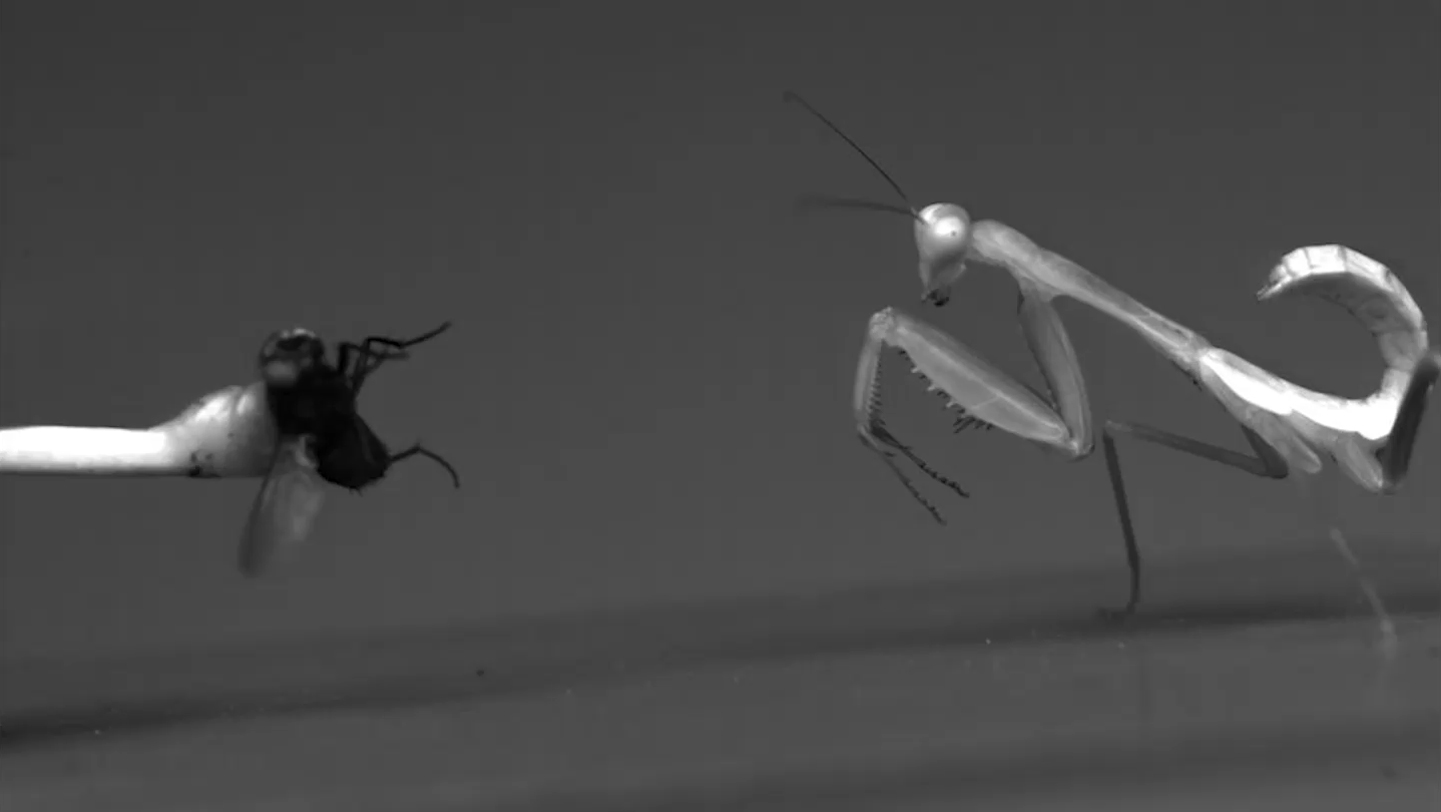
Imagine stepping into a lush rainforest, where the air hums with the life of countless creatures, and among the foliage lurks a silent predator: the giant rainforest mantis. These majestic insects, sporting names like Hierodula majuscula and belonging to a family that’s as diverse as it is fascinating, have mastered the art of patience. Instead of chasing down meals, they embody stillness, blending seamlessly with leaves and vines until an unsuspecting insect wanders too close. In a flash—a blur of motion that defies their usually statuesque demeanor—they strike. Their front legs, armed with specialized spines and a vise-like grip, snap forward like nature’s own spring-loaded traps. But here’s the twist: this isn’t blind aggression. These mantises, particularly the adults, can deliver strikes with surprising force, evolving techniques that make them apex ambush hunters. Researchers, particularly those at Kiel University in Germany, have been diving deep into this world, uncovering how the humble journey from tiny nymph to towering predator shapes their predatory prowess, and it’s filled with surprises that challenge our understanding of strength, growth, and survival.
In the world of insect research, details matter, and Thies Büscher, an entomologist from Kiel, has dedicated his work to dissecting these lightning-fast attacks. His team’s study, published in the March issue of Physiological Entomology, didn’t just watch mantises hunt—they measured it precisely. Picture this: a clever setup where a juicy fly larva is placed inside a translucent box attached to a sensitive force-measuring device. The mantises? Always famished, they’re more than willing participants. Büscher and his colleagues raised a brood of these Australian natives, starting from the tiniest nymphs. These baby mantises, no bigger than a fingernail, go through multiple molts—shedding their outer skins as they outgrow them, much like teenagers swapping out clothes. Males typically need six molts to mature, females seven, culminating in adults roughly the size of an adult human hand but weighing barely more than a penny. By tracking strikes through these stages, the scientists captured force data that maps out a mantis’s developmental arc, revealing how power builds over a lifetime. It’s not just about size; it’s about efficiency, transformation, and the raw mechanics of hunger meeting instinct.
Now, let’s talk growth spurts with a punchline. The youngest mantises in the study, those who’d only molted twice, delivered strikes registering a modest 2.5 millinewtons—a gentle nudge by mantis standards. But as they progressed, things got explosive. Adult males ramped up to about 70 millinewtons, while their female counterparts unleashed a whopping 196 millinewtons. That’s not mere numbers; it’s a testament to evolution’s fine-tuning. Females, emerging larger and more robust from high school (or rather, mantis high school), dominate the predatory scene. Their strikes aren’t about brute force alone—it’s a snatch-and-grab technique that captures prey alive. Without venom, they rely on razor-sharp mouthparts, biting into their catch to drain fluids as the victim slowly succumbs. Büscher, who admits to having felt those bites himself (rodent nibbles, he says, sting worse), marvels at how this adaptation fuels their survival. In a rainforest teeming with competition, where every calorie counts, a stronger strike means more meals, ensuring bigger, bolder females rise to the top.
Delving deeper, scaling becomes the elephant in the room—or the mantis on the leaf. While strike force generally scales with a muscle’s cross-sectional area (a two-dimensional measure), insect bodies occupy three dimensions, growing faster in volume than muscle area. This creates quirky imbalances. Proportional to body weight—which balloons in three dimensions—those wispy young mantises pack a relatively bigger punch than their adult selves. It’s like comparing a sprinter’s burst to a marathoner’s endurance; for their size, the little ones are powerhouses. Büscher’s intrigued by these nuances, seeing mantises as living laboratories for understanding physical laws in tiny bodies. But the real puzzle? Muscular cross-sections alone can’t explain the adults’ might. Females, in particular, defy predictions, smashing the setup harder than math suggests. Something extra is at play—a hidden reservoir of power that has Büscher puzzling anew. Could there be auxiliary muscles or anatomical tricks? It’s a mystery begging to be unraveled, echoing how other creatures, like mantis shrimp with their pressurized punches or somersaulting larvae, leverage stored energy for dazzling feats.
As Büscher hunts for answers in female mantis anatomy, the saga extends to eating habits, where evolutionary physiologist Christopher Oufiero of Towson University weighs in. His lab, not fixated on strike force, turned to devouring speed, observing 14 mantis species chowing down on over 300 flies. These camouflaged hunters—masters of disguise, from leaf-mimickers to camouflage queens—proved voracious eaters, unhindered by mouthpart limitations. Unlike many insects that nibble slowly, mantises feast greedily, aligning more with spider-like efficiency. Oufiero’s findings, in the February 2024 Ecology and Evolution journal, suggest they consume far beyond mere subsistence, fueling a lifestyle of abundance. It’s a reminder that predation isn’t just about the catch; it’s about the feast, sustaining giant rainforest dwellers in a world where stealth and strength intertwine.
Ultimately, these studies paint mantises as more than alien predators—they’re relatable icons of growth and adaptation. From kindergarten bugs grappling with size to high school heavyweight champions flexing force, we see parallels to human development: the awkward phases, the power surges, and the mysteries that keep us asking questions. Büscher’s quest for that elusive extra power source continues, while Oufiero’s dining dynamics add layers to how these creatures thrive. In our own lives, we might reflect on phases of strength—be it physical, emotional, or intellectual—that surprise us, scaling inconsistently yet beautifully. Mantises teach us patience has power, and in the quiet ambush, true might emerges. One can’t help but root for these underrated rainforest rulers, hoping future discoveries reveal more secrets in their strike, their stories echoing our own journeys of evolution and hunger.