


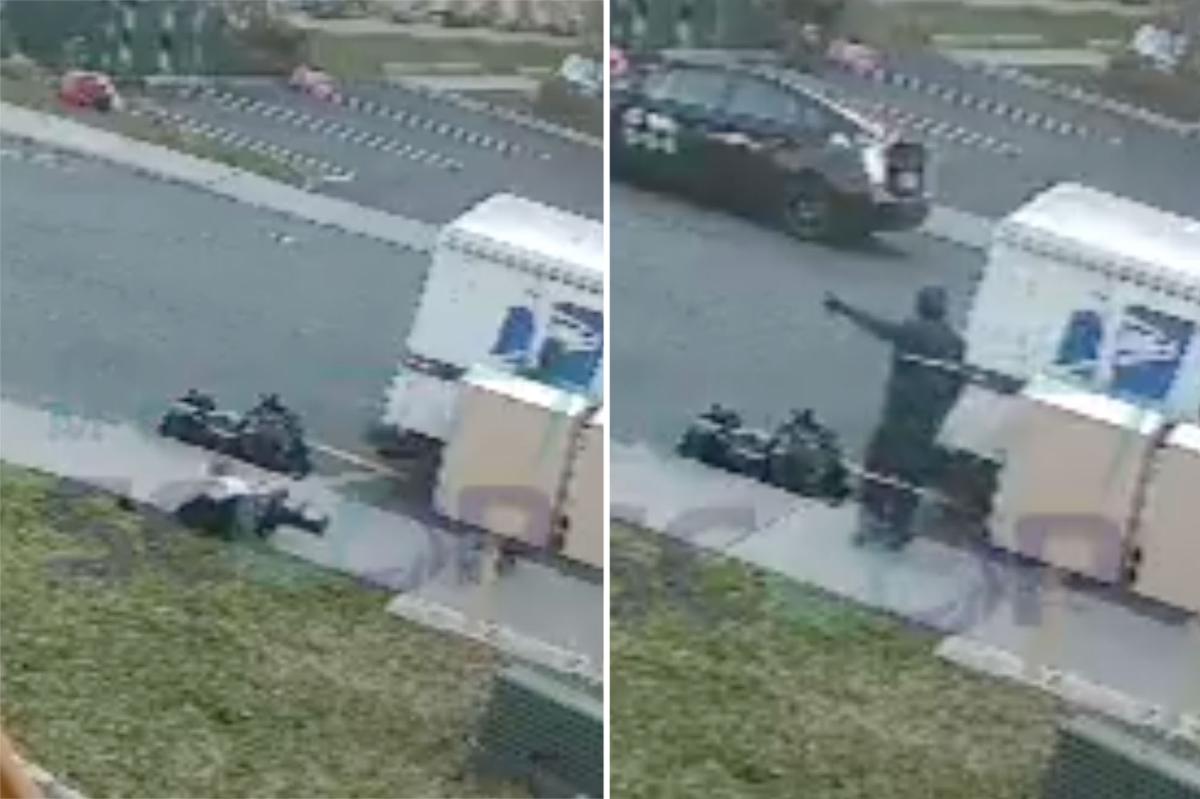
In the heart of Rockland County, New York, a shocking incident unfolded that sent ripples of disbelief and anger through the community. A seemingly ordinary afternoon turned into a nightmare when a US Postal Service worker, just 39 years old, was captured on home surveillance footage violently shoving a 4-year-old Orthodox Jewish boy. This act, raw and unprovoked, left many feeling a deep-seated fear for the safety of their children in what should be familiar neighborhood settings. The boy, innocent and wide-eyed, was simply approaching a community mailbox, perhaps out of curiosity or a child’s natural sense of wonder, when the postal carrier, his back turned as he filled the box with letters, suddenly spun around. In that split second, he launched himself at the child with a brutal two-handed push that sent the little one tumbling to the ground, his small yarmulke— a symbol of his faith and heritage—flying off his head. The video, first shared by local outlet The Monsey Scoop, painted a picture of heartlessness that tugged at the heartstrings of anyone watching, evoking memories of our own vulnerabilities as parents or community members who rely on everyday workers to embody trust and kindness. Outrage wasn’t just simmering; it was boiling over, especially as police announced that the suspect’s name was being shielded from the public, sparking accusations of selective justice. People wondered aloud why such leniency for someone who had targeted a defenseless child, whose only mistake was being in the wrong place at the wrong time. This wasn’t just an assault; it was a betrayal of the public’s trust in institutions meant to protect the vulnerable. As families gathered around their screens, watching the footage loop, a collective gasp echoed through living rooms, prompting damning questions about accountability and the hidden biases that might lurk behind such decisions. The boy miraculously escaped without physical injury, but the emotional scars—on him, his family, and the broader Jewish community—were palpable, reminding us all of the fragility of childhood innocence in a world that often prioritizes adults’ unexamined behaviors over a child’s right to safety.
The video footage, a window into this harrowing moment, revealed a scene that could have been straight out of a nightmare. The little boy, dressed in traditional Orthodox attire, approached the mailbox with the carefree gait of a toddler exploring his world. Behind him, his friends watched from a safe distance, their play momentarily paused by this inexplicable intrusion into their daily routines. The postal worker, engrossed in his duties, appeared startled when he turned to find the child so close, but his reaction defied all reason—a sudden, forceful shove that propelled the boy backward like a doll flung aside. The child’s small frame hit the ground, his yarmulke tumbling away, a poignant symbol of disruption to his religious identity and innocent play. In that instant, the camera captured not just the physical act, but an emotional betrayal: a grown man, entrusted with the mundane task of delivering mail, choosing aggression over patience. What drove this? Was it a momentary lapse of judgment, exhaustion from a long day, or something deeper, whispered as hate underlying the shove? As the boy scrambled to his feet, dusting himself off and retrieving his hat before rushing back to his peers, viewers couldn’t help but feel a surge of protective fury. This wasn’t random; it was personal, etching itself into the collective memory of a community already wary of prejudice. Families paused their evenings, hearts aching for this child who embodied purity, and wondered how many such incidents go unreported, hidden behind closed doors or foggy lenses. The tape looped online, amplifying the outrage into a demand for transparency, forcing us to confront how quickly trust in public figures can shatter, and how a child’s momentary curiosity could invite such unwarranted violence.
Authorities moved swiftly, but not without controversy, turning the incident into a symbol of systemic flaws. The postal worker, identified only as a 39-year-old resident of Stony Point, was arrested on Thursday and processed through the Ramapo Town Justice Court, released on his own recognizance—a decision that set off alarms for many who viewed it as too lenient. He was initially charged with misdemeanor endangering the welfare of a child and attempted assault in the third degree, reflecting the severity of shoving a mere four-year-old capable of upending life’s balance. Yet, as outrage mounted, police hinted at additional charges looming, with expectations that he would face attempted assault in the second degree on Saturday, elevating the stakes and underscoring the gravity of his actions. This escalation wasn’t just legal; it was a nod to the community’s outcry, acknowledging that what transpired wasn’t a minor scuffle but a calculated strike against vulnerability. However, the lack of a hate crime designation left many scratching their heads, wondering if anti-Semitic undertones—given the boy’s visible Jewish identity—were being overlooked in a post vigilant about such sensitivities. The arrest itself became a rallying point, with neighbors in Rockland County sharing stories of their own encounters with frustrations in public service, from rude interactions to outright hostility. For the boy’s family, it was a relief to see action taken, yet the uncertainty of the charges’ outcome hung heavy, a reminder of how justice can feel provisional. As the case progressed to an unspecified court date, questions lingered about rehabilitation versus punishment, and how such incidents erode the foundation of community trust. Parents, especially in tight-knit Orthodox circles, doubled down on vigilance, turning playgrounds and streets into monitored spaces, fearing that one bad actor could mar the image of public service forever.
The Ramapo Police Department’s stance on anonymity only fueled the flames, revealing a policy that “very rarely” releases suspects’ names in news releases, a practice rooted in tradition but increasingly outmoded in the digital age of public scrutiny. By declining to identify the postal worker—citing unspecified reasons—the department left a gaping void that social media eagerly filled with speculation and condemnation. This decision, crafted perhaps to protect the suspect’s presumption of innocence, backfired spectacularly, as citizens decried it as a shield for the guilty, especially when a child was the victim. Outrage poured forth organically, with New Yorkers flooding platforms like Facebook to demand answers, their voices a chorus of frustration against opaque institutions. Memes circulated, comparisons were drawn to high-profile cases where names were promptly released, and debates raged about double standards—why hide a man’s identity when his actions had been broadcast for all to see? In Orthodox Jewish communities, where trust in external authorities can be tenuous, this secrecy amplified fears of unchecked bias, prompting calls for reform in how law enforcement handles assaults on minors. The boy’s family, likely grappling with their own turmoil, must have felt the weight of public opinion tilting toward judgment of the system rather than support for healing. This incident spotlighted broader issues: the erosion of accountability in an era of bodycams and viral videos, where anonymity can no longer shield perpetrators from the court’s judgment of the crowd. Residents shared personal anecdotes of similar interactions gone wrong, weaving a tapestry of discontent that threatened to undermine faith in public safety. Ultimately, the policy’s rigidity versus public demand for transparency created a standoff, with each unanswered question stoking the fire of communal anger and a push for change.
Echoing the community’s fury, social media posts exploded with visceral reactions, each one a raw testament to human empathy and outrage. “Why are you hiding his name?” demanded Facebook user JP Gale in a searing comment on Friday, capturing the exasperation of those who saw this as preferential treatment for someone who had assaulted a vulnerable child. “You’re going out of your way to protect the identity of a man who assaulted a child, and I think we can all guess why,” Gale added, implying suspicions of bias that cut deep into sensitive topics like prejudice against Jewish communities. Another poster, Frienda Bill, pleaded, “We need this man’s name. He is a danger,” articulating the primal fear that such individuals might strike again if not brought into the spotlight. Melissa Alpegiani Fogarty echoed this on Facebook, questioning, “Where is this person’s name and the news conference? He assaulted a child,” her words underlining the desperate need for a platform where accountability can be openly addressed. These comments trended not just in Rockland but across New York, as users shared the video and dissected the events, transforming personal trauma into a public movement. Parents recounted their own heart-pounding moments—watching their toddlers near busy roads or strangers—while others evoked broader societal concerns, from workplace stress in the postal service to the psychological toll on young victims. Stories flowed of children bullied or harmed by authority figures, each amplification a reminder that one incident can mobilize thousands. The online discourse became a virtual town hall, where anonymity bred boldness, and heated debates about justice versus mercy played out in real-time. For the boy’s parents, these voices offered solace in solidarity, yet also mounted pressure on officials to act decisively. In the end, these posts humanized the outrage, turning a localized incident into a mirror for national conversations on child safety, transparency, and the moral imperatives of protecting the innocent from predators in plain sight.
As the story unfolded, key institutions remained frustratingly silent, leaving gaps that amplified the uncertainty and fueled more speculation. The United States Postal Service, rather than issuing a statement, declined to comment on Saturday when queried about the mail carrier’s employment status—whether he was still on the job, suspended, or terminated—nor would they address the authenticity or details of the shove captured on video. This reticence perplexed many, who expected swift action from an organization integral to daily life, symbolizing reliability yet here seemingly evasive. Was the worker placed on leave, pending investigation? Had internal reviews begun to address potential training lapses or psychological evaluations for employees handling high-stress routes? The lack of clarity only deepened public distrust, with rumors swirling about union protections or bureaucratic hurdles delaying recompense. Similarly, the Ramapo Town Justice Court offered no response to requests for comment, their silence a stark contrast to the active engagement of social voices online. This opacity frustrated advocates seeking updates on the case’s trajectory, including timelines for hearings or the postal worker’s next court appearance, details crucial for a community hungry for closure. For the Orthodox Jewish family at the center, these unbridled responses from official bodies likely compounded their sense of isolation, as they navigated healing for their child while awaiting assurances of justice. Broader implications loomed, such as implications for USPS hiring practices or police protocols in handling child-involved crimes, sparking calls for policy reviews. Residents imagined supportive outreach programs for affected families, or community forums to rebuild trust. Yet, without statements, the narrative remained incomplete, a reminder of how institutional inertia can exacerbate emotional wounds. Ultimately, this collective demand for transparency highlighted a societal thirst for accountability, urging entities to humanize their responses and bridge the divide between bureaucracy and the people it serves. As days passed, the incident lingered as a stark lesson in empathy, urging all of us to foster safer environments where children can approach mailboxes and wonders without fear, and where wrongs are met not with excuses, but with unwavering accountability.