

Paragraph 1:
Imagine strolling through a city where ancient ruins from the Roman Empire casually rub shoulders with gleaming glass skyscrapers—it’s the kind of historical charm that draws millions of visitors every year. But as enchanting as these layered urban landscapes are, they often clash with the rhythms of modern life. Narrow winding streets might have sufficed for horse-drawn carriages, but they buckle under the weight of rush-hour traffic, sprawling suburbs, and the need for efficient public services. That’s where the magic of a purpose-built city comes in. Conceived from the ground up, these urban marvels are designed with intention: think neat grid patterns that place schools, supermarkets, and health clinics within easy reach, while infrastructure anticipates future growth, from traffic flows to green spaces. It’s a fresh start, unburdened by the ad-hoc sprawl of centuries past. Countries have taken this concept even further by redesigning entire capitals from scratch, prioritizing functionality alongside ambition. Equatorial Guinea’s latest leap into this trend is Ciudad de la Paz, declared the capital in January this year, sparking curiosity about how these bold experiments balance progress with practicality. This article dives into some of the world’s most notable purpose-built capitals, from global icons to hidden gems that might surprise you at dinner parties. As we explore their stories, it’s fascinating to consider how these cities reflect human ingenuity—our drive to reinvent the spaces we live in, adapting to past lessons while dreaming of a better future. Take Brasília in Brazil, a testament to visionary engineering; or Canberra in Australia, born from compromise and creativity. Each one offers a glimpse into what happens when planners sketch dreams on blank canvases, imagining thriving communities instead of reactive fixes. Some, like Wellington in New Zealand, blend indigenous heritage with modern grids, creating a harmonious blend. Islamabad in Pakistan shows how security and spirituality can shape a skyline, while Naypyidaw in Myanmar whispers tales of secrecy and scale. Belize’s Belmopan emerged from disaster’s ashes, and now Ciudad de la Paz whispers of potential inEquatorial Guinea. These aren’t just places; they’re bold statements on human resilience and imagination. Walking through them, you can almost hear the architects’ debates—debates that echo our own daily struggles to balance tradition with innovation. It’s not always perfect; some feel eerily empty, like ghost towns waiting for life to fill them. Yet, they inspire us to think bigger about our own towns and cities, wondering if a fresh start could heal the aches of overcrowding or inefficiency. In a world where climate change demands smarter planning and pandemics highlight the need for resilient spaces, purpose-built capitals remind us that urban design is as much about hope as it is about bricks and mortar. Exploring these stories, I find myself reflecting on my own dreams of ideal living—perhaps a neighborhood where parks are the hubs, and transport is a joy, not a chore. These cities challenge us to visualize utopia, one grid line at a time, blending the poetic with the pragmatic in ways that make history tangible and the future feel possible.
Paragraph 2:
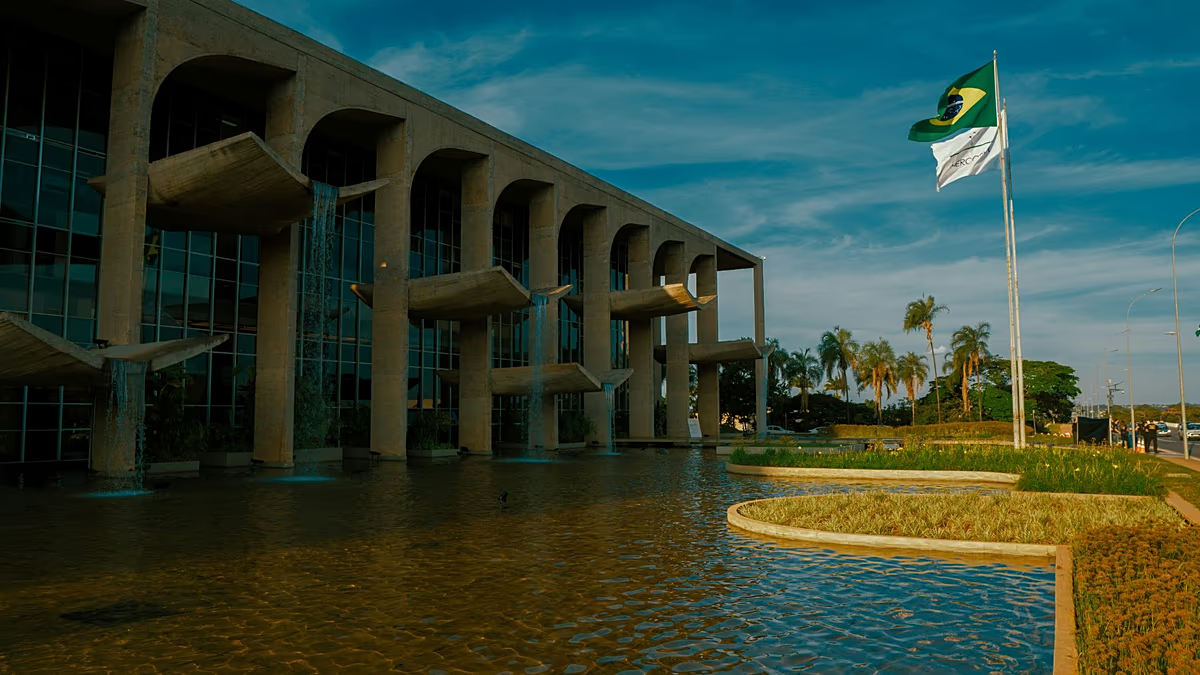
Brazil’s Brasília stands as the poster child for purpose-built capitals, a bold leap from chaos to order that redefined what a city could be. Picture this: in 1960, as Brazil shook off colonial legacies and embraced modernization, President Juscelino Kubitschek dreamed of a capital that wasn’t perched precariously on the southeastern coast like Rio de Janeiro. Instead, he envisioned a inland heartland hub that symbolized national unity and progress—a place where the future unfolded in concrete and glass. Chosen for its central location, Brasília was meticulously planned by architect Oscar Niemeyer and urbanist Lúcio Costa, emerging as a living artwork of modernism. I’ve always been captivated by how Brasília’s wide avenues, like its notorious Monumental Axis, stretch toward the horizon, designed to handle the anticipated crush of cars and people. It’s like the city was built for efficiency, with residential “superblocks” fostering community while towering ministries stand sentinel, each clad in white curves that evoke silence and strength. Visitors often describe a surreal sense of space—vast esplanades where traffic obeys the rhythm of the boulevards, unlike the clogged veins of older cities. As Brazil’s third-largest city by population today, with over 3 million residents, Brasília hums with governmental energy, yet it retains an otherworldly vibe, almost like stepping into a utopian novel. Architecture buffs flock here for gems like the Metropolitan Cathedral, its hyperboloid glass structure piercing the sky like a crown of light, or the National Congress, with its twin towers resemblnap everting open books—symbolism that speaks to democracy’s fragility and beauty. I can imagine standing beneath them, feeling the weight of history; it’s not just a building, it’s a dialogue with the ages. Recognized as a UNESCO World Heritage Site in 1987, Brasília is hailed as a “landmark in town planning,” a testament to human ambition that shaped mid-20th-century ideals. Yet, it’s not all flawless; critiques highlight how the city’s social stratification—wealthy areas gleaming while slums persist on the outskirts—mirror broader inequalities. Still, walking the lawns of the Palácio da Alvorada or watching sunset over Paranoá Lake stirs something primal in me—the joy of purposeful creation. Brasília reminds us that cities aren’t accidents; they’re acts of will. When I think of it, I picture families picnicking along its sculptural bridges, children racing down symmetrical sidewalks, a place where order breeds freedom. It’s inspired countless imitations worldwide, proving that a well-planned city can become a beacon of hope in a disorderly world. From the thrill of its air-conditioned malls to the quiet majesty of its monuments, Brasília feels alive with potential, a canvas where the human spirit paints possibilities far beyond the ordinary.
Paragraph 3:
Australia’s Canberra offers a compelling blend of history, compromise, and cultural vibrancy, standing as a purpose-built capital with deep roots in reconciliation and foresight. The lands surrounding Canberra have been home to the Ngunnawal people for tens of thousands of years, their stories woven into the very soil—tradition custodians who hunted, gathered, and lived in harmony with the landscape long before European eyes turned westward. British settlement began in the late 1820s, but it was the early 20th century’s federation fervor that birthed Canberra’s destiny. As Sydney and Melbourne vied for supremacy, a compromise was struck: a new capital city that symbolized unity across the vast continent. A design competition, championed by the Department of Home Affairs, yielded winners in 1912, with construction kicking off amidst World War I’s shadows. Today, with a population hovering around 450,000—less than a tenth of Melbourne’s—Canberra thrives not in size but in soul, a green oasis ringed by mountains and dotted with embassies that hum with international intrigue. Picture the broad avenues, lined with eucalyptus swaying in the breeze, connecting residential suburbs to gleaming parliamentary buildings like the High Court, where justice echoes through modernistic designs. It’s a city built for the long game, with master plans envisioning sustainable growth amid vineyards and rolling hills. Visitors rave about its world-class museums, like the Australian War Memorial, where stories of sacrifice stir the heart, or the National Gallery of Australia, home to Aboriginal art that pulses with ancestral wisdom. I can envision wandering the Lake Burley Griffin, its man-made shores hosting weddings and wildfires, where families gather for picnics, and the air carries the scent of wattle flowers. The foodie scene, especially in suburbs like Braddon, is legendary—think buzzing bistros serving wild-caught fish or wines from nearby vineyards, a culinary escape that feels intimate and exciting. Yet, Canberra’s charm lies in its community feel; small-town warmth amidst governmental grandeur. It’s where rugby matches roar on weekends, and festivals celebrate diverse cultures, from Chinese lanterns to Indigenous ceremonies. Walking its paths, you sense the Ngunnawal spirit lingering, a reminder that thoughtful planning can honor the past. Some say it’s quiet, almost sleepy compared to Sydney’s bustle, but that’s its strength—a sanctuary for reflection. As a traveler, I’d love to hike the Brindabella Ranges or cycle along shared paths, feeling the rhythm of a city designed for life. Canberra teaches us that compromise isn’t weakness; it’s the foundation of something enduring, where purpose-built spaces foster connection across generations.
Paragraph 4:
Wellington, New Zealand’s vibrant capital, embodies a fascinating tapestry of indigenous heritage and 19th-century ambition, crafted with grids that blend practicality with poetic flair. Long before European arrival, Māori explorer Kupe discovered this land in the 10th century, naming it Te Whanganui a Tara, with tribes like Te Ātiawa and Taranaki shaping a rich tapestry of stories and settlements. Under British influence, New Zealand’s seat of power shifted—from Old Russell (now Okiato) to Auckland—before settling on Wellington in 1865, drawn by its strategic Cook Strait position bridging North and South Islands. Though not built entirely from scratch, its modern layout emerged as a grid of interconnected blocks in 1840, designed by Captain William Mein Smith, transforming a windy peninsula into a functional hub. With nearly 215,000 residents, it’s dwarfed by Auckland’s 1.7 million, yet Wellington pulses as the cultural heartbeat, a UNESCO City of Design where creativity thrives. Imagine bracing against the notorious winds on Wellington Harbour, where yachts bob beside the parliament buildings, or strolling Te Papa Tongarewa, the national museum, where interactive exhibits bring Māori mythology to life—taunting sea monsters and heroic deeds that make history feel immediate. The city’s fame as New Zealand’s arts capital shines through institutions like the New Zealand Symphony Orchestra, whose concerts resonate through halls, or the Royal New Zealand Ballet, whose graceful leaps mirror the city’s dynamic spirit. Food lovers flock to neighborhoods like Cuba Street, where fusion cafes burst with flavors from lamb burgers to veggie bowls, reflecting the area’s embrace of diversity. Hiking Mount Victoria or Jordan Park offers panoramic views of the strait, where the sea’s whisper mixes with urban energy. I’ve always felt a personal connection here; it’s like the city understands the adventurer’s soul, with its coffee houses and bookshops fostering deep conversations. Wellington’s grids aren’t rigid—they allow for freedom, with green spaces inviting picnics amid blooming rhododendrons. Yet, it’s not untouched by challenges; earthquakes have tested its resilience, but each tremor underscores human adaptability. As a cultural hub, it hosts festivals like Wellington International Film Festival, where cinephiles debate over craft beers. In essence, Wellington humanizes planning: it’s a place where ancestral wisdom guides modern design, creating spaces for stories to unfold. Walking its streets, you feel the harmony—a reminder that cities thrive when they honor roots while embracing change.
Paragraph 5:
Islamabad in Pakistan represents a strategic fresh start, born from security concerns and Islamic ideals in the 1960s, evolving into a serene administrative heart. Founded to replace Karachi as the capital in 1967, Islamabad—meaning “city of Islam”—was strategically selected for its proximity to military headquarters in Rawalpindi, offering protection in a turbulent region. Today, with over 1.1 million residents, it’s Pakistan’s tenth-largest city, a planned enclave where broad avenues connect residential sectors to government compounds, fostering a sense of order amidst the country’s vibrant chaos. Picture the calming vistas of Faisal Mosque, its marble domes rising like petals toward the heavens, one of the world’s largest mosques, where sunlight filters through intricate carvings, inviting quiet reflection or Friday prayers that unite thousands. The Pakistan Monument, a striking steel starburst, symbolizes the country’s diverse cultures, while Rawal Lake offers recreational respite, its shores lined with picnic spots and boathouses. Architecture here blends functionality with spirituality, from colonial-inspired buildings to modern parks that encourage family outings. I can imagine the cool mountain breezes refreshing after a heatwave, or the Dera Ismail Khan route transforming into scenic drives where locals share stories of resilience. Visiting Daman-e-Koh, an ancient viewpoint, connects past and present, with picnics overlooking Islamabad’s geometric layout, a grid engineered for efficiency yet softened by green belts and fountains. Cultural highlights include bustlingWaste markets and art festivals, where handicrafts tell tales of craftsmanship. Yet, Islamabad embodies hope in stability, a city designed to endure regional tensions. Its universities buzz with intellectual energy, training future leaders, while quiet neighborhoods echo with children’s laughter. In a country of dynamic personalities, Islamabad provides a composed backdrop, much like a steadfast friend. As an alternative to Naypyidaw in Myanmar, which began construction in 2002 to succeed Yangon by 2005, about 320 kilometers north. Chosen for defensibility, Naypyidaw—meaning “abode of kings”—became a secretive fortress for military rule, with vast, empty roads that evoke ghostly stillness, accommodating officials amid jungle surroundings. Damaged by the 2025 earthquake, it’s rebuilding slowly; attractions like the newly opened Māravijaya Buddha statue, the world’s largest marble Buddha, symbolize rebirth. Despite travel advisories from places like the UK excluding Naypyidaw and Yangon, it intrigues as a massive yet sparsely populated anomaly, prompting reflections on scale and isolation in urban design. Both cities teach that purpose-built spaces can shield or stagnate, mirroring human tendencies toward security versus connection.
Paragraph 6:
Belmopan in Belize and Ciudad de la Paz in Equatorial Guinea illustrate how disasters and ambitions can inspire capitals carved from necessity, transforming challenges into opportunities for renewal. In Belize, Hurricane Hattie devastated 75% of Belize City’s infrastructure in 1961, prompting a westward move inland to Belmopan, with construction starting in 1967 and official status achieved in 1970. Named for the Belize and Mopan Rivers, it’s home to about 20,000 residents, a humble counterpoint to Belize City’s 64,000, offering a tranquil alternative. Tourists flock to nearby St. Herman’s Blue Hole National Park for snorkeling in crystal-clear waters teeming with marine life, or hiking Guanacaste’s lush trails, where howler monkeys serenade amid rainforests. Government buildings stand proudly on Mango Street, surrounded by markets and community spaces that foster a tight-knit vibe. I envision attending Caribbean festivals here, with rhythms of salsa and punta dancing echoing through squares, or simply savoring Belizean cuisine under mango trees. Belmopan feels restorative, a place where nature’s scars heal human hearts, reminding us of resilience post-trauma. Meanwhile, Equatorial Guinea’s Ciudad de la Paz, inaugurated in January this year, marks the newest shift from Malabo, driven by accessibility and a milder climate since its 2015 establishment. Designed for 200,000, it’s currently a serene ghost town, with wide plazas waiting for inhabitants. Exploring its modern layouts, you sense untapped potential—quiet avenues, planned ports, and community centers poised for bustling life. Like Belmopan, it’s a canvas for dreams, perhaps inspired by regional aspirations. Both cities encourage contemplating how purpose-built spaces can rebuild futures, blending practicality with hope. In Belize, the warmth of Western culture shines; in Equatorial Guinea, equatorial breezes hint at prosperity. These stories humanize urban rebirth, showing that even in quiet starts, greatness can stir. As I ponder, I feel inspired to visit, to witness transformations firsthand—the quiet promise of cities yet to thrive.