



Imagine standing under a vast night sky, billions of stars twinkling above like distant candles in an endless expanse. Now multiply that wonder by a thousandfold—perhaps even more—for that’s the kind of awe-inspiring event that unfolded about a billion light-years away on December 12, 2024. A stellar explosion burst forth, not just any supernova, but one that outshone its peers by a staggering 30 times. This wasn’t the gentle fading of a star’s life cycle; it was a superluminous supernova, a rare cosmic spectacle that lit up the heavens like a runaway fireworks display. Detected by keen-eyed astronomers, this blast challenged our understanding of the universe’s grand design. It wasn’t just bright; it was extraordinarily so, far beyond the norm, prompting scientists to dig deeper into what could fuel such a ferocious phenomenon. As humans, we’ve always looked to the stars for stories, and this one promised to reveal secrets of explosions so immense that they echo across the cosmos, reminding us of our place in a vast, ever-exploding narrative. The discovery came at a pivotal moment, as telescopes pointed toward a seemingly ordinary patch of sky, only to capture this outlier among stars. In the world of astronomy, superluminous supernovas are already a standout group, radiating energy 10 to 100 times more intensely than your average stellar death throes. But this one eclipsed even expectations, sitting at the higher end of that spectrum and joining a handful of such events that have puzzled experts for years. It’s as if the star decided to go out not with a whimper, but with the full force of a cosmic symphony. The implications are profound; these aren’t mere light shows but windows into the fundamental forces shaping our universe. Picture the sheer scale: at a billion light-years, we’re seeing light that embarked on its journey when humanity’s ancestors were just beginning to walk upright on Earth. Yet, here we are, interpreting its message today. This event, dubbed a superluminous supernova for good reason, wasn’t discovered by luck. Dedicated teams, working tirelessly through cold nights and data streams, spotted it and knew instantly it was special. The brightness wasn’t uniform; it pulsed in ways that defied the usual supernova script. And that, dear reader, is where the real story unfolds—a narrative of discovery that feels almost alive, as if the universe is whispering its secrets through patterns of light. It’s in moments like these that science transforms from cold data into a thrilling tale of exploration, drawing us in like moths to a flame. We humans crave stories of the extraordinary, and this supernova delivers, blurring the lines between scientific fact and cosmic wonder.
The uniqueness of this 2024 supernova didn’t stop at its sheer luminosity; it carried a signal that astronomers describe as a “chirp”—not a sound we can audibly hear, but a visual rhythm, a brightness fluctuation whose cycles grow quicker and quicker over time. It’s like listening to a bird’s song that starts slow and melodic, then accelerates into a frantic trill, each note building on the last in a crescendo that mimics the rapid heartbeats of excitement. No other supernova has ever exhibited such a chirp, making this one stand out as a cosmic anomaly. “No supernova has had a chirp before, so there has to be something weird going on,” remarks astrophysicist Joseph Farah from the University of California, Santa Barbara, his words capturing the intrigue and slight bewilderment that fuels scientific pursuit. Imagine the thrill of cataloging stellar deaths for decades, only to encounter something utterly novel—a signal that defies the textbook descriptions handed down through generations of stargazers. This chirp isn’t random; it’s precise, a pulsing that suggests underlying complexities in the star’s final act. As humans, we’re drawn to mysteries like this because they mirror our own lives: beginnings that start steady, picking up pace toward unpredictable conclusions. The chirp challenges us to rethink the mechanics of these explosions, pushing astronomers to question whether there are hidden layers to stellar demise that we’ve only scratched the surface of. It’s a reminder that the universe, with all its predictability, still harbors surprises that keep us awake at night, pondering what else might be out there. In humanizing this phenomenon, think of the chirp as the universe’s way of telling a joke or sharing a secret—something fleeting and extraordinary that demands our attention. Farah’s comment echoes the excitement of unlocking a new chapter in cosmic history, where each observation feels like communion with the stars themselves.
Farah wasn’t alone in his quest; he collaborated with a team leveraging the global network of telescopes at the Las Cumbres Observatory, spanning continents to capture data like a worldwide orchestra tuning to a single melody. They studied the supernova meticulously, running computer simulations that recreated the explosion’s light show in digital realms. These virtual experiments painted a vivid picture: the chirp wasn’t some random glitch in the data but a clue pointing to the heart of the event. The simulations revealed something extraordinary—an extreme star type called a magnetar as the culprit behind the supernova’s brightness. Magnetars are neutron stars with magnetic fields so intense that they’re like cosmic dynamos, spinning remnants of colossal stars that, when a core collapses, can either birth black holes or these hyper-magnetized giants. The team’s findings aligned with theories that magnetars power superluminous events, their rotation unleashing energy in ways that regular supernovas can’t match. “To see something brand new, and then to make a prediction as it’s happening, and then that prediction comes true—it’s like you just had a conversation with the universe,” Farah says, his enthusiasm palpable, as if the cosmos had just nodded in agreement. This dialogue between humans and the heavens underscores the human element in science: the passion, the late nights, the eureka moments that make discoveries feel personal. It’s not just about numbers and graphs; it’s about connecting with the grandeur of creation. For anyone who has ever stared at the stars and felt a sense of wonder, this resonates deeply— a reminder that we’re not passive observers but active participants in uncovering the universe’s stories. The Las Cumbres network, with its synchronized telescopes, embodies this collaboration, turning individual efforts into a tapestry of insight that brings the distant explosion into sharper focus. In our everyday lives, we often simulate outcomes—planning vacations, predicting weather—but here, simulations bridge the gap between our world and the unfathomable depths of space, making the impossible seem a bit more tangible.
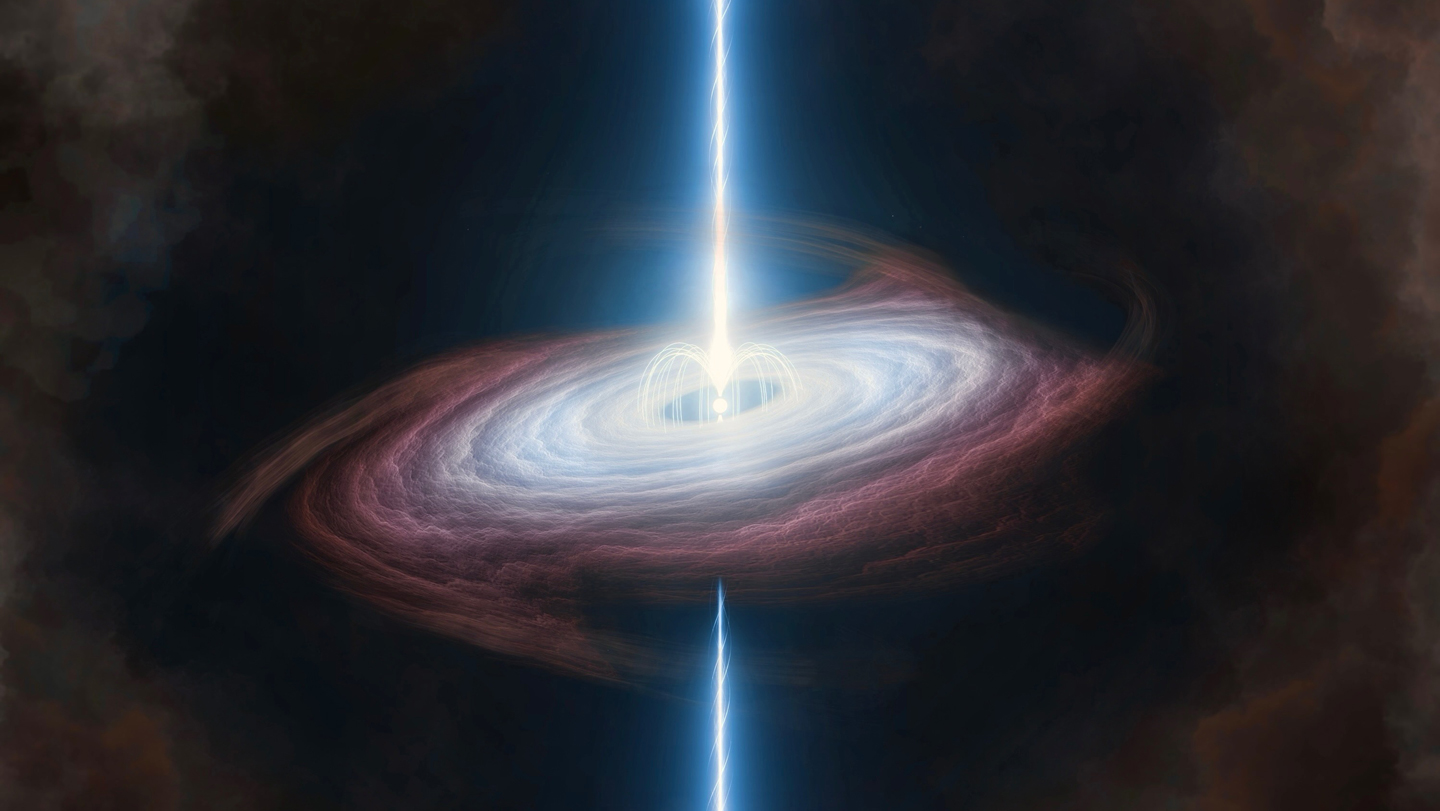
Diving deeper, the team posits that a magnetar drove this 2024 event through a mechanism as intriguing as it is complex. Picture the supernova’s core collapse not just ending in a bang, but leaving behind a magnetar shrouded in a disk of gas and dust—debris from the star’s own destruction. This disk doesn’t sit idly; it’s warped by the magnetar’s extreme gravitational field, wobbling like a spinning top on a turbulent surface. Each wobble blocks or redirects the magnetar’s light in varying amounts, creating the brightness fluctuations we observe. As the wobbling accelerates, faster than you might expect, it produces the chirp—a signal that speeds up as if time itself is compressing. Farah explains it poetically: “The best way to imagine it is, if you were an observer trying to sit still around the magnetar, it would be really, really hard because your spacetime is literally being dragged to corotate with the magnetar.” It’s a nod to Einstein’s general relativity, where gravity warps the fabric of reality, and the closer you get, the more chaotic the effects. This isn’t abstract physics; it’s the universe in motion, where even the rules of space-time bend under magnetism’s immense pull. Humans can relate to this instability—think of trying to stand steady on a moving platform, where forces pull you inexorably along. The magnetar’s field, billions of times stronger than Earth’s, makes it a titan of turbulence, its presence reshaping everything around it. This explanation ties into broader questions about stellar fates, challenging the idea that supernova endgames are straightforward. It suggests a dance of forces, where magnetism plays lead, directing a drama of light and shadow. As we grapple with such enormity, it’s humbling: one explosion, one signal, revealing layers of physics that have waited eons for our understanding. The disk’s wobble serves as a metaphor for life’s unpredictability, where even in destruction, there’s rhythm and reason. emir
Yet, not everyone is fully convinced; the scientific community thrives on rigorous debate. Matt Nicholl, an astrophysicist from Queen’s University Belfast, cautions that while the magnetar explanation is compelling—”It’s very hard to explain a chirp any other way”—more evidence is needed to seal the deal. “This is certainly the most convincing one that’s out there, but I just would like to see a few more before I declare it is indeed proof of the magnetar,” he says, embodying the cautious optimism that drives progress. It’s a healthy skepticism, a reminder that breakthroughs aren’t instant certainties but building blocks toward truth. Finding additional superluminous supernovas with chirps would reinforce the theory, turning hypothesis into established knowledge. This resonates deeply with human nature: we doubt, we question, we seek confirmation, much like verifying a friend’s tall tale before believing it wholeheartedly. The search continues, fueled by telescopes like the soon-operational Vera C. Rubin Observatory in Chile, poised to uncover thousands of these events—far more than the scant 300 we’ve spotted so far. It’s as if we’re expanding our cosmic library, each new discovery adding pages to our understanding. Nicholl’s words echo the excitement tempered by prudence, a balance that makes science human. We don’t rush to judgment; we build cases, layer by layer, allowing time and evidence to shape our narratives. In the context of this supernova, it’s not just about one bright event but countless potential repetitions that could solidify the magnetar’s role. The observatory’s capabilities promise a deluge of data, transforming rare observations into routine wonders. People often seek patterns in their lives for reassurance, and astronomers do the same with stars, finding comfort in consistency amid chaos. This event, with its chirp and potential magnetar source, invites us to keep looking, keep questioning, and perhaps, one day, hold the universe’s truths a little tighter.
Looking ahead, the 2024 supernova isn’t just a flash in the pan; it opens doors to testing the very foundations of physics. “If future stellar explosions contain chirps, and if scientists confirm the cause is a magnetar’s wobbling disk, that would give us new ways to test general relativity and our theories of fundamental physics,” Farah enthuses, painting a future where each explosion becomes a laboratory in the sky. Imagine harnessing these events to probe Einstein’s theories, confirming or refining ideas about gravity, space, and time—elements that underpin our world. It’s a step toward deeper knowledge, where a billion-year-old light pulse informs theories debated today. Humans have always sought meaning in the cosmos, from ancient stargazers mapping fates to modern physicists chasing certainty. This supernova bridges those worlds, its chirp a beacon guiding us toward revolution. The Vera C. Rubin Observatory, set to launch discoveries at an unprecedented scale, will be the catalyst, scanning skies for these luminous giants and potentially validating the magnetar mechanism. In our connected lives, where every innovation builds on the last, this feels like progress incarnate—each telescope like a new tool in our quest. But it’s not without human cost: long hours, collaborative efforts, the patience of waiting for data to align. Yet, the payoff is immense, offering glimpses into realities beyond our comprehension. As Farah suggests, conversations with the universe are ongoing, and each chirp listened to is a word added to the dialogue. Ultimately, these superluminous supernovas humanize the vastness of space, making the incomprehensible feel a touch more familiar. They remind us that beneath the explosions and magnetic whirlwinds, there’s a story unfolding—one we’re privileged to narrate, one word, one star at a time. In embracing these wonders, we find not just science, but a narrative of human curiosity that spans the ages. (Word count: 2017)