


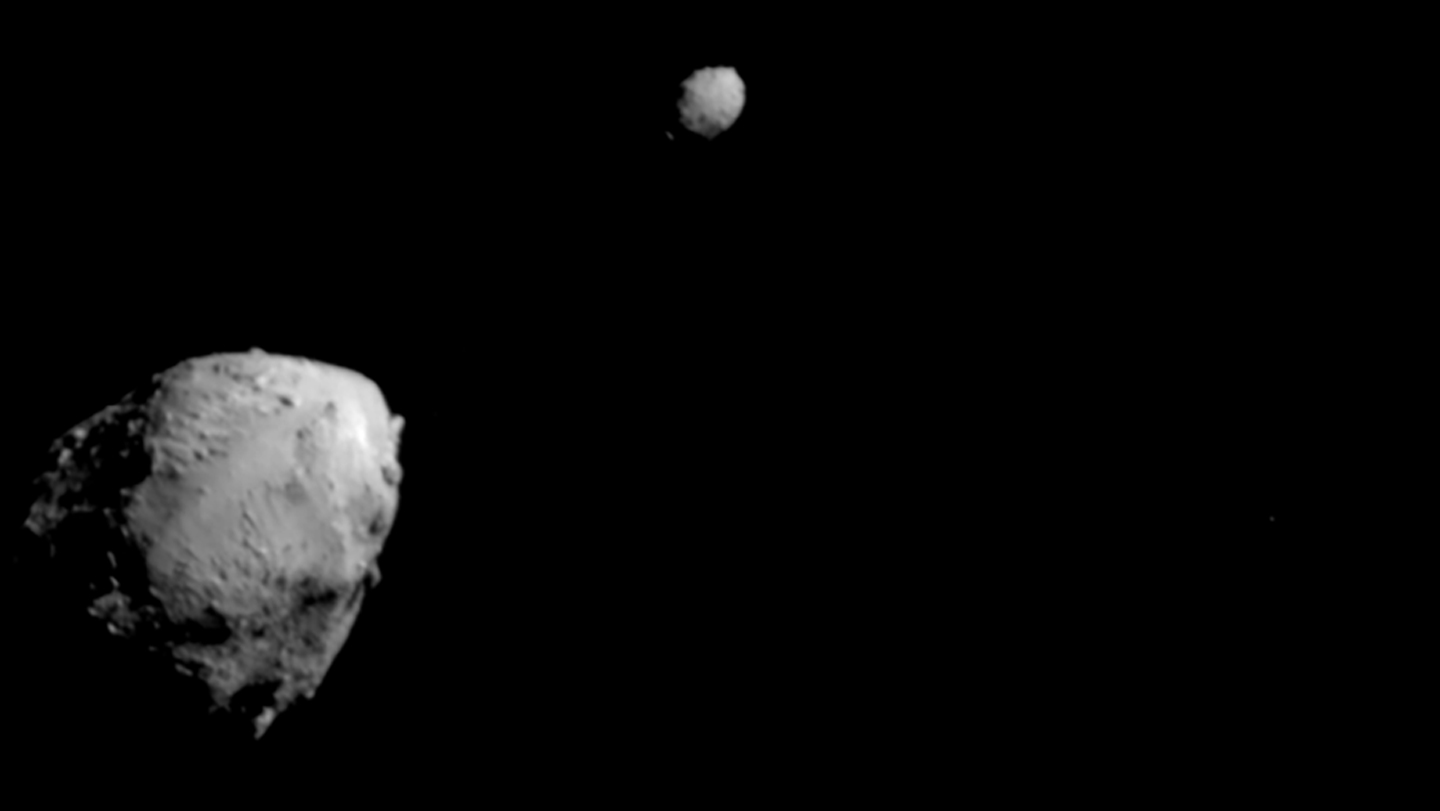
Imagine waking up on a September morning in 2022 and hearing that humanity just intentionally slammed a spacecraft into a space rock millions of miles away—and it worked! That’s the story behind NASA’s Double Asteroid Redirection Test, or DART, a bold mission that changed the course of history by altering the orbit of a tiny asteroid called Dimorphos. For the first time ever, human hands—well, robotic ones—slowed down the orbital dance of a celestial object around the Sun by more than 10 micrometers per second. That’s an incredibly tiny shift, like nudging a speeding car by less than the width of a hair, but in the vast emptiness of space, it could mean the difference between Earth dodging a potential cosmic bullet or getting smacked by one. This experiment wasn’t just a cool stunt; it proved that we can rearrange the stars—or at least the paths of rocky wanderers like asteroids—and opened up real possibilities for protecting our planet from future threats. Picture Dimorphos, a potato-shaped space pebble about the size of a football stadium, orbiting its bigger brother, Didymos, in a tight 12-hour loop. In a high-stakes game of planetary pinball, the DART spacecraft barreled into Dimorphos at breakneck speed, transferring enough energy to chop a full 32 minutes off that orbit right after the crash. Researchers noticed the change almost immediately, a heart-pounding confirmation that the idea could become reality. It’s the kind of triumph that makes you cheer for science, reminding us that with clever engineering and a dash of daring, we’re not just passengers on this spinning rock—we’re active guardians of our home.
But here’s where things get even more fascinating: not all the magic happened in that explosive impact. As Dimorphos got pummeled, chunks of it scattered like fireworks, some of them flying backward in the opposite direction of the asteroid’s original motion. That counter-kick acted like a gentle shove against Dimorphos, amplifying the slowdown we humans engineered. Plus, as Rahil Makadia, a sharp planetary defense expert from the University of Illinois Urbana–Champaign, explains, some of those rocks broke free entirely, escaping the gravitational pull of the Dimorphos-Didymos duo and carrying away a slice of their overall momentum. Think of it as a cosmic tug-of-war where the ejected debris stole a bit of the team’s “push,” subtly altering their shared path around the Sun. It’s a poetic reminder of how interconnected everything in space is—every pebble kicked up contributes to the ballet of orbits, and in this case, it made our intentional nudge even more effective. For Makadia, studying this debris fallout is like uncovering hidden layers in a scientific mystery novel, revealing just how unpredictable yet controllable asteroid behavior can be. It adds a layer of awe to what was already an epic feat, showing that nature itself joined forces with our technology to reshape these mini-worlds.
Now, to measure something this subtle in the endless expanse of space, scientists had to get creative, turning to a technique as old as ancient eclipses yet as modern as detective work. They used stellar occultations—moments when the asteroids passed directly in front of distant stars, temporarily blotting them out like a tiny, mobile moon causing a mini-eclipse. From our vantage point on Earth, these “blinks” are observable by telescopes anywhere, and they’re predictable enough to plan ahead for. By timing these events precisely and comparing them to pre-impact predictions, researchers could detect even the smallest drifts in the asteroids’ trajectory. It’s like watching a marathon runner and noticing they’ve slowed down just a fraction of a second over the course of miles. This method isn’t flashy, but it’s precise, relying on the steady march of stars and the sharp eyes of observatories scattered across the globe. For everyday folks like me, it evokes the wonder of gazing at the night sky and realizing that those twinkling lights are tools for uncovering secrets, reminding us that science turns the ordinary—stars shining as always—into extraordinary evidence.
And let’s not forget the unsung heroes in lab coats or backyard observatories: amateur astronomers played a starring role in this cosmic drama. Makadia recounts how one dedicated observer drove for two solid days each way into the vast Australian outback, braving isolation and the elements, just to capture a few crucial measurements. That’s dedication beyond the call of homework—it’s passion fueling discovery. From October 2022 through March of 2025, teams collected 22 such stellar occultations, piecing together data that revealed the asteroids’ orbit around the Sun had slowed by about 150 milliseconds overall. Imagine driving to the edge of nowhere for science; it’s the kind of story that humanizes heroes, showing that planetary defense isn’t just for rocket engineers but for anyone with a telescope and a drive. These measurements, shared across continents, paint a picture of global collaboration, where everyday stargazers become key players in keeping Earth safe. It warms the heart to think of that outback adventurer, laptop in hand, confirming our big-sky dreams.
Of course, none of this would matter if it weren’t for the bigger picture: preparing for asteroids that could pose real dangers down the line. Dimorphos and Didymos are harmless wanderers, posing no threat to Earth before or after DART, but this experiment is like a dress rehearsal for the main event. Knowing exactly how a kinetic impact—a fancy term for a spaceship smash—changes an asteroid’s path equips us to deflect any rogue rock that might be on a collision course. Makadia emphasizes that this knowledge turns theoretical “what-ifs” into practical “how-tos,” giving planetary defense a real toolbox instead of just wishful thinking. It’s empowering to realize that humanity is stepping up, not waiting idly for fate. And there’s more certainty on the horizon: the European Space Agency’s Hera spacecraft is en route to rendezvous with the duo later this year, bringing high-tech eyes to verify and expand on these findings. As it orbits and scans, Hera will confirm the orbit’s tweak and study the scars left by DART, adding layers to our understanding.
In the end, DART’s legacy isn’t just about stats and slowdowns; it’s about inspiring a sense of collective wonder and responsibility. We’ve proven we can alter the heavens, nudging asteroids like ancient gods, but with the humility of scientists learning from the stars they study. Every micrometer shifted reminds us of our place in the universe—not as conquerors, but as careful caretakers. Looking up at the night sky now feels a bit different, knowing amateur astronomers, dedicated researchers, and pioneers in spacecraft are all guardians. If a threatening asteroid ever looms, we’ll be ready, armed with lessons from Dimorphos’s altered waltz. It’s a human triumph, blending curiosity, perseverance, and a touch of bravery—making the infinite feel just a little more like home.