


The Mystery of Saturn’s Moons and Their Dramatic Past
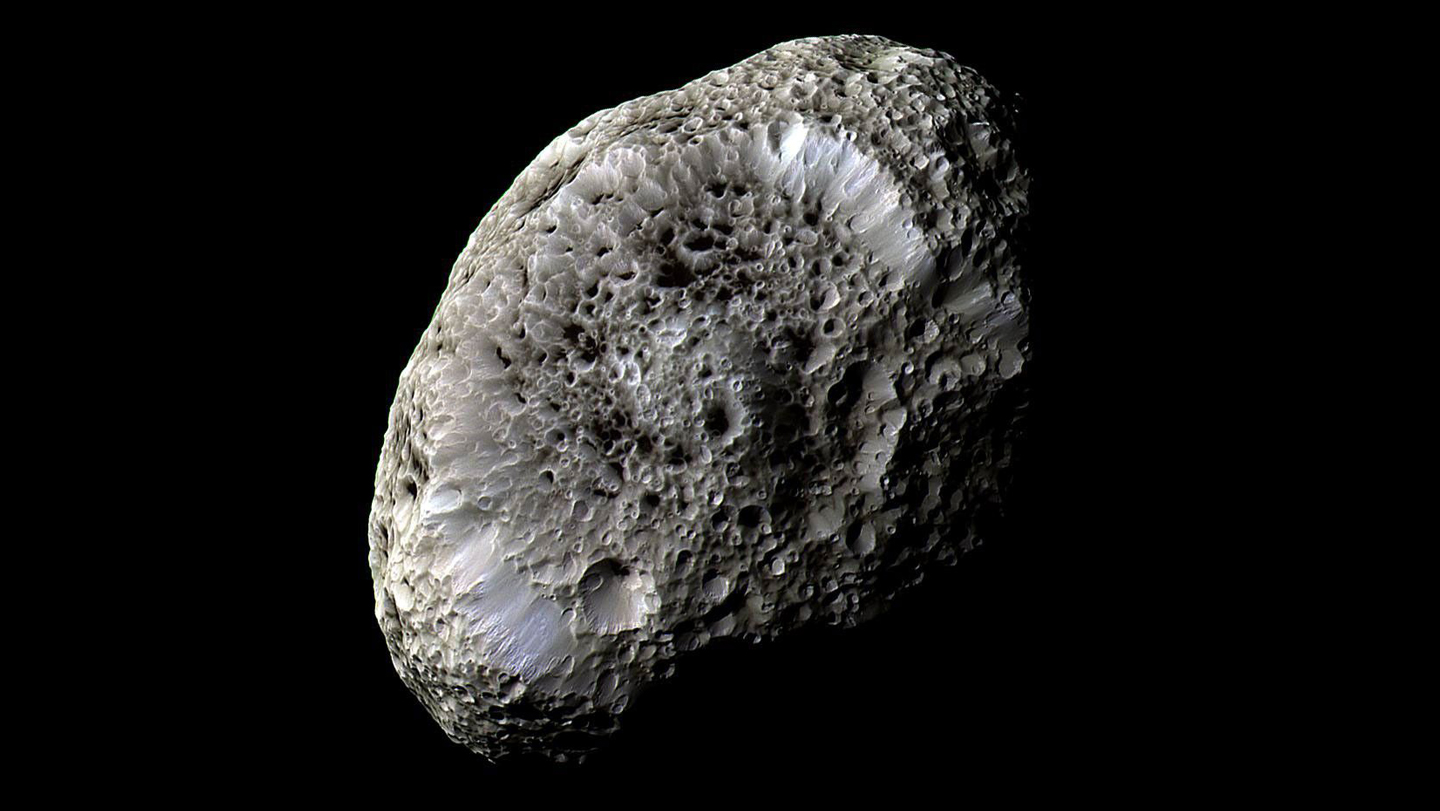
Imagine floating through the vast, icy expanse of space, gazing at Saturn’s majestic rings and its peculiar assortment of moons. Among them, Titan stands out as the largest—a hulking, atmosphere-shrouded world that’s like a mini-version of Earth. Then there’s Hyperion, the weirdest of the bunch: spongy, irregularly shaped, tumbling end over end like a deranged potato orbiting through chaos. How did these two end up this way, and why do their orbits tell a story of cosmic upheaval? Scientists like Matija Ćuk from the SETI Institute have been piecing together clues, suggesting that about 400 million years ago, a catastrophic collision reshaped Saturn’s family forever. Picture a doomed, mysterious moon—dubbed proto-Hyperion—crashing into Titan with enough force to sling debris into space, some of which stuck together to form the chaotic Hyperion we know today. This event didn’t just sculpt Hyperion; it set off a chain reaction that might explain why Saturn’s rings look so youthful compared to the planet itself.
At the heart of this tale is the subtle dance between Saturn and its neighbor, Neptune. For years, astronomers thought these two giants shared a rhythmic wobble—a spin-orbit resonance—where their spins and orbits synced like partners in a cosmic ballet. But data from NASA’s Cassini spacecraft, which orbited Saturn from 2004 to 2017, revealed cracks in this harmony. Saturn’s wobble was just a tad off, hinting that something had disturbed the peace relatively recently, in cosmic terms. Ćuk argues this disruption came in waves: first, the proto-Hyperion smash with Titan broke the resonance, freeing Saturn to wobble on its own. It’s like a domino effect where one tiny nudge cascades into planetary-scale changes. As Titan’s orbit shifted post-collision, becoming wider and more eccentric over eons, it interacted gravitationally with Saturn’s inner moons, stirring up a slow-motion calam ity that ground them down and birthed the glittering rings. This humanizes the story—it’s not just cold data; it’s about planets feeling each other’s pull, like sibling rivalries escalating into full-blown fights that redraw the family portrait.
Building on a 2022 idea from another team, Ćuk’s team used computer simulations to model the collision. They imagined proto-Hyperion, roughly the size of our own Moon, slamming into Titan, which survived intact but spun out of control, its orbit forever altered. The debris from this cosmic wreck coalesced into Hyperion, that bizarre, porous moon orbiting in a hazy, unpredictable path. But how does this tie into the rings? The chaos didn’t stop there. With Titan’s new trajectory widening over time, it nudged other moons into disastrous resonances, leading some to collide and disintegrate. These shattered remains became the raw material for Saturn’s rings, those sparkling, ephemeral bands that scientists estimate are less than 150 million years old. It’s a story of survival and creation: one moon dies to give life—or at least form—to others, reminding us how interconnected everything is in this solar system patchwork quilt.
Yet, not everyone agrees with this narrative. Planetary scientist Jack Wisdom from MIT offers a compelling counterpoint with his Chrysalis theory. He posits that a different extra moon, Chrysalis, once existed and was responsible for breaking the Neptune resonance, only to be torn apart by Saturn’s gravity into the rings. He ties it directly to the rings’ formation, seeing it as a simpler explanation. Ćuk, however, finds Hyperion as the smoking gun—a more direct clue because its chaotic tumble suggests recent, violent origins within the last 400 million years, aligning with the resonance breakup. Both theories acknowledge disruption was key, but their paths diverge: Wisdom’s is straightforward, like a single act that cleans up loose ends, while Ćuk’s is messier, a multi-step drama involving moon pileups and evolving orbits. It’s fascinating how science debates these scenarios, much like historians arguing over the causes of real-world events—each clue bringing us closer to the truth.
Critics of Ćuk’s idea point out that his model implies Saturn’s inner moons, like the cratered Mimas, should be younger than a few hundred million years. But Mimas’s pockmarked surface screams ancient age, not fresh from a recent reshuffle. Ćuk counters that the fiery chaos of the inner system could have filled Mimas with craters quickly, like a storm etching a landscape in hours rather than eons. Wisdom says the extra complexity in Ćuk’s scenario outweighs its strengths, preferring a neater fit for the data. Imagine being one of these researchers, huddled over simulations, tweaking numbers like a chef adjusting a recipe—knowing that each run could unlock secrets about our cosmic home. It’s human to feel the thrill of discovery, the frustration of uncertainty, urging us to keep questioning.
Ultimately, more simulations are needed to crown a winner between these theories—or perhaps blend them into something new. Ćuk muses about a “third variant” that marries both ideas, while Wisdom notes the debate pushes the field forward. This isn’t just about rocks and ice; it’s a reminder of how Saturn’s past collisions mirror the unpredictable twists of life on Earth—accidents turning into opportunities, chaos birthing beauty. As we look up at Saturn, gleaming in the night sky, we see echoes of its wild history, urging humanity to explore and understand the universe’s hidden stories. With tools like Cassini and future probes, who knows what dramas we’ll uncover next? The solar system feels a little less distant, a little more alive, when we weave these tales.