


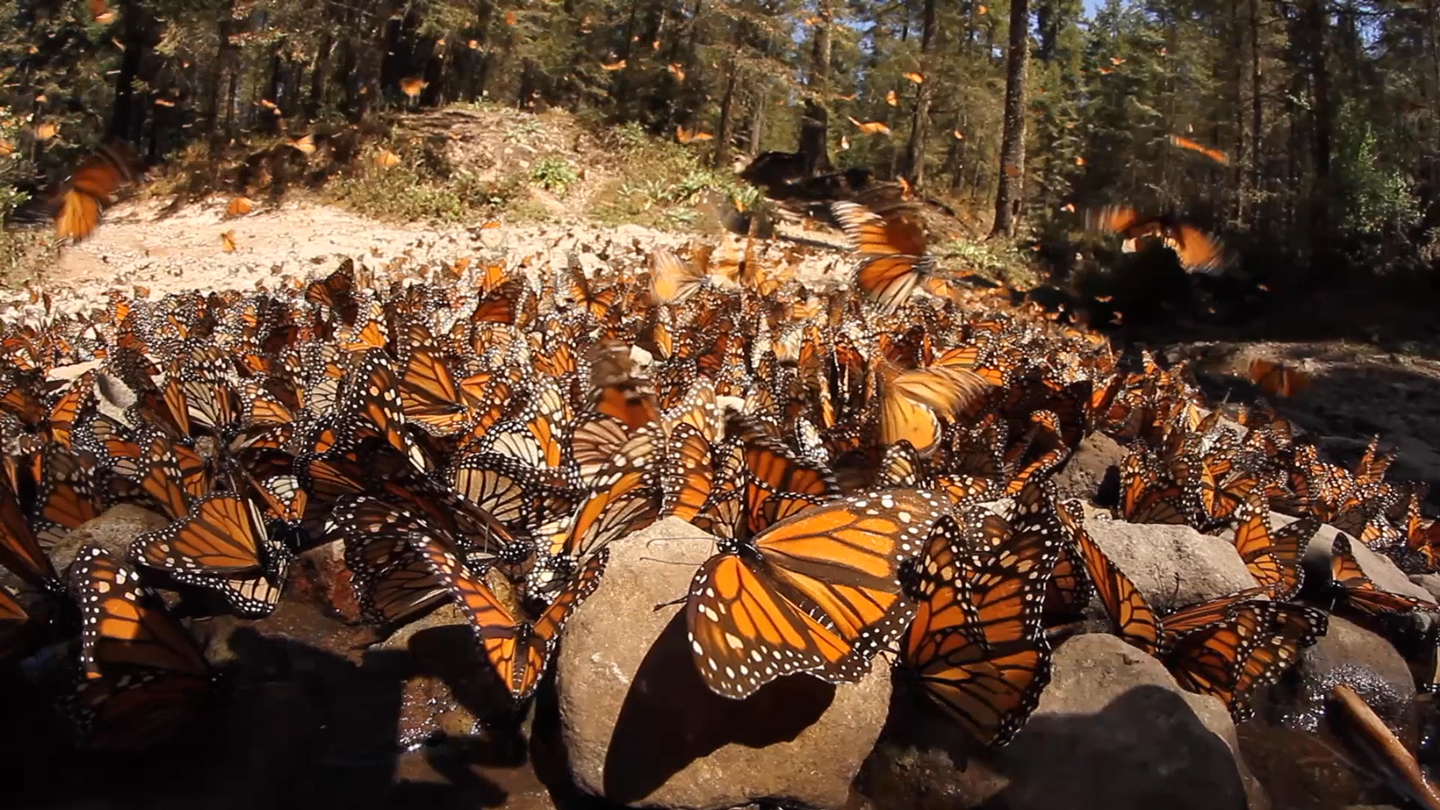
Imagine, if you will, the sheer wonder of a spectacle that unfolds every autumn across North America—a migration so awe-inspiring it feels almost mythical. Millions of monarch butterflies, those elegant creatures with their orange and black wings, embark on an epic journey from their summer breeding grounds in Canada and the United States, traveling thousands of kilometers southward to their winter sanctuaries in the mountainous forests of central Mexico. Picture them fluttering in synchronized waves, a living river of color against the sky, defying the chill of approaching winter. This isn’t just a simple flight; it’s a generational relay race, where one set of butterflies lays eggs, dies, and hands the baton to their offspring, who continue the trek. Each year, these fragile travelers cover distances equivalent to a human crossing from New York to Los Angeles multiple times over, following the blooming trails of milkweed, their lifeline plant that DOUBLEs as both a cradle for their eggs and a banquet for their hungry caterpillars. It’s a symphony of survival, orchestrated by instinct and the subtle cues of nature, where every flap of a wing tells a story of perseverance and adaptation. But now, in an era of warming skies and shifting seasons, this annual pilgrimage faces an unprecedented threat. Climate change, that invisible force reshaping our world, lurks like a shadow over their path, potentially turning this beautiful tradition into a fading memory. As temperatures rise and weather patterns morph, the very landscapes that have sustained this migration for millennia are changing, raising questions about whether these butterflies can keep up. Researchers and enthusiasts alike watch with bated breath, knowing that the fate of these winged wanderers mirrors our own struggle to protect the delicate balance of life on Earth. In the hive of scientific inquiry, teams are scrutinizing data, piecing together how global heating might unravel the threads of this extraordinary journey.
The rhythm of the monarchs’ migration is as predictable as the turning of seasons, yet infused with the poetry of life’s cycles. Come spring and summer, as temperatures bask the northern landscapes, the butterflies awaken from their winter slumber in Mexico’s oyamel fir forests, where they cluster in dense, shimmering clouds that cloak the treetops like living autumn leaves. This northward return isn’t a solo endeavor but a multi-generational odyssey spanning months. The original winter survivors, having endured the cold, mate and lay eggs on milkweed plants sprouting along the route. Their progeny—not the butterflies we saw migrating south, but the next generation—emerge as chubby caterpillars, feasting on the plant’s toxic leaves that make them unpalatable to predators, their bodies accumulating a bitter chemical armor. After metamorphosis, these young adults take flight, continuing the push north, drawn by an innate compass toward fresh milkweed expanses where they, too, will reproduce before dying. This relay ensures that by summer’s peak, monarchs from Mexico’s highlands reach as far as southern Canada, painting fields and meadows with their vibrant presence. Along the way, they navigate diverse terrains: lush midwestern prairies, rugged Appalachian hills, and wide-open Great Plains, guided not just by the sun’s position but by Earth’s magnetic field, a feat that still marvels amateur astronomers and seasoned biologists. Yet, this journey’s grace belies its fragility. Milkweed—a plant once abundant in roadside ditches and forgotten farms—is dwindling due to modern agriculture’s fervor for herbicides and landscaping’s preference for tidy yards. Urban sprawl claims their stopover sites, transforming wild sanctuaries into parking lots and strip malls. And as climate change alters rainfall and blooms, the milkweed timetable shifts unpredictably, sometimes flowering too early or too late, leaving monarchs scrambling for sustenance. Observers report fewer clusters in backyard gardens, their once-familiar flutter now a rare treat, reminding us of how interconnected our actions are with these tiny travelers.
Sadly, the monarch migration isn’t just threatened by habitat loss; it’s confronting a cascade of crises that have seen their numbers plummet to alarming lows. Since the 1990s, populations clustering in Mexico’s wintering grounds—once numbering nearly 700 million strong, enough to weigh as much as a Boeing 737—have dwindled by over 80 percent, a statistic that stings like a cold wind. Extreme weather events, exacerbated by climate chaos, play a cruel role: harsh winters in the north freeze resting sites, while sudden freezes or droughts in the south desiccate forest canopies critical for shelter. Pesticides, those silent assassins sprayed on crops to protect harvests, linger in the air and soil, contaminating food sources and weakening the butterflies’ already gossamer wings. Parasites too have surged; microscopic worms hitch rides on migrating monarchs, sapping their vitality and turning once-robust travelers into feeble ghosts. Citizen scientists, those unsung heroes armed with binoculars and notebooks, have witnessed the toll firsthand—orchards in the Midwest that used to buzz with activity now echo with silence, and September skies devoid of the flamboyant orange rivers. Amid this decline, stories emerge of resilience: Communities planting milkweed corridors to bridge the gaps, schools educating children on hosting monarch waystations, and dedicated researchers tagging individual butterflies to trace their paths, each tagged wing a beacon of hope. Yet, the overarching dread of extinction looms, a mirror to our own vulnerabilities as we grapple with a warming planet. Conservationists warn that without swift action—to curb emissions, restore habitats, and foster empathy for these winged kin—future generations might only read about this migration in history books, a poignant reminder that apathy toward nature’s wonders can dim the colors of our shared world.
Enter the vanguard of science, stepping into the fray with models and projections that illuminate a daunting future. In a study published in PLOS Climate on February 25, a team led by biologist Carolina Ureta and conservationist Víctor Sánchez Cordero from Mexico’s National Autonomous University employed advanced computer simulations to forecast how climate change might redraw the map of monarch suitability in Mexico. By blending data on climate projections, biological needs, and environmental variables, they traced the shifting sands of ideal habitats, where milkweed thrives and monarchs can securely overwinter amid the oyamel firs’ protective embrace. Their findings whisper of potential devastation: By 2070, under optimistic scenarios that account for moderate warming, suitable overwintering grounds could shrink from about 19,500 square kilometers to roughly 8,000—a loss equivalent to vanishing entire ecosystems overnight. More alarming runs, factoring in unchecked emissions and extreme shifts, paint an even grimmer picture, with habitats fracturing into isolated pockets, pushed southward from current sites in Michoacán and Mexico State toward warmer climes. This southward drift isn’t arbitrary; as aerosols, rainfall, and temperatures recalibrate monsoon patterns and elevate baselines, milkweed’s range follows, tugging the butterflies farther into unfamiliar territories. Researchers like Ureta envision a scenario where the migration route elongates, transforming a straightforward 4,000-kilometer circuit into a more torturous labyrinth, demanding greater energy expenditure that could burden already stressed populations. Interestingly, citizen observers have reported anomalous behaviors—monarchs lingering in northeastern or central Mexico rather than pressing forward, hinting at an evolutionary whisper: perhaps some are opting to stay put, especially since not all monarch populations globally undertake such epic treks; Chileans, Kiwis, and Europeans linger year-round in milder zones. These simulations don’t just predict decline; they challenge us to think holistically, emphasizing how interconnected phenomena like deforestation and pollution amplify climate’s toll, turning passive observers into activists.
The implications ripple outward, touching on the very essence of what defines these insects’ migratory spirit. Ureta poses a profound question: Is the species itself endangered, or merely its wanderlust? While monarchs might persist as residents in adjusted niches, the legendary migration—the heartbeat of their identity—could fizzle into folklore. That extended journey southward, followed by a northward push through newly fragmented habitats, could siphon vital energy reserves, leaving butterflies too depleted to breed prolifically or evade predators. Wing size emerges as a subtle sleuth in this detective story; migratory populations sport broader spans for efficient long-haul flights, while resident kin elsewhere boast smaller wings suited to short hops. Monitoring these traits in Mexican overwinterers might reveal whether climate pressures are breeding a divide—some venturing north as tradition dictates, others electing sedentary sanctuary closer to home. Ecologists fret over cascading effects: Fewer migrants mean fewer pollinators for northern ecosystems, where monarchs fertilize wildflowers and crops alike, their “kiss” of pollination sustaining biodiversity wallets. In human terms, imagine the loss of cultural icons like the Thanksgiving turkey or Christmas parades; theVOID of an empty autumn sky disrupts our sense of seasonality, dimming the wonder that drew poets and painters alike to these fleeting visitors. Yet, among the gloom, there’s a spark: Simulations also highlight mitigation windows, where aggressive reforestation, emission cuts, and milkweed networks could stabilize routes. It’s a call to action, urging us to cherish these butterflies not as mere insects but as ambassadors of balance, teaching that protecting their flight paths safeguards our own voyage through an uncertain future.
Ultimately, the tale of the monarch migration is a tapestry of hope interwoven with hardship, urging humanity to embrace stewardship before it’s too late. As we stand at the crossroads of progress and preservation, the butterflies’ plight serves as a mirror, reflecting how our choices—driving less, planting more, advocating fiercely—can either extinguish or ignite their flame. Citizen science flourishes, with apps and community gardens connecting everyday people to these aerial nomads, fostering a global empathy that transcends borders. Researchers like Sánchez Cordero and Ureta continue refining models, seeking answers in the wings of tagged individuals buzzing northward, their data a lifeline for policy changes that could spare forests and curb emissions. In the grand narrative of Earth’s biodiversity, monarchs remind us that resilience demands collective effort, not solitary survival. By honoring this migration, we honor life’s intricate dance, ensuring that future autumns still blush with orange rivers against the sky—a living testament to compassion’s power to defy the tides of change. So, the next time you spot a monarch alighting on a flower, pause and ponder: It’s not just a bug; it’s a traveler, a miracle, and a plea for us all to fly a little higher.