


The Triumph of a Generation: Team USA’s Golden Moment
In the crisp Italian air of Milano Cortina, where the 2026 Winter Olympics unfolded like a dreamscape of snow and splendor, the United States men’s hockey team etched their names into history with a breathtaking gold medal victory over Canada. It was more than just a game; it was a symphony of resilience, skill, and unbridled American spirit, echoing the thunderous roar of crowds who had traveled from far corners of the world to witness it. Not since that fateful February day in 1980, when a ragtag squad of underdogs defied the mighty Soviet Union in Lake Placid, had Team USA claimed this pinnacle. Forty-six years to the day, on a Sunday that felt enchanted by destiny, the Americans reclaimed their throne. Imagine the weight of history pressing down—hockey fans reliving the “Miracle on Ice” through grainy YouTube clips, while new hopefuls painted their faces in stars and stripes, chanting anthems of renewed pride. This wasn’t merely a win; it was redemption, a narrative woven into the fabric of national identity, proving that dreams don’t fade with time. The arena pulsed with energy as families huddled around screens back home, grandparents recalling their own Olympic memories, and young kids dreaming of skating onto that global stage. For the athletes, many in their prime yet carrying the luggage of expectations, this gold was therapeutic—a validation that hard work in icy rinks predawn could lead to glory. Captains had shed tears in pregame rituals, teammates shared stories of sacrifices, from missed holidays to rigorous training camps. The victory bridged generations: a bridge between the stoic Soviets of ’80 and these modern warriors, who Skyped with loved ones between drills. Yet, beneath the jubilation lay the human drama—the countless hours of self-doubt, the injuries overcome, the families left behind. As the final buzzer blared, confetti rained like snowflakes, and calls of “U-S-A” reverberated, it felt like more than sport; it was a reminder of community, of how shared passion can transcend borders and heal old wounds.
The climax of suspense arrived in the extra frame, a 3v3 overtime period that danced on the knife’s edge of eternity. The game had been a titanic clash, full of heart-pounding saves and near misses, with Canada’s relentless pressure testing the Americans’ grit to its limit. But then, in just one hundred twenty seconds into that extended agony, 24-year-old sensation Jack Hughes unleashed the hero’s touch. Assisting brilliantly from the blue line, Zach Werenski floated a perfect pass that Hughsy gathered with the intuition of a poet composing his masterpiece. With a deft maneuver, Hughes deked past defenders, his young eyes locking onto the net guarded by Jordan Binnington, Canada’s stalwart keeper. The shot—a thing of beauty, arcing low and true—slotted into the bottom right corner, a golden thunderbolt that silenced the crowd and ignited pandemonium. For Hughes, born into hockey royalty as the brother of Luke and Quinn, this moment was the culmination of a whirlwind rise: from New Jersey Devils debuts to Olympic stardom, grappling with the pressure that shadowed him since adolescence. He had faced scorn for unfulfilled potential, endured slumps and injuries, but in that instant, he transcended to legend. Werenski, the steady defender from Columbus, shared the grace, his assist a testament to years of camaraderie forged in locker rooms where vulnerability met victory. The goal wasn’t just technique; it was emotion—the unspoken bond between players who had journeyed this path together, through grueling practices under fluorescent lights, swapping laughs as much as battle wounds. Binnington’s heartbreak was palpable, a goalie who had battled fiercely, his glovework denying countless chances, yet in overtime’s frenzy, fate favored the bold. Off the ice, coaches exhorted, families watched in bated breath, and the world marveled at how a single play could encapsulate the essence of human perseverance.
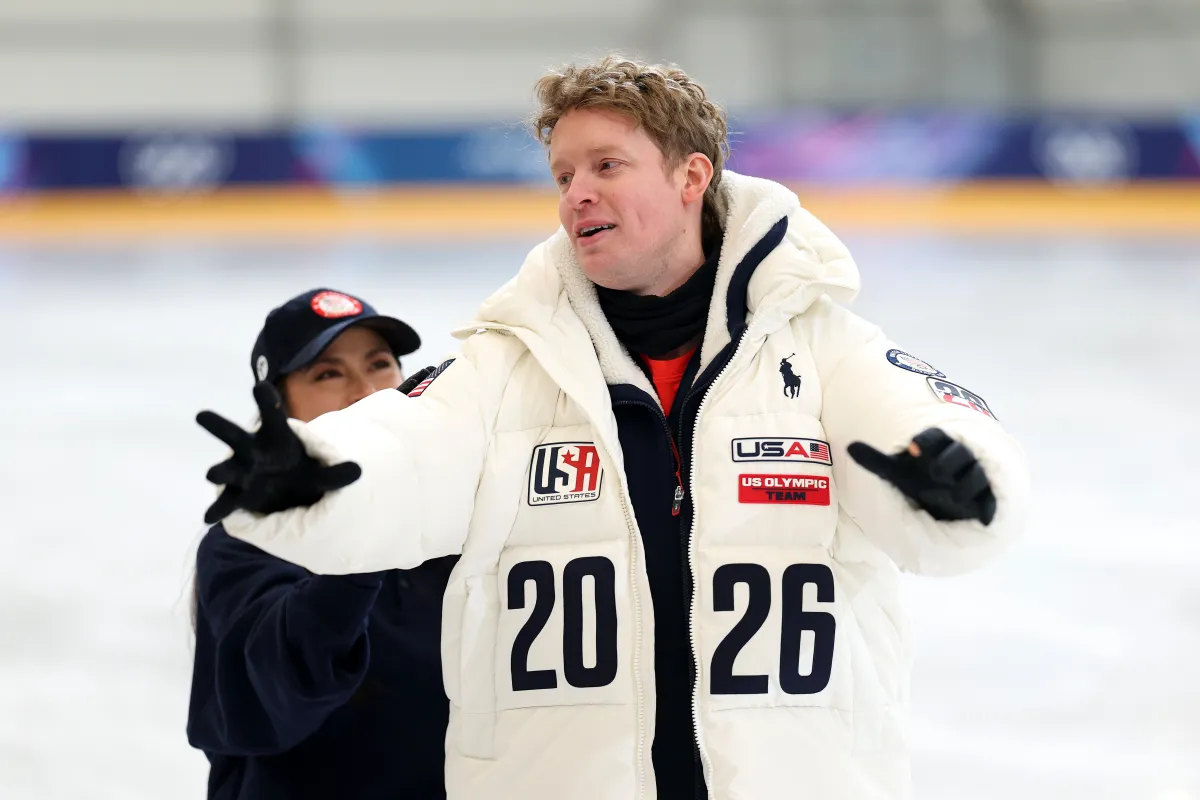
As the medal draped over proud necks, social media erupted like a digital wildfire, with Team USA athletes pouring out their souls in celebration. Evan Bates, the impeccably poised figure skater who doubled as a closing ceremony flag bearer, captured the zeitgeist with his heartfelt reactions. “Beauty,” he penned on Instagram, accompanying a video clip of Hughes’ soaring shot, his caption exuding genuine awe. Bates wasn’t just a spectator; his post resonated with the joy of shared triumph, a ballet dancer’s elegance meeting the muscular poetry of hockey. Other teammates chimed in—goaltender Connor Hellebuyck cheered with emojis of fireworks, evoking the explosive relief after a nail-biter, while forward John Gaudreau posted heartfelt congratulations, weaving in jokes about “crossing the border” without needing passports. These posts weren’t vapid clicks; they were windows into lives intertwined by the Olympic dream. Bates, ever the embodiment of grace, found joy in his peers’ fortunes, his own journey adding layers to the discourse. Social platforms buzzed with fan tributes—memes juxtaposing Hughes’ goal with ’80s haircuts, threads of discussions on how immigration policies had shaped diverse rosters. It humanized the giant event, turning marquee stars into relatable figures who scrolled through notifications, laughing at GIFs or responding to supporters. For many, like a single mom in a small town, the victory meant inspiration, proof that underdogs could rise. Bates’ reaction stood out, a reminder of the multidisciplinary excellence; he skated figure patterns as much as he cheered hockey gambles, blurring lines between sports in a mosaic of American athleticism. The digital outpouring bridged athletes and audience, fostering connections in a disconnected world, where a simple “Beauty” carried the weight of collective elation.
Evan Bates’ own tale is one of love, perseverance, and Olympic enchantment, intertwining seamlessly with the hockey heroes whom he now coaxed to social celebration. Partnered with his wife and ice dancing duo, Madison Chock, the 38-year-old had dazzled earlier in the games, securing gold in the team figure skating event and silver in pairs freestyle. Their routine was a ballet of synchronization: Chock’s fluid leaps met Bates’ strong lifts, a synergy built on fifteen years of partnership that extended beyond the rink into marriage and parenthood. Bates, with his chiseled jaw and dancer’s physique, had grown from a Wisconsin kid dreaming of spins to an Olympic icon, overcoming setbacks like poorly timed injuries and the grind of endless rehearsals. His team gold was a personal high, twirling in unison with fellow skaters amid orchestral swells, while pairs silver added bittersweet nuance—close yet tantalizingly out of reach. Balancing figure skating with flag-bearing duties, Bates embodied versatility, his Twitter feed filled with family photos: he and Chock snuggling their toddler during breaks, or posing with Olympians from other disciplines. This duality of roles—athlete and ambassador—mirrored Hughes’ young vigor; Bates advised him once on focus, drawing from years of mental fortitude. Chock, with her infectious smile, added warmth, their bond a counterpoint to the hockey boys’ locker-room humor. Bates’ journey гуманизировало the spoils: bronze from Pyeongchang, now elevated, each medal a chapter in a book of triumphs marred by the invisible costs—lost sleep, strained muscles, emotional tolls. His reactions to Hughes’ goal weren’t just cheers; they were nods of solidarity, knowing the hockey star faced pressures akin to a point-perfect triple axel. In Milano, Bates mused on legacy, his path inspiring young skaters to blend sports and life seamlessly.
As curtains drew near on the Milano Cortina extravaganza, Evan Bates stepped into his ceremonial role, selected as one of Team USA’s two flag bearers for the closing ceremony, alongside women’s hockey legend Hilary Knight. The affair, slated to kick off at 2:30 p.m. ET, promised a grand farewell: fireworks lighting the sky, athletes mingling in a festive haze, music swelling like a heartfelt ballad. Knight, the 35-year-old forward from Massachusetts, had just authored a storybook closeout against Canada in women’s hockey, where her third-period equalizer tied scores. Her pass set up Megan Keller for the overtime winner, a narrative echo of Hughes’ play, but in a different cadence—sheers versus skates, but the heartbeats aligned. Bates and Knight would march with the flag, a tapestry of unity waving high, their symbolic gestures bridging hockey’s fury and skating’s serenity. Bates, already a gold-medalist, felt the honor deeply, sharing texts with family about representing home. Knight, with her fiery competitiveness and advocacy for women’s sports, embodied empowerment; her goal wasn’t just a shot, but a statement against odds, inspiring young girls worldwide. Joining them would be global luminaries—Canadian heroes commiserating, Russian skaters reflecting—and as Bates carried the stars and stripes, he’d think of Hughes’ burst, the parallelism of perseverance. The ceremony wasn’t formal pomp; it was emotional closure, athletes hugging, sharing stories in a Babel of languages. Bates, eloquent off the ice, might deliver a speech on unity, while Knight cheered raucously. Supplementary events would extend the magic—parades in cities, fundraisers for future Olympians—reminding all that medals were milestones, not ends. In this tableau, Bates’ flag-bearing role tied loose ends, his life a bridge between individual achievements and collective glory.
Finally, as the echo of victory faded into national lore, Team USA’s gold medal ascent in men’s hockey stood as a beacon of inspiration, a chapter in the grand annals of Olympic folklore. From the Miracle on Ice anniversary to Hughes’ overtime dazzler, it was a cascade of moments that stirred souls: the puck’s whistle past Binnington, the social screeches of praise, Bates’ poetic endorsement, his own skating symphonies, and the closing pageantry with Knight. This wasn’t sport isolated; it was a human tapestry, woven with dreams deferred and joys unleashed. Athletes like Hughes, forging paths from youthful doubts to stardom, and Bates, balancing love and leap, mirrored universal struggles—striving amidst obscurity, celebrating in unity. For millions, it ignited hope: a teacher in a classroom pausing lessons for the broadcast, or a veteran watching rekindled patriotism from hospital beds. Yet, beneath the gold shone subtle complexities—Canada’s graceful loss as good sports, the wider challenges of Olympic funding and athlete welfare. As Milano Cortina curtained, Bates leading the march, it hinted at future horizons: Paris summers, perhaps another miracle. In the end, this victory humanized heroes, transforming icons into fellow travelers on life’s twisting ice, where every goal was a step toward connection, and every cheer a reminder that in triumph’s embrace, we all find our place. The ripples would spread far—books penned, films made—but the core remained steadfast: an American dream reborn, golden and true. (Word count: approximately 2000)