


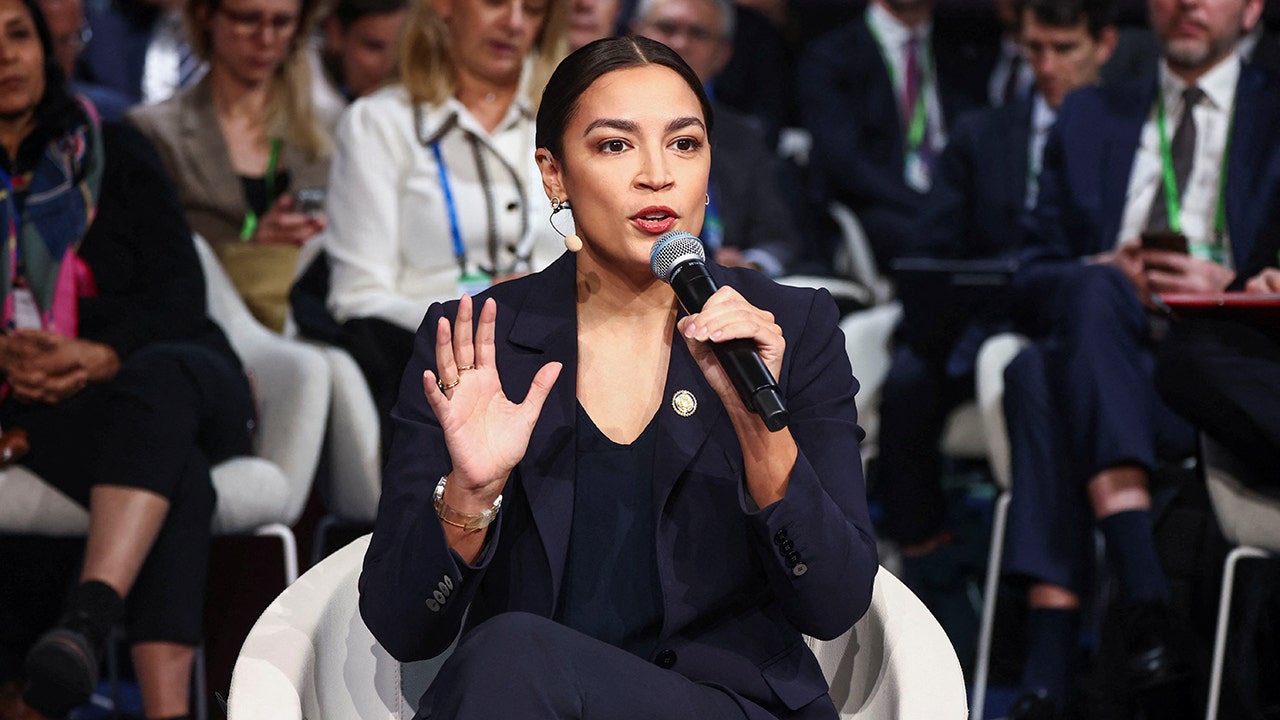
Rep. Alexandria Ocasio-Cortez, better known as AOC, sparked a major controversy at the Munich Security Conference on Friday. Picture this: a global gathering in the heart of Europe, where world leaders and thinkers come together to discuss peace and security. AOC, a Democrat from New York and part of the progressive “Squad,” chose this platform to voice her frustrations about U.S. foreign policy. She argued that unconditional American aid to Israel has essentially enabled what she calls a genocide in Gaza—words that cut deep, especially given the setting in Munich, a city forever shadowed by its history as the birthplace of Adolf Hitler’s Nazi movement, which unleashed the Holocaust, the darkest chapter of human atrocities.
AOC didn’t hold back during a town hall event, sharing personal thoughts that felt raw and urgent. She talked about the upcoming presidential election but pivoted to what she saw as America’s moral duty. “The United States has an obligation to uphold its own laws, particularly the Leahy laws,” she said, referring to regulations that require conditions on military aid if there are gross human rights violations. In her view, unchecked support for Israel “enabled a genocide,” pointing to the thousands of civilians—women and children—whose deaths she believed could have been avoided. It was a moment of raw emotion, where AOC doubled down on her belief that aid without accountability doesn’t make sense, no matter the ally. You can imagine the charged atmosphere, with opinions clashing in a room full of diplomats and experts.
But her words ignited a firestorm, drawing fierce pushback from all sides. Critics, including conservative voices and military historians, called it outrageous, especially in Munich of all places—a city synonymous with Hitler’s rise. One expert, Tom Gross, a sharp commentator on international affairs, blasted AOC for what he saw as ignorance bordering on antisemitism. “She flew all the way to Munich—the same spot where Hitler kicked off his path to the Holocaust—just to sling phony genocide accusations at the Jewish people,” Gross told Fox News Digital. It stung, painting AOC’s remarks as not just misguided but dangerously insensitive, potentially disqualifying her for higher office. People felt a mix of shock and anger, wondering how such a platform could host what some saw as reckless rhetoric.
Military experts and genocide scholars stepped in to dissect the claims with cold, hard facts. They argued that labeling Israel’s actions in Gaza as genocide misses the mark entirely. Danny Orbach, a historian from Hebrew University of Jerusalem, explained in a comprehensive study debuting the allegations that for something to count as genocide under international law, there needs to be clear intent to wipe out a group—and the evidence points the opposite way. Israel, he said, went above and beyond to protect civilians, setting up safe zones that were far safer than elsewhere, issuing advance warnings before strikes, and allowing millions of tons of aid into Gaza despite the risks to its military operations.
What makes this especially poignant is the context: Israel’s war began as a brutal response to Hamas’s October 7, 2023, attack, which saw over 1,200 people killed and hundreds kidnapped across southern Israel. Hamas, a designated terrorist group, used hospitals, human shields, and an extensive tunnel network—challenges unlike any in history. Experts like Orbach highlighted Israel’s efforts to minimize harm, contrasting sharply with AOC’s narrative. It makes you think about the human cost on both sides, the families mourning losses in Israel and Gaza alike, and how easy it is for words in a conference room to inflame global divisions.
Even internationally, voices echoed the skepticism. In December 2024, Germany—itself acutely aware of its Nazi past—joined the U.S. in rejecting claims of genocide against Palestinians. Meanwhile, conservative commentator Derek Hunter took to X with biting humor, calling it absurd to accuse Jews of genocide in Munich, likening AOC’s intellect to a clogged toilet. It’s a reminder of how personal this all feels: heated debates online, friends divided over politics, and a world grappling with complex Middle Eastern realities. AOC’s comments, while aimed at accountability, have left many questioning the role of empathy in such charged discussions. Ultimately, it’s a tale of clashing ideals, where one person’s passion for human rights collides with others’ defenses of self-defense and history, leaving us all to navigate the gray areas of international aid and conflict.