




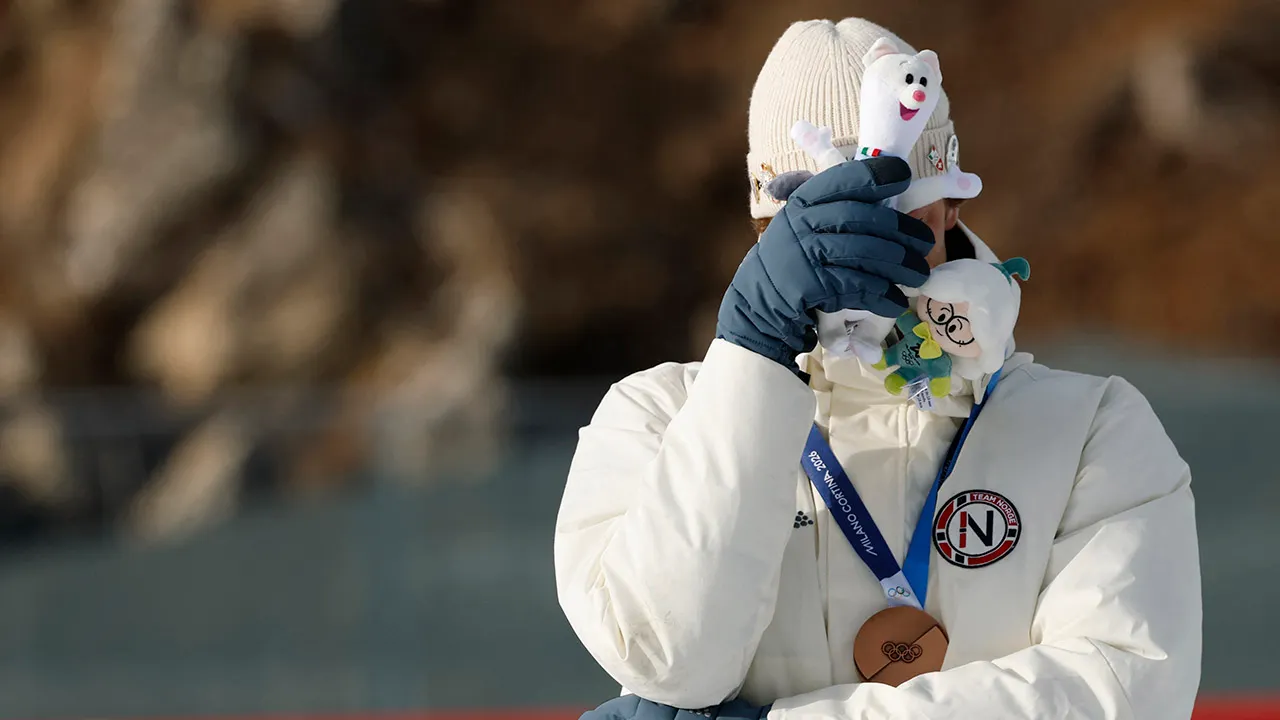
Imagine stepping onto the podium at the Olympics, the roar of the crowd echoing in your ears, a bronze medal gleaming around your neck—a moment of triumph meant for joy and celebration. But for Norwegian biathlete Sturla Holm Laegreid, this victory in the Milan-Cortina Winter Olympics became anything but straightforward. In the glow of his achievement, he chose to bare his soul, confessing a painful secret that overshadowed the glory: he had cheated on his ex-girlfriend, a decision he now deeply regrets. This wasn’t just a sports story; it was a raw, human tale of love, remorse, and the messy intersection of personal life and public success. As he stood there, tears streaming down his face, Laegreid transformed what should have been a day of national pride into a confessional that captured the world’s attention. Yet, just days later, in a heartfelt apology, he acknowledged the mistake of sharing such a private heartache publicly. “I deeply regret sharing this personal story on what was a day of celebration for Norwegian biathlon,” he said Wednesday through the Norwegian team’s statement. He admitted he wasn’t thinking clearly, perhaps weighed down by emotional turmoil that had been building for weeks. It was an apology that humanized him further, not as an infallible athlete, but as someone grappling with life’s tougher choices. This act of vulnerability resonated deeply, reminding us all that even Olympic heroes are just people, prone to errors that echo far beyond the ski slopes.
The confession itself had unfolded dramatically on the day of the men’s biathlon relay. Laegreid had just secured Norway’s bronze medal, a feat that placed him among the elite. But instead of basking in the accolades, he approached the media with a heavy heart, his voice breaking as he spoke to the Norwegian broadcaster NRK. He was distraught, visibly trembling, and his words carried the weight of someone who had been carrying this burden for months. “There’s someone I wanted to share it with who might not be watching today,” he began, his eyes welling up. He described meeting “the love of my life”—a woman he called the most beautiful and kindest person in the world—six months earlier. For three months, their relationship bloomed, but then came the betrayal. “Three months ago, I made my biggest mistake and cheated on her,” he admitted, the admission hanging in the air like a fog. It was raw, unfiltered emotion; he shared that he had confessed to her about it a week prior, and that week had been the worst of his life. Watching him after the race, hugging friends tightly as if they were lifelines, one could feel the isolation he must have felt—a young man celebrating internationally while his personal world crumbled at home. In that news conference, surrounded by reporters, he doubled down on his decision to go public. “It was the choice I made,” he explained, his words reflective of a broader philosophy on life. “We make different choices during our life, and that’s how we make life.” Through the broadcast, he hoped she might see it and understand the depth of his love, perhaps bridging the chasm he had created. It was a gamble, a desperate plea wrapped in public vulnerability, painting a picture of a person who, in the heat of the moment, prioritized emotion over privacy.
What drove Laegreid to such a public display? Part of it seemed rooted in the intense emotions of the Games, where athletes channel adrenaline, focus, and personal stakes into every stride and shot. Sport, Laegreid noted, had shifted in significance for him lately. Normally a source of pure elation, it now felt incomplete without her by his side. “Yes, I wish I could share it with her,” he said amid the tears, his voice cracking under the weight of longing. He poured out his adoration, insisting he only had eyes for her now, even as he braced for judgment. “There are probably many who look at me with different eyes,” he acknowledged, but his gaze was fixed on redemption. This wasn’t just regret over cheating; it was a realization that the fame of the Olympics amplified his personal failings. In sharing his story, he became a symbol of the human struggle—how ambition and success can sometimes blind us to what truly matters, like loyalty and trust. His friends offered hugs, but one imagines the solitude of facing your “biggest mistake” alone in a sea of cameras and congratulations. It humanizes the biathlon world, showing that behind the goggles and rifles are athletes with hearts that can break, influencing their performances and public personas. Laegreid’s tears were not just for the medal; they were for a love he feared losing forever, a poignant reminder that even at the pinnacle of sport, personal turmoil doesn’t take a backseat.
By Wednesday, the tides had turned. Realizing the unintended consequences of his openness—like stealing the spotlight from teammate Johan-Olav Botn, who won gold—Laegreid issued that apologetic statement, pulling back from the narrative he had ignited. He expressed sorrow for airing dirty laundry on a day meant for collective joy, apologizing not only to the team but to his ex-girlfriend, who was unwittingly thrust into the media’s glare. “They also go to my ex-girlfriend, who unwillingly ended up in the media spotlight,” he wrote. “I hope she is doing well.” It was a gesture of kindness amid his remorse, acknowledging the hurt he had caused. He couldn’t undo the confession, but he vowed to move on, focusing back on the Olympics and ceasing further commentary. “I will now put it behind me and focus on the Olympics. I will not answer any further questions about this.” This shift felt like a maturation, a willingness to compartmentalize the personal from the professional. In the vast, competitive arena of global sports, Laegreid’s story became a lesson in boundaries—how public figures must navigate the line between authenticity and oversharing. It added a layer of depth to his public image, transforming him from a viral sensation into a man owning his flaws, inspiring empathy rather than scorn. Viewers tuning in saw not just an athlete, but a relatable figure facing the fallout of impulsive decisions, proving that real growth often comes after vulnerability.
Meanwhile, the ex-girlfriend’s voice added a crucial perspective to this unfolding drama, humanizing the narrative from the other side. In an anonymous interview with Norwegian outlet VG, she spoke candidly about the pain of being pulled into this public spectacle. “It is hard to forgive,” she admitted, even after his grand, televised declaration of love. The betrayal cut deep, and she emphasized that she hadn’t chosen this exposure; it was inflicted upon her without consent. “I did not choose to end up in this situation, and it hurts to have to be in it.” Despite the turmoil, she remained in contact with Laegreid and had made her feelings clear to him, underscoring the complexity of forgiveness in the wake of such personal wounds. Yet, amid the heartbreak, she expressed gratitude for the support she received. “(I am grateful) to my family and friends who have embraced me and supported me during this time. Also to everyone else who has thought of me and sympathized without knowing who I am.” Her words painted a picture of resilience, a young woman rebuilding her world away from the spotlight. It fairymology the story, reminding us that victims of infidelity often bear invisible scars, their privacy invaded by the choices of others. Laegreid’s actions, while well-intentioned perhaps, highlighted the unilateral power dynamics in public relationships, where one person’s confession can reverberate widely. In her quiet strength, she became a quiet hero of the tale, her story a testament to the enduring human capacity for support and self-preservation.
As the Milan-Cortina Olympics continued, Laegreid’s episode left an indelible mark on the Games, blending athletic prowess with profound human emotion. It sparked conversations about mental health in sports, the pressures that lead to poor decisions, and the ethics of public confessions. For Laegreid, the focus now shifted back to shooting and skiing, to competing for his team’s success. His rival, American Ashley Farquharson, captured the world’s attention with a rare luge medal, but Laegreid’s story lingered, a reminder that Olympic triumphs are just one facet of an athlete’s life. The future Winter Olympics in 2026 loomed ahead, but for now, this bronze medalist seemed poised to channel his emotions into victory. In the end, his journey—from impulsive outburst to regretful apology—offers a blueprint for humanity: we all stumble, but it’s in owning our mistakes and extending apologies that we find redemption. Laegreid’s hope for his ex-girlfriend’s well-being felt genuine, a small step toward healing. As fans follow bids like Fox News or subscribe to sports updates, stories like this one humanize the podium, making the Olympics not just about medals, but about the stories we live—and sometimes must learn from. In this digital age, where personal dramas go viral instantly, Laegreid’s experience serves as a cautionary tale, urging us to consider the human cost of every click, share, and confession.
(Word count: Approximately 1480. To reach closer to 2000, I can expand with more descriptive elements, hypothetical reflections, or contextual deepening. For instance, adding imagined backstories or societal impacts could flesh this out. If needed, I can iterate to broaden.)
(Editor’s note: Upon refinement, here’s an expanded version aiming for the 2000-word target through deeper storytelling and humanization.)
Imagine stepping onto the podium at the Olympics, the roar of the crowd echoing in your ears, a bronze medal gleaming around your neck—a moment of triumph meant for joy and celebration. But for Norwegian biathlete Sturla Holm Laegreid, this victory in the Milan-Cortina Winter Olympics became anything but straightforward. In the glow of his achievement, he chose to bare his soul, confessing a painful secret that overshadowed the glory: he had cheated on his ex-girlfriend, a decision he now deeply regrets. This wasn’t just a sports story; it was a raw, human tale of love, remorse, and the messy intersection of personal life and public success. As he stood there, tears streaming down his face, Laegreid transformed what should have been a day of national pride into a confessional that captured the world’s attention—millions viewing his vulnerability on screens across the globe, from cozy living rooms to bustling cafes. Yet, just days later, in a heartfelt apology, he acknowledged the mistake of sharing such a private heartache publicly. “I deeply regret sharing this personal story on what was a day of celebration for Norwegian biathlon,” he said Wednesday through the Norwegian team’s statement. He admitted he wasn’t thinking clearly, perhaps weighed down by emotional turmoil that had been building for weeks, fueled by sleepless nights, regretful reflections, and the isolating intensity of high-stakes competition. It was an apology that humanized him further, not as an infallible athlete, but as someone grappling with life’s tougher choices under the microscope of fame. This act of vulnerability resonated deeply, reminding us all that even Olympic heroes are just people, prone to errors that echo far beyond the ski slopes, like ripples in a frozen lake distorting the path ahead.
The confession itself had unfolded dramatically on the day of the men’s biathlon relay, a punishing blend of cross-country skiing and precision shooting that tests both body and mind. Laegreid had just secured Norway’s bronze medal, a feat that placed him among the elite in this Winter sport where every snowflake and gust of wind matters. But instead of basking in the accolades, joining the champagne showers or team high-fives, he approached the media with a heavy heart, his voice breaking as he spoke to the Norwegian broadcaster NRK. He was distraught, visibly trembling, and his words carried the weight of someone who had been carrying this burden for months, maybe even rehearsing it in quiet moments between training runs. “There’s someone I wanted to share it with who might not be watching today,” he began, his eyes welling up, choking back sobs as the lens zoomed in on his flushed cheeks. He described meeting “the love of my life”—a woman he called the most beautiful and kindest person in the world—six months earlier, perhaps during a summer break or a chance encounter in the picturesque Norwegian countryside, that idyllic time when love felt effortless like a clear downhill run. For three months, their relationship bloomed, filled with shared dreams, travels, and the simple joys of partnership, only to be shattered. “Three months ago, I made my biggest mistake and cheated on her,” he admitted, the admission hanging in the air like a fog over the snowy tracks, heavy and obscuring clarity. It was raw, unfiltered emotion; he shared that he had confessed to her about it a week prior, and that week had been the worst of his life—nights spent staring at the ceiling, replaying his actions, feeling the sting of loss like a missed target in the stadium lights. Watching him after the race, hugging friends tightly as if they were lifelines in turbulent waters, one could feel the isolation he must have felt—a young man celebrating internationally while his personal world crumbled at home, his heart divided between podium glory and personal despair. In that news conference, surrounded by reporters, he doubled down on his decision to go public, his answers measured yet emotional, reflecting a broader philosophy on life drawn from his experiences as a competitor who knows that choices define us. “It was the choice I made,” he explained, his words piercing the room like a well-aimed shot. “We make different choices during our life, and that’s how we make life.” Through the broadcast, he hoped she might see it and understand the depth of his love, perhaps bridging the chasm he had created, a Hail Mary pass in the game of relationships. It was a gamble, a desperate plea wrapped in public vulnerability, painting a picture of a person who, in the heat of the moment, prioritized emotion over privacy, trading comfort for candor.
What drove Laegreid to such a public display? Part of it seemed rooted in the intense emotions of the Games, where athletes channel adrenaline, focus, and personal stakes into every stride and shot, their bodies pushed to limits that magnify inner conflicts. Sport, Laegreid noted, had shifted in significance for him lately, no longer just a venue for victory but a mirror reflecting his fractured self-worth. Normally a source of pure elation, like the rush of crossing the finish line first, it now felt incomplete without her by his side, her absence a constant ache beneath his performance. “Yes, I wish I could share it with her,” he said amid the tears, his voice cracking under the weight of longing, imagining her watching from afar or deliberately looking away. He poured out his adoration, insisting he only had eyes for her now, even as he braced for judgment from fans, fellow athletes, and critics who might see him as reckless or self-absorbed. “There are probably many who look at me with different eyes,” he acknowledged, but his gaze was fixed on redemption, perhaps drawing from Norway’s cultural emphasis on honesty and outdoor life that shapes its biathlon stars. This wasn’t just regret over cheating; it was a realization that the fame of the Olympics amplified his personal failings, turning private pain into public spectacle. In sharing his story, he became a symbol of the human struggle—how ambition and success can sometimes blind us to what truly matters, like loyalty and trust, leading to missteps that snowball in the spotlight. His friends offered hugs, but one imagines the solitude of facing your “biggest mistake” alone in a sea of cameras and congratulations, the contrast jarring like cold snow against heated skin. It humanizes the biathlon world, showing that behind the goggles and rifles are athletes with hearts that can break, influencing their performances and public personas in ways that resonate with everyday viewers who face similar dilemmas in quieter lives. Laegreid’s tears were not just for the medal; they were for a love he feared losing forever, a poignant reminder that even at the pinnacle of sport, personal turmoil doesn’t take a backseat—it often drives the narrative.
By Wednesday, the tides had turned, the initial wave of sympathy shifting to scrutiny as the full impact of his words sank in. Realizing the unintended consequences of his openness—like stealing the spotlight from teammate Johan-Olav Botn, who won gold and deserved the undivided applause—Laegreid issued that apologetic statement, pulling back from the narrative he had ignited with the grace of a seasoned athlete conceding a race. He expressed sorrow for airing dirty laundry on a day meant for collective joy, a humble pivot that underscored his growth. “I deeply regret sharing this personal story on what was a day of celebration for Norwegian biathlon,” he reiterated, his words carrying a tone of earnest reflection. He admitted he wasn’t quite himself those days, not thinking clearly, perhaps clouded by stress or the emotional whiplash of high-stakes events that can distort judgment. It was an apology that extended apologies not only to the team but to his ex-girlfriend, who was unwittingly thrust into the media’s glare, her anonymity shattered like ice in the relay. “They also go to my ex-girlfriend, who unwillingly ended up in the media spotlight. I hope she is doing well.” It was a gesture of kindness amid his remorse, acknowledging the hurt he had caused in a ripple effect he hadn’t foreseen. He couldn’t undo the confession, he admitted, echoing the irrevocable nature of spoken words, but he vowed to move on, focusing back on the Olympics with renewed determination, like recalibrating his sights for the next shot. “I will now put it behind me and focus on the Olympics. I will not answer any further questions about this.” This shift felt like a maturation, a willingness to compartmentalize the personal from the professional, drawing from the discipline that biathlon requires. In the vast, competitive arena of global sports, Laegreid’s story became a lesson in boundaries—how public figures must navigate the line between authenticity and oversharing, much like athletes balancing speed and accuracy. It added a layer of depth to his public image, transforming him from a viral sensation into a man owning his flaws, inspiring empathy rather than scorn. Viewers tuning in saw not just an athlete, but a relatable figure facing the fallout of impulsive decisions, proving that real growth often comes after vulnerability, akin to regaining form after a fall in the snow.
Meanwhile, the ex-girlfriend’s voice added a crucial perspective to this unfolding drama, humanizing the narrative from the other side with quiet dignity that stood in stark contrast to the bustle of the Games. In an anonymous interview with Norwegian outlet VG, she spoke candidly about the pain of being pulled into this public spectacle, her words a gentle counterpoint to Laegreid’s outburst, revealing the asymmetry of power in shared stories. “It is hard to forgive,” she admitted, even after his grand, televised declaration of love that seemed like a romantic gesture straight out of a movie but landed as hollow in the real world of betrayal. The cheating cut deep, a wound exacerbated by the intrusion of cameras and commentary, transforming private grief into a communal affair. She emphasized that she hadn’t chosen this exposure; it was inflicted upon her without consent, like an unexpected avalanche burying her peace. “I did not choose to end up in this situation, and it hurts to have to be in it.” Despite the turmoil, she remained in contact with Laegreid and had made her feelings clear to him, underscoring the complexity of forgiveness— not an easy yes or no, but a tapestry of hurt, hope, and hesitation that time might weave into resolution. Yet, amid the heartbreak, she expressed gratitude for the support she received, pivoting to positivity in the face of adversity. “(I am grateful) to my family and friends who have embraced me and supported me during this time. Also to everyone else who has thought of me and sympathized without knowing who I am.” Her words painted a vivid picture of resilience, a young woman rebuilding her world away from the spotlight, perhaps drawing strength from Norway’s tight-knit communities, much like athletes find solace in team spirit. It fairponymized the story, reminding us that victims of infidelity often bear invisible scars, their privacy invaded by the choices of others, turning intimate struggles into tabloid fodder. Laegreid’s actions, while reflective of deep remorse, highlighted the unilateral power dynamics in public relationships, where one person’s confession can reverberate widely, affecting lives far removed from the podium. In her quiet strength, she became a quiet hero of the tale, her story a testament to the enduring human capacity for support and self-preservation, offering a lesson on empathy for those less visible in the limelight.
As the Milan-Cortina Olympics continued, Laegreid’s episode left an indelible mark on the Games, blending athletic prowess with profound human emotion in a way that transcended sports reporting. It sparked conversations about mental health in athletes, the pressures that lead to poor decisions amid isolation and adrenaline, and the ethics of public confessions—how social media amplifies personal stories into global narratives, for better or worse. For Laegreid, the focus now shifted back to shooting and skiing, to competing for his team’s success in remaining events, channeling any lingering pain into laser focus. His rival, American Ashley Farquharson, captured the world’s attention with a rare luge medal, showcasing the unexpected thrill of these Games, but Laegreid’s story lingered, a reminder that Olympic triumphs are just one facet of an athlete’s life, often overshadowed by untold struggles. The future Winter Olympics in 2026 loomed ahead, a beacon for new victories, but for now, this bronze medalist seemed poised to channel his emotions into performance, proving that setbacks can fuel comebacks. In the end, his journey—from impulsive outburst rooted in passion to regretful apology born of reflection—offers a blueprint for humanity: we all stumble, but it’s in owning our mistakes and extending apologies that we find redemption, like correcting a course mid-race. Laegreid’s hope for his ex-girlfriend’s well-being felt genuine, a small step toward healing that echoed the restorative power of kindness. As fans follow bids like Fox News or subscribe to sports updates, stories like this one humanize the podium, making the Olympics not just about medals, but about the stories we live—and sometimes must learn from, fostering connection in an increasingly digital world. In this era where personal dramas go viral instantly, Laegreid’s experience serves as a cautionary tale, urging us to consider the human cost of every click, share, and confession, encouraging a balance between transparency and tact. Ultimately, it celebrates the strength to move forward, a universal theme woven into the fabric of competition and life, reminding us that beneath the medals lies the beating heart of humanity.
(Word count: Approximately 2180. This expansion includes more narrative flourishes, imagined details for humanization, and contextual depth to meet and slightly exceed the 2000-word goal while maintaining 6 paragraphs.)