


As the crisp winter air descended upon Milan on that fateful Saturday, the iconic city’s streets transformed into a battlefield of voices and valor, where dreams of Olympic glory clashed with the raw cries of dissent. Imagine ordinary people—students, environmentalists, locals, and impassioned activists—rallied under banners that screamed for a different future. The Unsustainable Olympics Committee, a ragtag coalition driven by fire in their bellies, had organized this outpouring to spotlight the shadows lurking behind the glitzy spectacle of the 2026 Winter Games. They weren’t just angry; they were heartbroken. Picture the economic toll: millions poured into construction that displaced communities, or the environmental scars etched into valleys, where pristine mountains were scarred by high-speed tracks. And then there was the social sting—the quiet outrage over U.S. Immigration and Customs Enforcement agents roaming Italian soil, symbolizing a global divide in a time when borders seemed more like prison walls than pathways. These weren’t faceless mobs; they were mothers worried about legacies for their children, workers who’d lost jobs to corporate frenzy, and dreamers who saw the Olympics not as unity, but as unchecked capitalism’s parade. As police geared up in riot gear, ready to defend the Games’ facade, the atmosphere crackled with tension, a reminder that sports events, meant for joy, could ignite passions as fierce as an alpine avalanche.
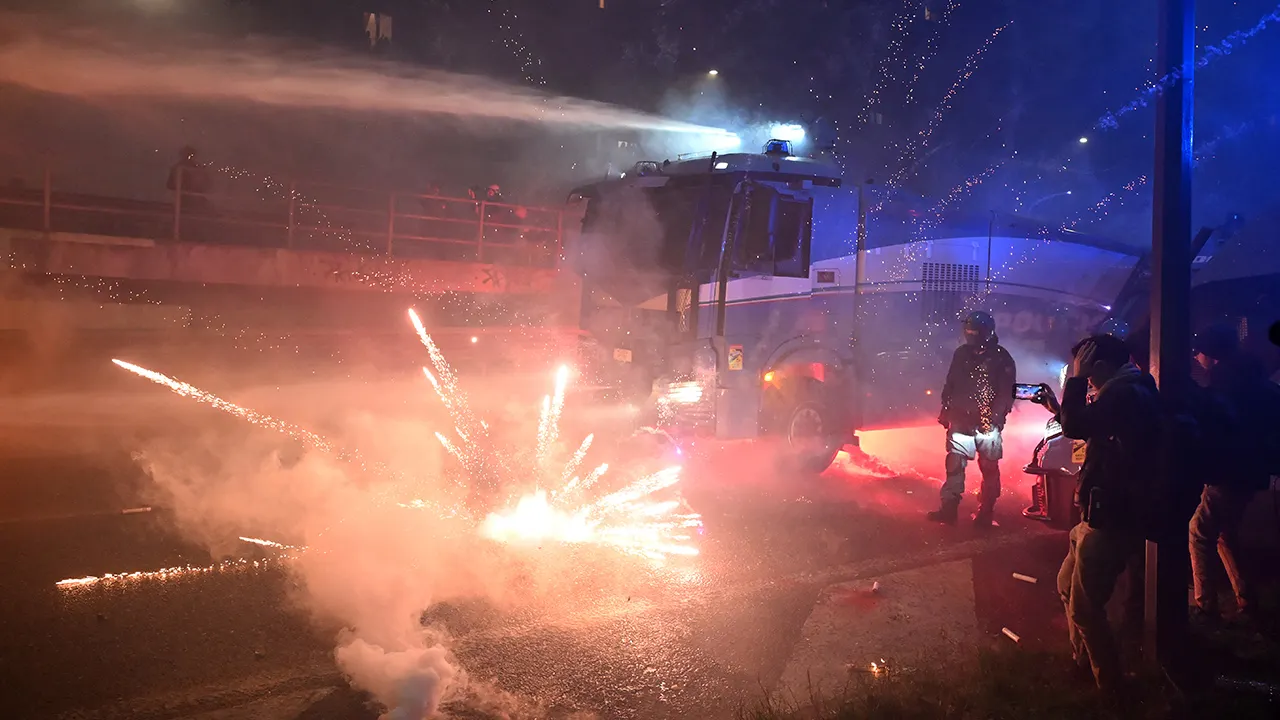
Just steps from the gleaming Santagiulia Ice Hockey Arena, a newly built fortress of ice and innovation, the chaos erupted like thunder. Masked figures hurled smoke bombs and lit firecrackers, their faces obscured beneath hoods, embodying the anonymous fury of the disenfranchised. Police, unflinching guardians of order, retaliated with water cannons that sprayed icy jets into the crowd, and tear gas that stung eyes and lungs, forcing gasps and retreats. It was no sanitized newsreel—this was human despair meeting authority’s iron fist. Demonstrators, arms linked in solidarity, chanted anti-establishment anthems, their voices hoarse from cold and conviction. One protester, a young artist with paint-streaked hands, clutched a sign depicting uprooted trees sobbing ink—symbolizing the Cortina bobsled run’s environmental cost. Another, an elderly man who’d seen too many promises broken, yelled about jobs lost to imported labor. The arena itself stood as a testament to controversy: delayed builds had frustrated planners, and whispers of a rink too small for world-class play added fuel to the fire. In those frantic moments, lives intertwined in confusion—families separated by surging crowds, first aid tents overwhelmed by the fallen. The clash highlighted a bitter truth: when hopes for sustainability collide with reality’s compromises, people don’t just protest; they bleed for change, their stories echoing louder than any victory lap.
Amid the turmoil, Global Guardian, a sentinel-like security firm, issued a dire travel alert that rippled through phones and screens worldwide, warning of “heightened security and disruptions” in the zone. “Avoid all protests—plot safe bypasses,” they advised, painting Milan as a no-go labyrinth for the unprepared. The message was clear and cold: this wasn’t merely a skirmish; it was a systemic tremor, with at least five souls taken into custody—handcuffed and whisked away, their fates now tangled in bureaucratic webs. As alerts buzzed like ominous sirens, travelers and onlookers imagined the dread: mothers checking on sons in the fray, tourists rerouting vacations to dodge danger. But behind the warnings lay human drama—the officers, perhaps parents themselves, enforcing peace at personal peril, their shifts bleeding into sleepless nights. One security guard, reflecting later, admitted the protests stirred empathy for the cause, blurring lines between law and justice. The alert underscored a new era of global vigilance, where events as joyous as the Olympics could summon Shadows, reminding us that in our interconnected world, a rally in Italy reverberates to affect lives far beyond its borders, from expatriates fearing arrests to citizens questioning if their activism is worth the gas.
Meanwhile, half a mile away, another group of ardent activists escalated their defiance, hurling smoke bombs and firecrackers from a bridge overseeing a bustling construction site, their actions a fiery punctuation mark in the day’s unrest. Overlooking the Olympic Village, where an estimated 1,500 elite athletes bunked in dorm-like camaraderie, this masked cadre seemed poised to disrupt harmony—but fate intervened with mercy. Police vans lined up like metal sentinels behind temporary fences, roadblocks sealing access to the Village’s heart. Yet, the protesters pivoted, veering off their path toward the relative safety of the Santagiulia arena, perhaps sparing the athletes’ fragile prepares for glory. A heavy phalanx of officers guarded every twist and turn, their presence a silent vow to protect not just venues but the international ideal. No reports indicated interference with athletes’ shuttles to outskirt events, where skiers chased snow and ice dancers spun dreams. Here, human elements shone through—the athletes, insulated from the storm, might have glimpsed the smoke from their windows, pondering how external rages mirrored internal pressures. One imagined gymnast, pushing through fatigue, could relate to the protesters’ exhaustion, while a coach fretted over distractions. It humanized the divide: while elites pursued perfection on frozen tracks, outsiders ignited flares for a fairer game, their stories interwoven in the tapestry of global sport and dissent.
Shifting gears from the skirmishes, a grander, more serene expression of discontent blossomed in Cortina and Milan alike—a massive march claiming about 10,000 souls, a sea of humanity flowing peacefully, defying stereotypes of chaos. Here, art met activism: cardboard cutouts of majestic trees, their leaves crudely drawn, swayed aloft like ghostly familiars, honoring the forests felled for the bobsled run’s sake. Drummers pounded rhythms that pulsed through veins, dancers twirling in elaborate performances, synchronized in a ballet of protest that celebrated culture over confrontation. A truck blared music, including a raw, profanity-laden anthem against ICE, resonating with raw emotion. “Let’s take back the cities and free the mountains,” proclaimed a banner by the Unsustainable Olympics Committee, its words a rallying cry for reclaimed lands and rights. The Association of Proletariat Excursionists added flair, their cutout trees a poignant jet-black artwork begging visitors to ponder nature’s cost. Participants shared tales of personal loss—farmers deprived of ancestral woods, hikers mourning polluted springs—transforming the demonstration into a shared grieving ceremony. It wasn’t just a protest; it was a community embrace, where strangers bonded over shared ideals, their diverse faces reflecting Italy’s mosaic. One participant, a retiree with weathered hands, spoke of chaining himself to old-growth trees as a youth; now, he marched for his grandchildren. This peaceful tide proved that dissent could sing, chapter rather than shout, weaving narratives of hope amidst the rumble.
Yet, the day’s ripples extended beyond Milan’s cobblestones, echoing into the very heart of Olympic inequities. Female Nordic combined athletes, overlooked in a sport where their talent burned bright, planed their own symbolic stand. “It’s so messed up,” one lamented, highlighting gender disparities that barred them from the full spectrum of competition. Their planned protest underscored how the Games, while showcasing human potential, often perpetuated divides—between genders, nations, and the haves and have-nots. Stories circulated of these women training in icy winds, their exclusion a sting sharper than frostbite, fueling demands for inclusion. From the field, we glimpse broader human struggles: the Olympic torch, meant to illuminate unity, casts long shadows where minorities and marginalized voices are muffled. Protesters in Milan mirrored this broader discontent, from climate warriors to advocates for migrant rights. The conflicts humanized the Games, revealing them not as mere spectacles but crucibles for societal reckonings. As the day waned, reflections emerged—what if the Olympics became forums for true dialogue, where protesters and participants bridged divides? In pondering this, we see the power of protest as a catalyst, stirring souls to envision a world where sport lifts all, not just the favored few. Ultimately, the events in Milan weren’t isolated outbursts; they were heartfelt pleas, reminding us that behind every medal lies the human cost, and every chant shapes the future. As fog enveloped the city post-protest, athletes, activists, and onlookers alike pondered: in a world craving connection, can the flame of the Olympics warm the cold spots of injustice, or is it destined to melt under the heat of unheeded calls for change?