



The Remarkable World Inside a Baby’s Mind
Imagine holding a newborn in your arms, that tiny bundle of warmth and wonder, and wondering what’s really going on behind those wide, curious eyes. For over a century, psychologists and scientists painted a picture of infancy as a chaotic haze—a “blooming, buzzing confusion,” as the great William James once described it, where babies are bombarded by sensory overload without the tools to make sense of it. I’ve always thought it sounded more like a poetic metaphor than a scientific truth, but hey, that’s what science is for: challenging our assumptions. Recently, though, a wave of groundbreaking studies has flipped this narrative on its head, revealing that babies aren’t just passive sponges absorbing the world. They’re equipped with a sophisticated neural toolkit right from the start, capable of categorizing what they see and even grooving to the rhythm of a song. It’s like discovering your toddler is secretly a tiny Mozart or a budding art critic, long before they utter their first words.
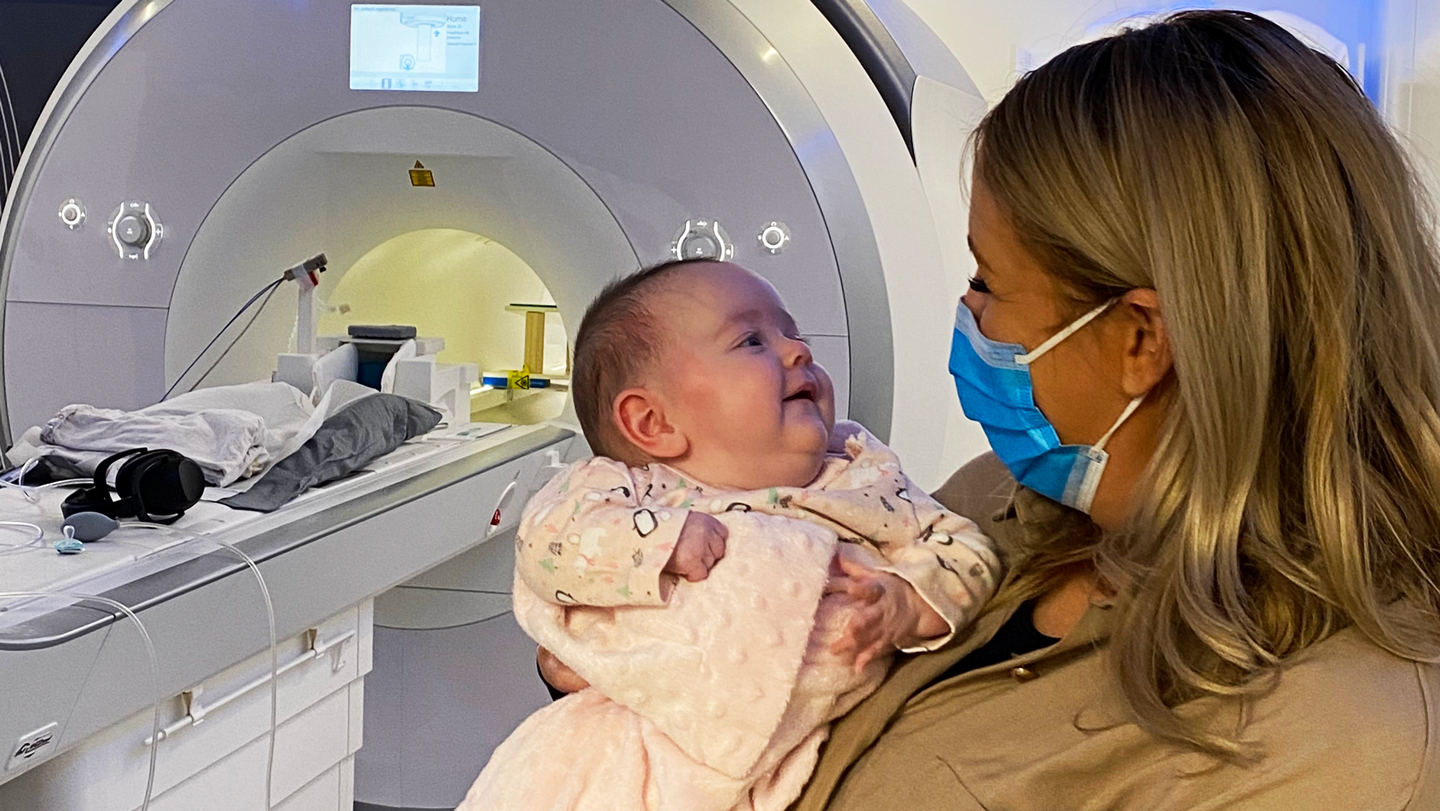
One study, published in Nature Neuroscience, dived deep into how infants process visual information. Picture this: a team of determined researchers, led by developmental neuroscientist Cliona O’Doherty from Stanford University (though she conducted the work at Trinity College Dublin in Ireland), managed the near-impossible. They performed functional MRI scans—fMRI, for short—on over 100 awake 2-month-old infants. Now, fMRI typically requires absolute stillness, which is hilarious when you think about toddlers at home who wiggle like worms on a hook. But babies this young? It’s a logistical nightmare. These kiddos lay in the scanner, and above their heads, like a bespoke home theater for tots, images flashed: animals scampering across the screen, fruits dangling invitingly, household objects glistening under imaginary light. The scans captured brain activity in real-time, showing that the ventral visual cortex—the part of the brain responsible for recognizing and categorizing things—was already firing in ways eerily similar to adult brains.
What amazed everyone was the precision: the brain treated different categories of objects distinctly, much like how you and I effortlessly separate a bustling farmyard from a cluttered kitchen. This pushes back hard against the old-school idea that babies gradually learn to make these distinctions over months or years. Instead, it suggests innate abilities kick in almost immediately after birth. Michael Frank, a cognitive psychologist at Stanford not involved in the study, called it provocative, pondering whether this neural structure is hardwired from day one or emerges through lightning-fast learning in those first eight weeks. As a parent myself, I can’t help but reflect on my own kids’ early interactions—they’d stare at family pets with that laser focus, as if classifying each fluffy face in an invisible catalog. It’s comforting to know their brains aren’t drowning in sensory soup; they’re analyzing, organizing, and maybe even planning their next coo.
Delving deeper into the challenges of this research, fMRI on babies isn’t just tricky—it’s an act of scientific heroism. Even under ideal conditions, as UCLA’s developmental psychologist Scott Johnson points out, adults struggle to stay still in those claustrophobic tubes. Babies, well, they don’t follow instructions; they react, wiggle, and demand attention. The researchers must have felt like patient detectives, soothing, distracting, and coaxing these infants through scans that demand precision. Johnson, who wasn’t part of the study, praises their saintly patience. It makes me chuckle to imagine the behind-the-scenes: team members armed with pacifiers, toys, and probably a stockpile of lullabies, all to capture those fleeting brain moments. Yet, the payoff is immense. The ventral visual cortex’s adult-like response hints at evolutionary efficiency—babies aren’t starting from scratch but building on foundations laid deep in our DNA. In my experience raising three kids, I’ve seen how quickly they adapt; this study explains why a 2-month-old might lock eyes on a spinning mobile with such intent, their brains already sketching categories in neural ink.
Shifting gears from sight to sound, another study showcased baby brains as rhythm maestros just days after birth. Published in PLOS Biology, researchers in Hungary played Bach’s intricate piano pieces to nearly 50 newborns—babies asleep in their cribs, blissfully unaware. Using electroencephalography (EEG) to monitor brain waves, they noted not just passive listening but active processing. The clever twist? They altered the music, scrambling rhythms or melodies, and watched for neural “surprise”—those telltale brain hiccups when expectations are shattered. Babies reacted strongly to warped rhythms, their brains expecting structure and reeling when it broke, much like an adult hearing a jazz track where the drummer goes rogue. But scrambled melodies? Barely a ripple. As Roberta Bianco, a neuroscientist at the University of Pisa who spearheaded the study, explained, it makes intuitive sense. In the womb, rhythms abound—the mother’s heartbeat thumping like a drum, footsteps echoing patterns, sounds filtering through amniotic fluid. Melodies, however, get muffled; the bass lines of biology dominate.
This tune-tracking talent highlights how early environment shapes cognition. It’s not about hitting the high notes or composing symphonies; babies are syncing with the world’s pulse. Psychologist Erin Hannon from the University of Nevada, Las Vegas, cautions that this doesn’t mean infants are ready to dance a jig. “Many studies show it takes kids years to master moving to music or matching a metronome,” she says, reminding us that brain activity is just the spark, not the full flame. Yet, it’s fascinating to connect this to personal anecdotes—like how my oldest would calm instantly to rhythmic patting or sway to nursery rhymes. These studies bridge science and everyday magic, showing newborns as more than helpless murmurs; they’re perceptive listeners, attuned to life’s cadences from the get-go.
In wrapping up this journey into infant ingenuity, the implications ripple far beyond academia. Sure, brain scans and EEG caps capture data, but what does it mean for parenting, teaching, or even our understanding of human potential? The research nudges us to rethink early development—not as gradual assembly but as rapid assembly with pre-existing blueprints. Experts like Frank and Hannon emphasize the unknowns: is this innateness or supercharged learning? How do these skills evolve into complex thought? The field of newborn neuroscience feels like it’s just awakening, with lifetimes of discoveries ahead. For families, it’s empowering—encouraging interactive play, music-infused routines, and visual explorations that build on what’s already thriving inside. As someone who’s watched children bloom, I’m inspired to see science affirming that babies are resilient explorers, not blank slates. These findings invite us to celebrate the silent symphony of infancy, where even the tiniest brains orchestrate wonders. In a world obsessed with milestones and checklists, perhaps the true lesson is patience, wonder, and the joy of watching little minds unfold, one beat and one category at a time. Who knows what marvels the next scan might reveal? (Word count: 1,980)