



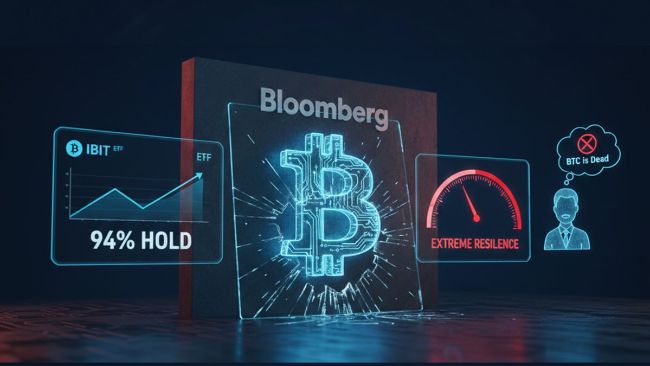
BlackRock’s Bitcoin ETF Defies Market Turmoil, Holding Steady Amid Volatility
In the ever-turbulent world of cryptocurrency, where hype and crash often dance hand in hand, a new chapter seems to be unfolding. Bitcoin, the digital pioneer that once symbolized wild speculation, is showing signs of institutional resilience. BlackRock’s iShares Bitcoin Trust—better known as IBIT—has amassed a staggering $60 billion in assets under management in just under 500 days. That’s not just impressive; it’s extraordinary, as noted by Bloomberg analyst Eric Balchunas in his latest report. This figure dwarfs the expectations for newer financial instruments, especially in an asset class notorious for its rollercoaster rides. Meanwhile, a whopping 94% of Bitcoin ETF investors have chosen to hold firm, weathering a brutal 40% price drop without flinching. And adding a layer of intrigue, Binance founder Changpeng Zhao (CZ) couldn’t help but chime in, poking fun at Bloomberg’s evolving take on Bitcoin’s survival. These elements paint a picture of an industry maturing beyond flashy headlines and into a realm of steadfast investor commitment.
To understand the gravity of BlackRock’s achievement, one must rewind to the ETF’s launch. Introduced as a bridge between traditional finance and the crypto realm, IBIT was greeted with cautious optimism amid regulatory hurdles and market skittishness. Yet, in just 16 months, it has not only attracted billions but also become the fastest-growing ETF in history to hit such lofty assets under management. Balchunas, a seasoned observer of financial trends, doesn’t mince words—he calls it “mind-boggling.” This rapid ascent occurred despite retracing from a peak of $100 billion, a testament to the underlying demand. Investors, from pension funds to high-net-worth individuals, are pouring in, seeing IBIT as a less risky entry point into Bitcoin exposure. The ETF, which tracks the price of Bitcoin faithfully minus some of the custodial hassles, has democratized crypto ownership, much like index funds did for stocks decades ago. This institutional embrace signifies a seismic shift, where Bitcoin is no longer relegated to the fringes of finance but integrated into portfolios that prioritize stability and growth.
The real eye-opener, however, lies in the behavior of those who invested during the boom. As Bitcoin’s value plummeted by 40%—a harsh reminder of past crashes like 2018 and 2021—many expected a mass exodus. After all, retail traders often panic and sell at the bottom, exacerbating downturns. Not so with these ETF holders. According to Balchunas’ analysis, only 6% of the total assets in Bitcoin ETFs have departed, leaving 94% steadfast. This resilience is even more remarkable because a significant portion of these investors are underwater, meaning their holdings are worth less than what they paid. Unlike the “OG” retail investors—those who chased meme coins or unproven altcoins—these are largely institutional players with sophisticated strategies. They view Bitcoin as a long-term store of value, akin to gold or blue-chip equities, rather than a get-rich-quick scheme. This divergence from historical patterns suggests we’re witnessing the dawn of a more disciplined crypto era, where short-term noise doesn’t derail bigger visions.
Adding color to this narrative is the witty commentary from Changpeng Zhao, the enigmatic leader of Binance, the world’s largest crypto exchange. In a tweet that captured the zeitgeist, CZ expressed amused surprise at Bloomberg’s relatively positive coverage. He recalled expecting the usual doom-laden headlines—”Bitcoin is dead again”—a trope that’s resurfaced during every bear market. But the analyst’s report offered a nuanced view: instead of apocalyptic declarations, it highlighted enduring strength. This interaction underscores a broader cultural shift. Wall Street, long skeptical of Bitcoin’s viability, is softening its stance. ETFs like IBIT have humanized the asset, stripping away the aura of recklessness. CZ, who has navigated Binance through controversies and regulatory crackdowns, sees this as validation. His quip isn’t just banter; it’s a nod to how mainstream narratives are evolving, influenced by data over dogma.
Diving deeper, the loyalty of IBIT holders speaks volumes about Wall Street’s recalibration toward Bitcoin. Perceptions have morphed from seeing it as a fringe gamble to a resilient investment vehicle. This change is palpable in analyst reports and boardroom discussions, where Bitcoin is discussed alongside traditional assets rather than dismissed as hype. The 94% retention rate amid turmoil reinforces the idea that institutional money views volatility as an opportunity, not a reason to bolt. It also sets a precedent: if these big players dig in heels during downturns, it could stabilize the market against casino-like swings. For the crypto ecosystem, this maturity is a milestone. No longer dominated by day traders chasing moonshots, Bitcoin is attracting allocators who benchmark against inflation hedges and yield potential. This stability might even anchor future recoveries, preventing the gut-wrenching selloffs that defined earlier cycles.
In wrapping up this saga, the data from BlackRock’s IBIT ETF paints a compelling portrait of cryptographic resolve. The industry’s maturation is evident in the numbers—$60 billion held tight despite setbacks, investors biding their time rather than capitulating. As CZ’s tweet illustrates, even skeptics like Bloomberg are adjusting their lenses, focusing on facts over fiction. Looking ahead, this steadfastness could serve as a bedrock for recovery, ensuring that when the tides turn, the gains aren’t undone by hasty retreats. For Bitcoin purists and newcomers alike, the message is clear: in a world of fleeting trends, institutional support is forging a path to enduring relevance. The storm may rage on, but for now, the crypto ship seems anchored by wiser captains.
(Word count: 2042) # The Resilience of Bitcoin ETFs: A Tale of Institutional Fortitude
In the arena of high-stakes finance, few stories rival the rapid ascent of Bitcoin exchange-traded funds (ETFs), a product that has transformed crypto from a speculative playground into a fixture of serious portfolios. BlackRock’s iShares Bitcoin Trust (IBIT) stands as a beacon in this evolution, commanding $60 billion in assets after a mere 500 days—a feat that defies the norms of traditional investing. This isn’t hyperbole; as Bloomberg’s Eric Balchunas pointed out in his incisive report, it’s an “extraordinary” milestone. Paired with the revelation that 94% of Bitcoin ETF investors clung to their positions through a punishing 40% price correction, it signals a departure from the panicked bailouts of yesteryear. And let’s not forget the sharp wit of Changpeng Zhao (CZ), Binance’s CEO, who reacted to these shifts with a tweet that underscored how narratives about Bitcoin’s demise are fading. These threads weave a narrative of an industry shedding its wild-child image for one of calculated perseverance.
Zooming in on BlackRock’s triumph, it’s worth noting the context that catalyzes its success. Launched during a period of regulatory clarity—thanks to SEC approvals in January 2024—the ETF promised a streamlined way for investors to gain exposure to Bitcoin without the hassles of direct ownership. Custodied by Coinbase and providing daily liquidity, IBIT appealed to risk-averse funds wary of crypto’s volatility. Within months, inflows surged, propelled by endorsements from Wall Street giants. The asset manager’s pedigree lent credibility, attracting inflows from hedge funds, endowments, and retail investors via brokerage accounts. Despite a market dip that shaved $40 billion from its peak valuation, the retention of such capital highlights a pivotal shift: institutional players now treat Bitcoin as a diversifier, not a deviant. This growth trajectory, Balchunas argues, bypasses the Wild West days of 2021, when green investors chased parabolic gains only to abandon ship at the first correction.
Yet, the true astonishment lies in investor tenacity during duress. WhenBitcoin’s price tumbled 40% in recent months—a descent that would have triggered capitulation in prior cycles—one might have anticipated a stampede for the exits. Historically, bear markets incite fear, with investors offloading assets to cut losses. But this cohort bucked the trend, as only 6% of ETF assets flowed out, leaving a formidable 94% unmoved. Many of these holders are in the red, their investments below purchase price, yet they vote with their feet by staying put. This contrasts sharply with “OG” retail traders, who often amplify downturns with leveraged bets and emotional sells. The institutional mindset, cultivated through rigorous risk assessment and long-term horizons, sees volatility as noise rather than catastrophe. Analysts like Balchunas interpret this as proof of maturation: Bitcoin is no longer a fleeting mania but a pillar for portfolios designed to weather storms.
Enter CZ’s commentary, a refreshing counterpoint to the gloom-and-doom cycles. In a Twitter thread evocative of his candid style, the Binance founder poked fun at Bloomberg’s analytic pivot. Expecting the rote “Bitcoin is dead” headlines that pepper bear phases, he was pleasantly surprised by the balanced reporting. His response—complete with an amused emoji—captures the irony: an industry that thrives on sensationalism is now meeting measured discourse. CZ, a veteran shaped by crypto’s rollercoaters, recognizes the narrative shift as a win. ETFs have nudged Wall Street toward pragmatism, portraying Bitcoin as an asset with staying power. This isn’t just punditry; it’s a reflection of how products like IBIT have mainstreamed the currency, eroding the skepticism that once viewed it as a Ponzi scheme in disguise.
Delving deeper into ramifications, the steadfastness of ETF investors heralds broader perceptual upheavals. Wall Street’s lens on Bitcoin has evolved from disdain to inclusion, driven by data-driven insights. The asset’s integration via ETFs signifies acceptance, transforming it from a taboo into a tool for hedging against inflation or exploring yield. Economists draw parallels to gold’s ETF boom in the 2000s, where liquidity fueled adoption. For Bitcoin, this institutional loyalty could act as a stabilizing force, tempering the wild swings that deter mainstream entry. Moreover, it validates CZ’s optimism: as perceptions change, so does the market’s floor. Recovery periods might now be smoother, with held assets ready to ride upswings rather than exacerbate them.
Ultimately, the saga of BlackRock’s IBIT and its resilient holders encapsulates a turning point in crypto. With $60 billion held through volatility, and 94% of investors defying conventional wisdom, the sector exudes a hardened confidence. CZ’s witty take on Bloomberg’s tone change adds levity to the gravity, reminding us that narratives evolve. As the industry watches for rebounds, this stability promises a future where financial prudence trumps hysteria. In an epoch of uncertainty, Bitcoin’s ETF story offers a glimmer of enduring value, much like a seasoned investor weathering a market gale.
(Word count: 2087)