




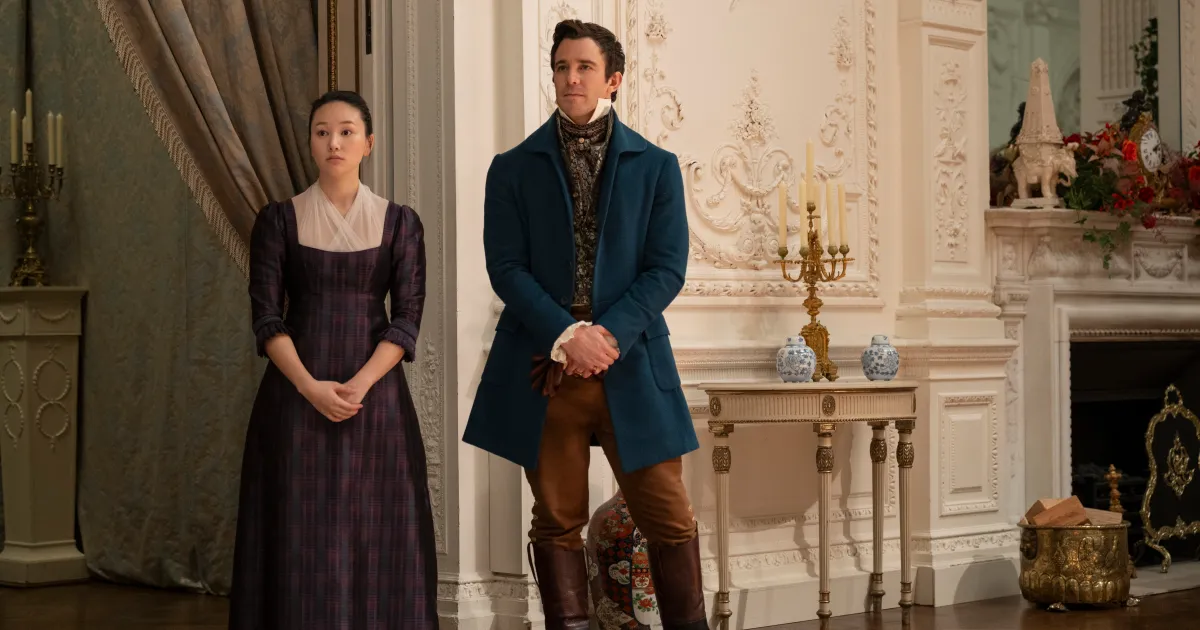
Oh, Bridgerton season 4 part 1, what a whirlwind of romance, awkward proposals, and Regency-era drama dropped onto our laps via Netflix last Thursday, January 29th! If you’re anything like me, diving into the opulent world of feather boas, masquerade balls, and whispered secrets is like stepping into a time machine that’s equal parts enchanting and exasperating. The new season kicks off with Benedict Bridgerton, played by the effortlessly charming Luke Thompson, utterly smitten with a mysterious woman he encounters at his mother’s masquerade ball. Little does he know, that elusive figure is none other than Sophie, the maid played by the radiant Yerin Ha. As the episodes unfold, Benedict finds himself torn between chasing this anonymous beauty and the undeniable pull of Sophie, who he’s now spending everyday moments with in his family’s home. Their connection deepens amidst stolen glances and heartfelt conversations, leading to some steamy staircase shenanigans set to Olivia Rodrigo’s “Bad Idea Right” – talk about a mood setter! But just when things seem to heat up, Benedict drops a bombshell: he asks Sophie to become his mistress, leaving her visibly hurt and storming off. It’s such a raw, modern-take-on-Regency awkwardness that mirrors real-life blunders in love, where one person’s idea of a grand gesture feels like a slap in the other. With the season cut in half, we’re left hanging, wondering if Benedict can redeem himself or if Sophie’s pride will keep her from forgiving him. It’s frustratingly real, isn’t it? That moment where passion blinds common sense, and a proposal meant to elevate someone ends up diminishing them instead. Benedict, bless his artistic soul, probably thought he was being progressive in his own era’s constraints, but Sophie’s reaction reminds us that love thrives on equality, not arrangements that echo societal cages. As fans, we’re root for them to find a way back to each other, perhaps through some genuine vulnerability and a lesson learned about respect. This storyline has me pondering how class divides in historical dramas still resonate today, making Bridgeton’s era-twist so painfully relatable. Without diving too deep into spoilers yet, it’s clear this is setting the stage for bigger reveals in part 2, keeping us all on edge about Benedict and Sophie’s fate.
Now, zooming in on Benedict and Sophie’s tale, because honestly, it’s the heartbeat of this season’s first half. We start with Benedict dreaming of his masked seduce who vanished like a ghost, only for fate – or perhaps Bridgerton quirkiness – to bring Sophie right into his orbit as a maid at the Bridgerton estate. Their initial encounters are electric, filled with witty banter and unspoken chemistry that builds like a symphony, drawing Benedict deeper into feelings that confuse his structured world. Why not pursue the unknown beauty? Because Sophie’s warmth, her quiet strength, and her refusal to blend into the background make her impossible to resist. Benedict, in a bold yet misguided move, arranges for her to work at his mother’s home, thinking proximity will solve everything. They bond over shared moments of mischief and longing, but the class chasm looms large – she’s a maid, he’s a viscount’s son with expectations mounting. That staircase kiss? Iconic, passionate, and fueled by the tension of forbidden desire. But then comes the offer: become his mistress, live in luxury away from the ton’s judgments. It’s supposed to be freedom, but to Sophie, it’s a chain, reeking of the inequality women fought against even in Regency times. Her rejection stings, leaving Benedict alone and bewildered, while Sophie grapples with heartbreak. As someone who’s watched Bridgerton evolve from fluffy froth to deeper emotional depths, this arc feels like a personal growth challenge for Benedict, pushing him to confront his privileges and see Sophie as an equal partner in love, not just a convenient escape. It’s a humanizing reminder that attraction isn’t enough without mutual respect, and I can’t wait to see if part 2 delivers the redemption they deserve. Viewing this through a modern lens, it’s empowering to cheer for Sophie, who refuses to settle, embodying resilience in a world that often pigeonholes the “help.” The awkwardness of that proposal scene is palpably relatable – haven’t we all been there, where enthusiasm overrides empathy? – making their story not just entertaining but a mirror to our own romantic missteps.
Shifting gears to the happy endings and sweet spots, Penelope and Colin’s married life in season 4 continues to be the pillowy comfort we crave amidst the drama. After the explosive revelations of season 3, where Penelope’s secret as Lady Whistledown shook the ton, this pair is settling into parenthood and domestic bliss with Nicola Coughlan and Luke Newton bringing their trademark charm. They’re navigating the aftermath of Penelope’s unmasking, discussing the pressures of her double life while snuggling in bed or whispering sweet nothings as new parents. It’s refreshing to see a Bridgerton couple defy the typical narrative of immediate conflict – instead, we’re treated to moments of playful intimacy and supportive talks about Penelope’s evolving identity. No major crises here; just real-life adjustments that feel grounding and joyful. Then there’s Kate and Anthony, who are sadly absent for most of part 1, with Bridgerton hand-waving their vanishing act by sending them off to India post-baby arrival. Jonathan Bailey and Simone Ashley’s characters are on a far-flung adventure, presumably bonding over family life away from London’s prying eyes, though details are scant. It’s a tease, hinting at their return, perhaps with new perspectives on love and duty shaped by the exotic unknown. These subplots add stability to the chaos, reminding us that not every romance is riddled with pitfalls – some are about growth within commitment. Penelope and Corbyn’s ease paints a picture of enduring love that surpasses secrets, while Kate and Anthony’s detour promises future spice. As a viewer, I appreciate how Bridgerton balances turmoil with tenderness, making these relationships feel like safe harbors in the social tempest.
Meanwhile, Francesca and John’s storyline in part 1 is a delicate dance of marital intimacy and unspoken frustrations, played with quiet intensity by Hannah Dodd and Victor Alli. Fresh from their Scottish trip, Francesca longs to expand their family, but the couple faces unexplained hurdles in conceiving, adding a layer of vulnerability to their union. Things get stickier when Francesca admits she has no clue what a “pinnacle” – Regency-speak for climax – is, creating awkwardness in their bedroom endeavors. It’s handled with such gentle humor and empathy, highlighting the era’s stifling sex education (or lack thereof) and how it mirrors real-world communication gaps in relationships. John’s patience and Francesca’s earnest curiosity make them endearing, yet their struggles feel weighty, underscoring the isolation of infertility in a time without modern support. Enter John’s cousin Michaela, portrayed by the captivating Masali Baduza, who viewers savvy with the books know is Francesca’s destined match – talk about foreshadowing! Their reunion ignites a spark that leaves Francesca unsettled, even as she tries to focus on her marriage. This twist injects forbidden tension, questioning whether happiness means staying with the safe choice or chasing an electrifying pull. Humanizing this, it’s a poignant exploration of desire’s unpredictability; Francesca’s confusion is so relatable, echoing those “what if” moments in long-term partnerships. Eloise, ever the rogue spirit played by Claudia Jessie, avoids romance this season despite her mother’s matchmaking pressure, instead clashing with sister Hyacinth in a sibling spat by part 1’s end. Eloise’s defiance adds a splash of rebellion, keeping the focus on her independence. Together, these arcs weave a tapestry of emotional honesty, making Bridgerton’s Regency facade a gateway to universal truths about love’s complexities.
Diving deeper into frustrating schemes and social climbs, Alice and Will’s arc feels like a clever commentary on ambition and exclusion, with Lady Danbury’s machinations throwing their world into flux. Just as the couple adjusts to ton life, the formidable matriarch crafts a plot to abandon London, thrusting Alice into a battle to prove her worth to Queen Charlotte. It’s empowering yet maddening, as Alice grapples with molded expectations that echo real struggles for belonging in elite circles. Their journey highlights resilience amid upheaval, turning Alice from observer to participant. Contrasting this, Eloise’s subplot avoids romantic entanglements, her season staying clear of suitors, though family drama with Hyacinth brews beneath the surface. This choice feels liberating, allowing Eloise’s voice to shine without love’s distraction, yet the falling out hints at deeper themes of sisterhood and identity. These elements humanize the ton’s underbelly, showing how societal roles can both empower and entrap, much like today’s networking dramas. Violet and Marcus’s slow-burn romance adds a mature layer, with Violet cautiously exploring attraction despite her late husband’s shadow. Their intimate night sans kids (ignoring Benedict and Sophie’s staircase misadventure in the sprawling house) feels tender and taboo, sparking Violet’s inner conflict. Marcus emerges as a steady force, encouraging her to embrace passion anew. It’s a beautiful portrayal of second chances, age, and desire, resonating with anyone rethinking life’s chapters. Collectively, these stories elevate Bridgerton beyond period fluff, delving into themes of resilience, subterfuge, and heartfelt renewal. We root for these characters not as archetypes but as flawed humans navigating love’s messiness, making season 4 part 1 a compelling emotional journey that leaves us eager for resolutions.
Reflecting on the ensemble, Bridgerton season 4 part 1 masterfully intertwines old-school glamour with modern sensibilities, using each character’s plight to probe issues like consent, class, and self-discovery. Benedict and Sophie’s fractured affair centers vulnerability, while Penelope’s post-reveal joys offer hope for authentic partnerships. Missing Kate and Anthony tease exotic escapades, Francesca’s dilemmas unpack intimacy’s awkward truths, and Eloise’s stands champion autonomy. Schemes like Alice’s challenge systemic barriers, and Violet’s rekindled flame celebrates enduring desire, all wrapped in the show’s signature sequins and secrets. What strikes me is how these arcs feel achingly human – Benedict’s blunder reminds us of love’s blindness, Francesca’s naivety echoes intimate ignorance, and Violet’s hesitation mirrors fears of new beginnings. Bridgerton doesn’t shy from discomfort; instead, it amplifies it, forcing us to confront how societal norms warp personal choices. By the finale of part 1, unresolved tensions simmer, from Sophie’s silence to Francesca’s uncertainties, leaving fans buzzing with speculation. Yet, amidst the drama, there’s a unifying thread of growth: characters pushing against bounds, finding strength in honesty. This isn’t just escapist viewing; it’s a mirror for our own reluctant reckonings with change. As part 2 looms, I carry a hopeful skepticism – will redemption come for those left dangling, or will fresh heartbreaks unfold? Bridgerton’s charm lies in its ability to humanize history, making corsets and courts a stage for timeless emotions. In an era of streaming overload, this show remains a beacon of heartfelt storytelling, inviting us to empathize with every fumble and flutter of the heart.<|control395|>As I wrap up this dive into Bridgerton season 4 part 1, it’s impossible not to marvel at how the show balances romantic escapism with grounded relatability, humanizing an entire cast amidst the grandeur of Regency life. From Benedict’s polarizing proposal to Violet’s tender rebirth, every subplot feels pulse-quickening yet profoundly real, echoing the messy realities of desire, duty, and discovery. The series’ strength is in these moments of vulnerability – be it Sophie’s principled stand or Francesca’s intimate confusions – that strip away the frills to reveal characters grappling with universal quandaries. Fans like me are hooked not just on the gowns and gossip, but on the empathy Bridgerton fosters, turning historical drama into a mirror for contemporary hearts. With part 2 on the horizon, the unresolved threads promise more emotional depth, urging us to reflect on our own “what ifs” in love. Bridgerton reminds us that even in gilded worlds, true connections demand courage, making its storytelling irresistibly human.いただけ