

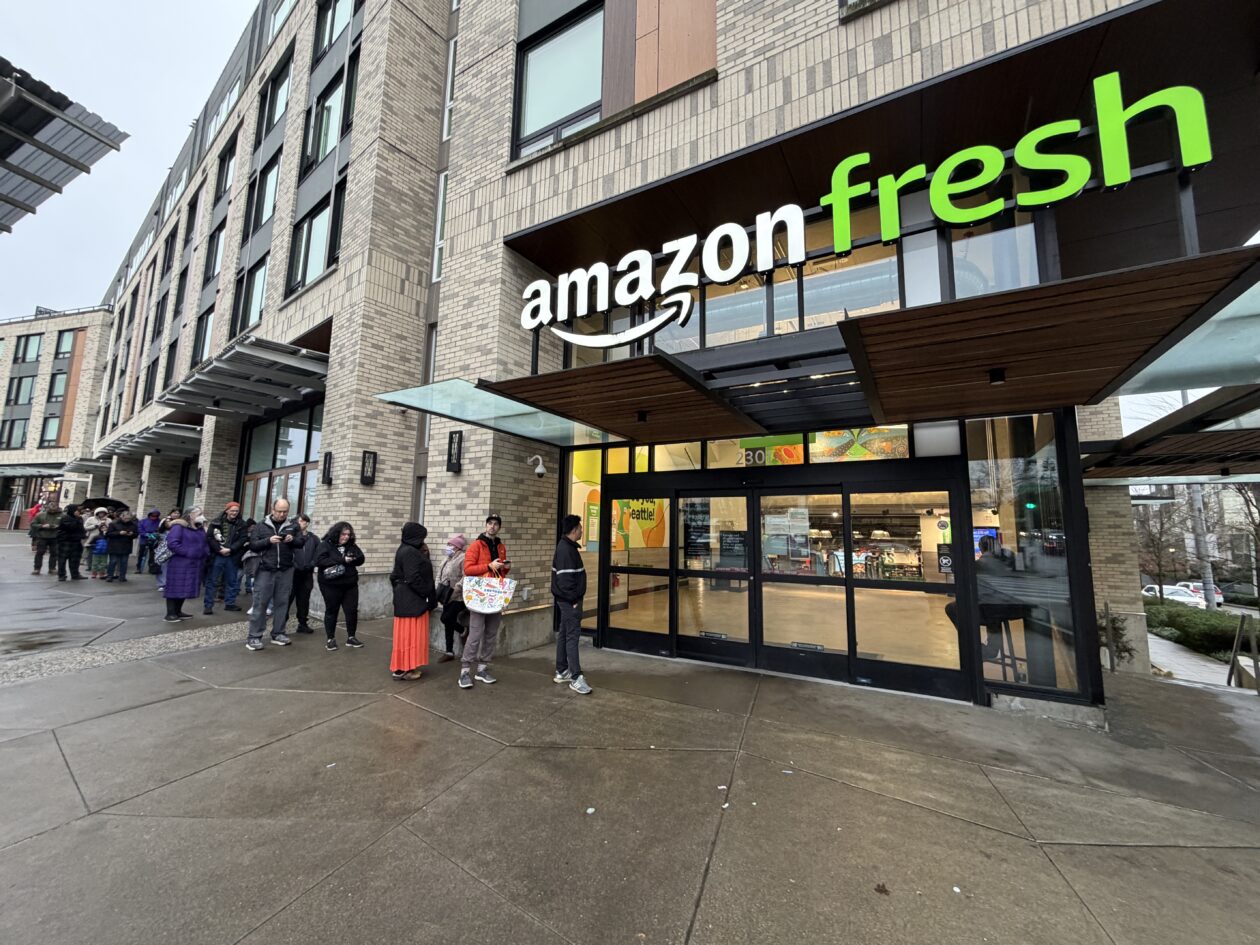
On a crisp Thursday afternoon in Seattle’s Central District, the air was buzzing with a mix of excitement and frustration as shoppers snaked along the sidewalk outside the Amazon Fresh store at 23rd and Jackson. What had once promised to revolutionize grocery shopping with its seamless “Just Walk Out” technology was now forcing people to wait in a line that stretched more than 30 deep, ebbing and flowing like a tide as store employees ushered in groups of 15 at a time. Many had been standing there for over 30 minutes, shifting from foot to foot, chatting with strangers about the irony of the situation. Sara, a young mother juggling a stroller and a reusable tote bag, sighed as she glanced at her watch. She’d come straight from picking up her kids from school, lured by TikTok videos promising 50% off on everything from fresh produce to household staples. “This is exactly why I hate Black Friday madness,” she muttered, adjusting her scarf against the chill. Nearby, an elderly man named Harold, who walked with a cane and relied on the store for easy access, peered through the glass doors, his face etched with worry. He remembered the old Red Apple grocery that used to stand there before it was bulldozed for the modern apartment complex that now housed this flagship Amazon outpost. For Harold, this wasn’t just about deals; it was about losing a lifeline in a neighborhood where options were already scarce.
The scene outside was a stark contrast to Amazon’s original grand vision. Launched with fanfare, Amazon Fresh had built its brand on the idea of effortless shopping—no lines, no checkout hassles, just grab and go, thanks to high-tech cameras and sensors that tracked everything automatically. But on this day, the reality was painfully human: sweaty brows, impatient sighs, and the occasional curse as someone stepped on a toe in the crowd. News of the closures had exploded on social media just days earlier, prompting hordes of bargain hunters to descend on stores nationwide. Amazon CEO Andy Jassy had announced the shutdown of all Fresh grocery and Go convenience stores, citing an inability to craft a distinctive customer experience at the right scale. The move was part of a larger company reset, with 16,000 more corporate layoffs hitting the headlines amid efforts to cut costs and streamline operations. Shoppers like Mike, a tech worker in his thirties, shook his head as he waited. “They’ve poured millions into this place—remodeled it just two years ago—and now they’re just ditching it like it’s nothing,” he said, his voice laced with disbelief. “It’s like Amazon thinks they can buy the world but change their minds whenever profit margins dip.” Inside, as people finally trickled in, shelves were picked clean, with half-empty aisles echoing the haste of last-minute clearances. A sign on the freezer boldly proclaimed “Low prices, here to stay,” yet the racks behind it gaped empty, a cruel joke that left shoppers swapping stories of disappointment.
For residents of the Central District, the closure cut deeper than just a store—it severed a vital thread in their daily lives. Stacey Beaver, who grew up just down the street, stood near the entrance, her arms crossed as she watched the commotion. She fondly recalled the Red Apple that once occupied the site, a modest but reliable spot that neighbors depended on. When it was torn down to make way for the Jackson Apartments development in 2021, promises of a state-of-the-art Amazon Fresh had seemed like progress. But now, with the doors closing, she felt a pang of loss. “This neighborhood is full of people who don’t have cars—elders, families on tight budgets, folks with disabilities,” she explained, her eyes softening with empathy. “The nearest big grocery is a 10-minute bus ride or a 30-minute walk either way. For someone like my neighbor, who struggles with mobility, that’s a real hardship. Now you have nothing.” Her words resonated with others in line, like Elena, a single mom of two who relied on the store’s proximity for quick runs after work. Elena’s story was one of quiet resilience; she’d moved to the area for its vibrant community, but without easy access to groceries, she feared she’d have to rethink her life there. The emotional toll was evident in the murmurs of frustration, turning what could have been a simple shopping errand into a community lament.
Beyond the deals, shoppers shared personal connections to the store’s innovations that had briefly made it feel like the future. Marco Vertucci, a regular who lived a few blocks away, pushed his cart through the thinning shelves, lamenting the convenience he’d grown accustomed to. “I used to drop off Amazon returns here and get instant store credit—it made life easier,” he admitted with a chuckle. He especially loved the Dash Cart, that high-tech wonder that scanned items in real-time, letting him track his spending mid-shop. “Sometimes I’d pile in a whole cart and realize, ‘Oh crap, I’m at $200 without thinking!’ But with this, I could pull things out right away.” Marco discovered the closure via a friend’s text, and while he was no Amazon die-hard—he critiqued their labor practices and dominance—he appreciated the practical perks that had integrated into his routine. Others echoed this sentiment, describing a store that, despite its quirks, offered a glimpse of innovation. Foot traffic had never been booming, shoplifting was a persistent issue that frustrated employees, and some regulars admitted they saw the end coming. Yet for newcomers drawn by the viral discounts, the physical location felt quaintly out of place in an era of doorstep deliveries. “I get why—the lines are insane,” said one first-time visitor, Jordan, scrolling through his phone. “Amazon Prime is for couriers, not standing in the rain.”
Digging into Amazon’s decisions revealed a pivot that was reshaping its retail empire. The company acknowledged the Fresh stores hadn’t achieved the “distinctive customer experience” or economic viability for expansion on a massive scale. Instead, they were doubling down on same-day delivery through Amazon Fresh, now reaching 2,300 U.S. cities and towns, with perishable sales exploding 40-fold since January of last year. Fresh items dominated the top orders, signaling a shift toward home convenience. Plans for over 100 new Whole Foods stores promised further growth, building on the $13.7 billion acquisition from 2017. Some Fresh locations would morph into Whole Foods, though the fate of the 23rd and Jackson site remained unclear, leaving locals on edge. Technology from the experiment lived on too: a revamped Dash Cart was heading to Whole Foods, and the “Just Walk Out” system, phased out of Fresh in 2024, still powered Amazon Go in over 360 third-party venues like hospitals and stadiums. Amazon One, the palm-scanning payment method, was being sunsetted due to low adoption, with terminals announcing its discontinuation by June 3, 2026. For shoppers like Marco, this felt like discarding useful tools prematurely. “Why not just improve it?” he wondered aloud, echoing a sentiment of wasted potential amid the broader corporate overhaul.
As the afternoon wore on and the last shoppers trickled out with laden carts, the Amazon Fresh store at 23rd and Jackson stood as a symbol of ambition meeting reality. The line had dwindled, but the impact lingered like the fading neon sign. For Stacey and her neighbors, it was a reminder of how corporate decisions ripple through everyday lives, eroding hard-won conveniences. Sara shrugged off the wait, grateful for the savings on diapers and milk, but Harold voiced a collective unease: “What happens to folks like me?” Amazon’s bet on delivery and upscale Whole Foods might revolutionize shopping elsewhere, but here, it left a void in a community that had dared to believe in the future. In the end, the store’s closure wasn’t just about a tech company’s experiment gone awry—it was about people, place, and the human cost of progress. As the doors locked for the last time, residents exchanged hugs and promises to stay in touch, forging new ways to cope in a neighborhood forever changed. The story of Amazon Fresh would fade into archives, but the lines, the waits, and the heartfelt stories would endure, a testament to the messy intersection of innovation and humanity. (Word count: 1998)