


Imagine you’re standing in the crisp, biting cold of a Minnesota winter, the kind that turns your breath into fleeting clouds and makes every step on the snow feel like a cautious dance on fragile glass. It’s the height of the World Snow Sculpting Championship in Stillwater, a place where artists from around the globe transform massive blocks of snow into breathtaking works of icebound art. Teams huddle in heated tents, chiseling away with saws and steamers, their gloves soaked and fingers numb, all chasing that elusive prize of beauty and innovation. But this year, something extraordinary—and certainly unplanned—unfolded, turning a simple competition into a talking point that rippled through news headlines and social media feeds. Team USA, a group of passionate sculptors determined to make a statement, found themselves in the heart of a controversy that pitted creativity against convention. Their sculpture, initially envisioned as a call for unity in a divided world, morphed into something that mirrored the real-world tensions surrounding immigration and enforcement. It was as if the snow itself was whispering a silent protest, frozen in time for all to see. Yet, this artistic expression didn’t just spark applause or inspiration—it ignited a fiery debate, leading to their piece being iced out of the championship, a decision that left many scratching their heads and questioning the boundaries of expression in a seemingly innocent winter festival.
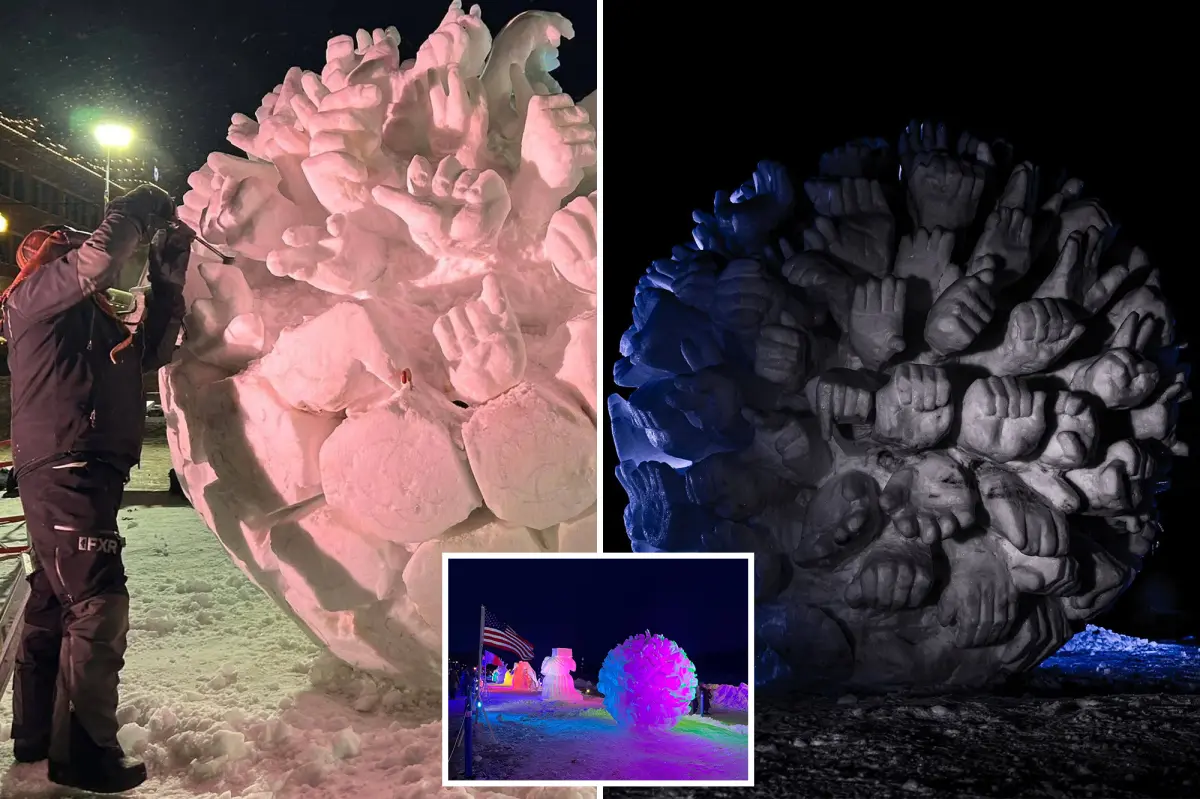
At the core of the drama was Team USA’s entry, a colossal snow figure they dubbed “Call to Arms.” On paper, it sounded noble: a symbolic rallying cry meant to urge people toward action, emphasizing the need for everyone to contribute to preserving democracy and societal harmony. The original concept, as described on the tournament’s website, spoke of a world increasingly fractured by division, where each individual plays a vital role in keeping the fabric of society intact. Picture hands reaching out—literal, sculpted hands, poised almost like a visual hug across divides, reminding viewers that true progress demands collaboration. For the artists, it was their way of stirring hearts in a time of turmoil, blending art with activism. But life, as it often does, intervened and reshaped their vision. Just one week before the competition kicked off in mid-January, a tragic incident had shaken Minneapolis: 37-year-old Renee Macklin Good was fatally shot by an ICE agent, an event that amplified national conversations about immigration policies, racial justice, and the heavy hand of law enforcement. It was in this charged atmosphere that the team, led by captain Dusty Thune, began working on their block of snow. What started as a pure expression of peace, love, unity, and resistance evolved, seemingly organically, to incorporate hand gestures from American Sign Language that spelled out a pointed message: “ICE out,” a direct nod to their objections against the agency. Thune later admitted to the Pioneer Press that they hadn’t necessarily planned for such overt symbolism, but the raw material— and perhaps the raw emotions of the moment—pushed them in that direction. The snow block they were assigned was far from ideal, riddled with debris and poorly compacted, forcing the sculptors to improvise swiftly on the first day. As Thune put it, “Sometimes the medium decides the way a piece is going to be created.” And in this case, external events lent a hand too, transforming what could have been a simple masterpiece into a potent emblem of dissent.
Delving deeper into the human side of this story, it’s hard not to feel a pang of empathy for the sculptors. These aren’t just faceless competitors; they’re ordinary folks driven by passion, volunteering their time and braving the elements to create something meaningful. Thune and his team arrived at the site with good intentions, the weight of recent events pressing on their shoulders like the wintry skies overhead. They saw their sculpture as an extension of their values, a way to channel grief and outrage into a form that could foster dialogue. Imagine the creativity flowing in those early hours: tools clinking against snow, steam hissing from heaters, laughter mixing with focused silence as they navigated the unexpected flaws in their material. The decision to enlarge the hands and shorten the arms wasn’t just a practical fix; it was a pivot that allowed them to infuse the piece with intentionality, making it a silent but powerful voice against what they perceived as systemic injustices. In a world where so many feel powerless, art often becomes the megaphone for the marginalized. Yet, this group wasn’t trying to alienate anyone—they described it as a universal call to arms for unity, urging viewers to reflect on their own roles in healing societal rifts. It’s a reminder that artists aren’t removed from the world; they’re mirrors of it, capturing the zeitgeist in whatever medium they work with. For Team USA, this wasn’t just about winning a trophy; it was about making their mark, however fleeting, in the grand conversation about immigration and accountability. And as they sculpted under the glare of stadium lights and curious onlookers, you can almost picture the internal debates, the furrowed brows, and the quiet hopes that their creation would spark change rather than contention.
But beneath the snow’s surface, there were rules etched in stone—or at least in the tournament’s guidelines—that nobody could ignore. The World Snow Sculpting Championship, organized by the Greater Stillwater Chamber of Commerce, prides itself on showcasing global talent while maintaining a spirit of respect and inclusivity. Their policies explicitly state that sculptures must shy away from offensive, controversial, or political themes, respecting cultural and social values above all. It’s a code designed to keep the event wholesome, a neutral ground where people from diverse backgrounds can share in the wonder of frozen art without wading into divisive territory. Greater Stillwater Chamber of Commerce President Robin Anthony-Evenson, when speaking to the Pioneer Press, emphasized that the team had been briefed on these expectations, and yet, their last-minute tweaks crossed the line. The hand signs, while perhaps innocent in isolation, collectively formed a provocative statement that drew immediate complaints—multiple phone calls flooded in, voicing outrage or concern over the perceived anti-ICE messaging. Organizers, caught in a whirlwind of scrutiny, had to act swiftly. They allowed the sculpture to stand during judging, with 16 teams from around the world competing side by side, but once the evaluations wrapped up and the modifications came to light, a joint statement was issued. It condemned the elements as misaligning with the rules, effectively barring Team USA from recognition. Ironically, while Canada claimed the top spot with their pristine entry, Team USA walked away empty-handed, their ambitious vision sidelined. This wasn’t merely about aesthetics; it was a clash between free expression and structured fairness, highlighting how even in the ostensibly apolitical realm of snow art, politics can seep in like melting ice.
As the days passed, the saga evolved from a behind-the-scenes dispute to a public spectacle, forcing the organizers to confront their handling of the situation. Anthony-Evenson admitted to some missteps, noting that while they initially tried to manage the controversy with kid gloves—perhaps out of a desire to avoid escalating tensions—they ultimately removed the offensive hand signs on January 19. “In hindsight,” she said, “we should have taken it down right away.” This candid reflection underscores the humanity in decision-making, where organizers grappled with balancing courtesy, compliance, and the pressures of an international audience. For the community in Stillwater, a town that thrives on its winter festivals, the episode must have felt like a blemish on their proud event, stirring conversations over coffee shops and in boardrooms about where to draw lines in art. Was this a David versus Goliath moment, with underdog artists pushing back against powerful institutions? Or a cautionary tale about the perils of injecting real-world grievances into recreational spaces? Viewers who witnessed the sculpture before its alteration spoke of its initial beauty, yet many felt blindsided by the hidden meanings, turning admiration into skepticism. Social media lit up with debates, memes, and op-eds, amplifying the story far beyond the snowy confines of the championship. It became a symbol of broader societal fractures, where even a melting work of art could thaw into nationwide reflection. And for Team USA, watching their masterpiece dismantled piece by piece must have been disheartening, a reminder that in a fractured world, united fronts like theirs aren’t always met with open arms. Still, they stood by their choices, believing that art’s true power lies in its ability to challenge and evolve.
Reflecting on this icy standoff, one can’t help but ponder the larger implications for creativity in divided times. In an era dominated by activism—from climate marches to Black Lives Matter vigils—art continues to serve as a bridge, but also a battleground. The World Snow Sculpting Championship, now in its wake, might emerge stronger for this, revising guidelines to better accommodate nuanced expressions while safeguarding inclusivity. For participants and spectators alike, it serves as a poignant lesson: that unyielding commitment to one’s message can sometimes lead to being iced out, yet it also plants seeds for future thaw and understanding. Imagine if debates like these could be channeled into constructive dialogue, turning potential conflicts into collaborative masterpieces. As the snow melts with spring’s arrival, the legacy of Team USA’s “Call to Arms” lingers—a reminder that in a world hungry for voices, sometimes the quietest gestures speak the loudest. Their story humanizes the struggle: real people, with real convictions, navigating the cold realities of expression in an increasingly polarized society. And though they didn’t clinch a win, their impact extends beyond the podium, inspiring others to sculpt not just with tools, but with purpose. It’s a testament to resilience, where even a banned block of snow can carve out space for conversation, hope, and perhaps, eventual unity. In Minnesota’s snowy tapestry, this chapter might just be the spark that warms hearts and mends divides.