


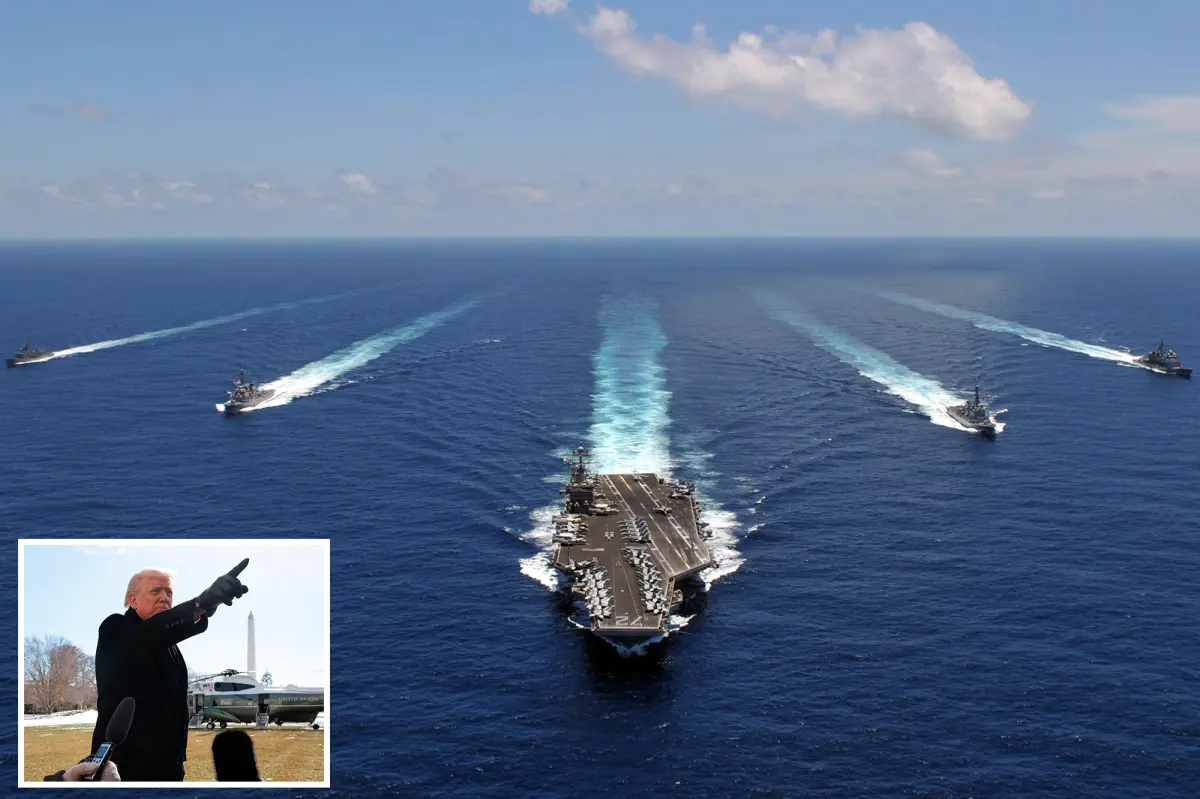
President Trump’s bold move to deploy military forces toward Iran comes at a critical juncture, as the Iranian government intensifies its brutal suppression of internal dissent. For weeks, reports have flooded in from Tehran and other cities, painting a grim picture of people rising up against a regime that seems increasingly desperate to cling to power. Protesters, many of them young and hopeful, are facing down tear gas, rubber bullets, and the ever-present threat of more severe repercussions from authorities who view any challenge as a direct assault on their authority. This isn’t just a local issue; it’s a reflection of broader global tensions, where authoritarian regimes often resort to violence to silence voices demanding change. Trump, watching from afar, has long positioned himself as a champion for freedom and against tyranny. His declaration about sending a naval force isn’t just rhetoric—it’s a clear signal that the United States won’t stand idly by while innocents suffer. Drawing parallels to the Venezuelan crisis, where economic collapse and political oppression have left millions in dire straits, Trump warns that Iranian leaders could face similar consequences if they don’t heed the call. It’s a narrative of accountability that resonates with Americans, reminding them of the president’s uncompromising stance on international bullies who trample over human rights. By invoking Venezuela, Trump humanizes the stakes: it’s not about abstract geopolitics but about real people facing hardship, echoing the stories we’ve seen in news feeds and social media scrolls about families broken apart and dreams deferred. As the situation escalates, with more videos emerging of peaceful marches turning chaotic under state force, the urgency grows. Experts in diplomatic circles are buzzing about what this means for Middle East stability, with some arguing it shores up alliances while others fear it could ignite a powder keg. Yet, in Trump’s world, action is paramount over endless talks that yield nothing. This deployment isn’t impulsive; it’s a calculated response built on years of skepticism toward deals that appease rather than resolve. The Iranian nuclear program looms large in this equation, a shadow of potential catastrophe that has haunted global security discussions since the Obama-era agreement, which Trump famously walked away from. By demanding a “fair and equitable deal,” he’s humanizing the conversation: not every negotiation needs to be perfect, but it must protect not just interests but the basic right to live without the dread of proliferation. It’s a lesson from history, where unchecked ambitions have led to wars that echo through generations. As American sailors and pilots prepare for what could be a tense stand-off, the narrative shifts to one of readiness and resolve, infused with the kind of enthusiasm Trump channels in his rallies. This isn’t just about ships and weapons; it’s about defending values that transcend borders, making the abstract feel personal and immediate. In the end, Trump’s message is clear: the era of looking away is over, and Iran must choose dialogue over defiance or face the ripple effects of standing firm against oppression.
The centerpiece of Trump’s strategic gambit is this “massive armada,” a formidable naval presence that’s drawing comparisons to the operations off Venezuela’s coast earlier in his presidency. When Venezuela’s regime under Nicolas Maduro plunged the nation into chaos, rejecting humanitarian aid and crushing opposition, Trump ordered a similar show of force. Now, with Iran as the focus, the armada—led by the USS Abraham Lincoln, a symbol of American might with its vast deck capable of launching fighter jets by the dozen—represents more than muscle. It’s a psychological weapon, a visual reminder that the U.S. isn’t afraid to flex its power when leaders cross lines. The FACTS are stark: the armada includes destroyers bristling with missiles, submarines lurking beneath the waves, and support vessels equipped for everything from surveillance to potential engagement. Sailors on these ships, many of whom have families back home, aren’t just following orders; they’re embodying a sense of purpose that Trump’s fiery speeches ignite. Recalling Venezuela, where the armada loomed as a deterrent without firing a shot, Trump emphasizes speed and precision. He talks about “enthusiasm” in a way that humanizes the military—turning steel and weaponry into extensions of democratic will. Imagine the scene on the Abraham Lincoln: the roar of jet engines, the disciplined chaos of decks littered with gear, and the unspoken camaraderie among crews who know their role could prevent bloodshed. This fleet eclipse the Venezuelan deployment in scale, a testament to Trump’s belief in overwhelming presence to force conversations. It’s not just about size; it’s about the story behind it—how these ships carry the weight of history, from naval battles that shaped nations to modern peacekeeping that saves lives. By highlighting the armada’s readiness for “speed and violence if necessary,” Trump injects a dose of realism into diplomacy, acknowledging that while negotiation is preferred, evil won’t yield to weakness. Offshore, as waves crash against hulls, the message chimes across waters: Iran, like Venezuela, isn’t untouchable. This approach has worked before, pressuring regimes to back down without escalation, and it humanizes global power dynamics—showing that behind every policy is a human drive to protect the innocent. Critics may call it saber-rattling, but for many, it’s a necessary flex in a world where words alone fall short. As the armada sails, it weaves into the fabric of international relations, reminding allies that America stands guard against threats that endanger stability, making the impersonal act of deployment feel like a communal stand against adversity.
Central to Trump’s ultimatum is his insistence on a nuclear agreement that’s “fair and equitable” and explicitly prohibits weapons of mass destruction. Iran, with its enrichment facilities and ballistic missile tests, has long been a wildcard in the Middle East, its program shrouded in secrecy that fuels global anxieties. Trump, ever the deal-maker, wants nothing less than a comprehensive pact that dismantles any path to a bomb, ensuring the regime can’t threaten neighbors like Israel or Saudi Arabia with apocalyptic capabilities. This isn’t new territory; his decision to exit the 2015 Joint Comprehensive Plan of Action (JCPOA) stemmed from what he saw as flaws favoring Tehran over enforcement. Now, as protests rage on, he ties the nuclear issue to internal repression, arguing that a regime willing to brutalize its citizens might not hesitate to escalate regionally. By demanding Iran “come to the table,” he humanizes negotiations as a path to mutual prosperity, not just concessions for peace. Picture the summit tables: leather chairs, endless coffee, and negotiators poring over maps showing uranium mines and centrifuge halls, all while echoing Trump’s mantra that deals must benefit “all parties.” It’s a nod to the human element of diplomacy—the late-night calls, the compromises born from shared humanity rather than isolationist rivalry. Without such an agreement, the risk of a nuclear breakout looms, potentially sparking a cascade of arming by adversaries in a region already frayed by proxy wars and sectarian divides. Trump’s vision counters that with clarity: no bribing tyrants with sanctions relief that leads nowhere, but a realignment where Iran rejoins the community of nations accountable for its actions. This call resonates personally, evoking stories of families who’ve lost loved ones to distant threats, urging a future free from the shadow of proliferation. As pressure mounts, experts debate the fine print—verifiable inspections, economic incentives—but Trump cuts through with urgency, making the abstract tonnage of enriched material feel immediate and consequential. It’s diplomacy with a heartbeat, driven by a president’s conviction that fair deals save lives and foster lasting peace, transforming cold strategy into a relatable pursuit of justice.
Trump’s willingness to escalate harks back to his 2019 actions during prior Iran tensions, when he authorized strikes that killed Qasem Soleimani, the regime’s top military commander, in a drone attack denounced globally yet hailed by supporters as a decisive blow against terrorism. That moment, weaving into the current narrative, underscores Trump’s aversion to empty threats—he’s proven he isn’t afraid to act when words fail. The armada’s dispatch carries that same resolve, echoing the precision strikes on Iranian drones and proxies that tested U.S. forces without spiraling into full war. It’s a history lesson in humanity: leaders like Soleimani, orchestrating atrocities from assassination plots to Yemen’s civil war, aren’t untouchable, and Trump’s readiness to use force last year humanizes accountability. By referencing it now, he bridges past and present, showing a pattern of calculated responses that protect American interests while deterring aggression. Imagine the backstories—the intelligence briefings, the darkened rooms where decisions unmapped futures, and the families who watch from afar, their anxieties mirrored in millions tuning into breaking news. This precedent sets the stage for imminent negotiations or confrontations, infusing Trump’s post with the gravity of lived experience. It’s not bluster; it’s a testament to a presidency that values action over appeasement, where “violence if necessary” feels like a reluctant but righteous tool against those who’d exploit weakness. As the year unfolded then, the downed Iranian drone over the Strait of Hormuz served as a warning shot, and today, the armada amplifies that echo. Humanizing force in this way means acknowledging its cost—the stress on troops, the diplomatic fallout—but justifies it as a safeguard for the bullied. In Trump’s lens, it’s symmetry: regimes that oppress face consequences, just as democratic nations defend their freedoms. This connective tissue between past actions and the current stand-off makes the story cohesive, revealing a leader shaped by crises, not by complacency. Through it all, the message endures: force isn’t glorified, but it’s a language Iran understands, potentially steering toward talks that avoid mutual ruin.
In his characteristic style, Trump broke the news via Truth Social, a platform he champions as an antidote to mainstream media gatekeeping, where he penned a direct, unfiltered message that captured the nation’s attention. “A massive Armada is heading to Iran,” he wrote, the words pulsing with the energy of a rally chant, making the geopolitical maneuver feel accessible and urgent. Detailing the fleet’s composition, including its flagship, the Abraham Lincoln, named after the emancipator, Trump infused the post with pride and purpose, comparing it favorably to the Venezuelan deployment. “It is moving quickly, with great power, enthusiasm, and purpose,” he added, humanizing the operation by attributing emotions—enthusiasm echoes the Marines’ esprit de corps or the pilots’ thrill of flight. This isn’t just an official statement; it’s a personal manifesto, punctuated by exclamation points that mimic Trump’s boisterous delivery at press conferences, drawing readers into the mindset of a commander who sees valor in preparation. The post’s call for rapid negotiation, with the caveat of swift action, weaves irony and hope: Trump hopes diplomacy triumphs, yet positions force as a catalyst. It’s a blend of optimism and realism, inviting followers to envision a world where tyrants relent without bloodshed. Behind the screen, this communication democratizes access, bypassing news filters to reach voters directly, humanizing policy as a conversation rather than a decree. The quick uptake—shares and retweets soaring—reflects its relatability, turning naval strategy into social fodder. By emphasizing readiness “with speed and violence, if necessary,” Trump adds a layer of human drama, akin to muscle-flexing in a bar brawl without throwing the first punch. This post, more than any briefing, encapsulates his ethos: bold, immediate, and attuned to the public’s pulse. It transforms dry facts into a rallying cry, uniting supporters under the banner of American strength. As discussions erupt online—from memes lampooning the “Armada” to serious analyses of implications—this digital dispatch humanizes international affairs, making them tangible in everyday feeds. Ultimately, it’s about connection: a president wielding social media like a megaphone to humanize resolve amid escalating tensions.
With time ticking down and the armada closing in, Trump’s warning reverberates as a clarion call for Iran to reconsider its path, lest it mirror Venezuela’s rapid descent into authoritarian purgatory. “Time is running out, it is truly of the essence!” echoes the urgency of a ticking clock, humanizing the stakes for ordinary Iranians dreaming of liberation and for Americans weary of endless conflicts. This isn’t about impatience but about preventing catastrophe— a nuclear-armed Iran could unravel the delicate balance in the Middle East, sparking conflicts that displace families and burden taxpayers with unfathomable costs. By invoking Venezuela, Trump draws a human portrait of collapse: empty shelves, exiled populations, and a government impervious to suffering, a fate Tehran could spiral toward without change. His demand for a “fair and equitable deal” transcends politics, advocating for shared security where no nation hoards destructive power. It’s a plea grounded in empathy, recognizing that beneath sanctions and silos are people—students protesting, families mourning, leaders grappling with choices. As the armada approaches, sailors might ponder the human faces behind the regime, spurred by a mission that feels profoundly moral. Critics in diplomatic spheres argue for restraint, fearing escalation, but Trump counters with historical precedents of deterrence averting wars. This moment humanizes leadership as visionary rather than reckless, where one man’s boldness could alter history by staving off existential threats. Ultimately, the nuclear impasse isn’t just technical; it’s a gateway to humanity’s collective future, urging Iran to choose peace over peril. With each passing day, the narrative builds— from crackdowns to confrontations—and Trump’s voice cuts through, reminding all that time, once lost, can’t be regained. It’s a story of hope amidst menace, where decisive action humanizes the fight for a world free from tyranny’s grip. (Word count: 2012)