


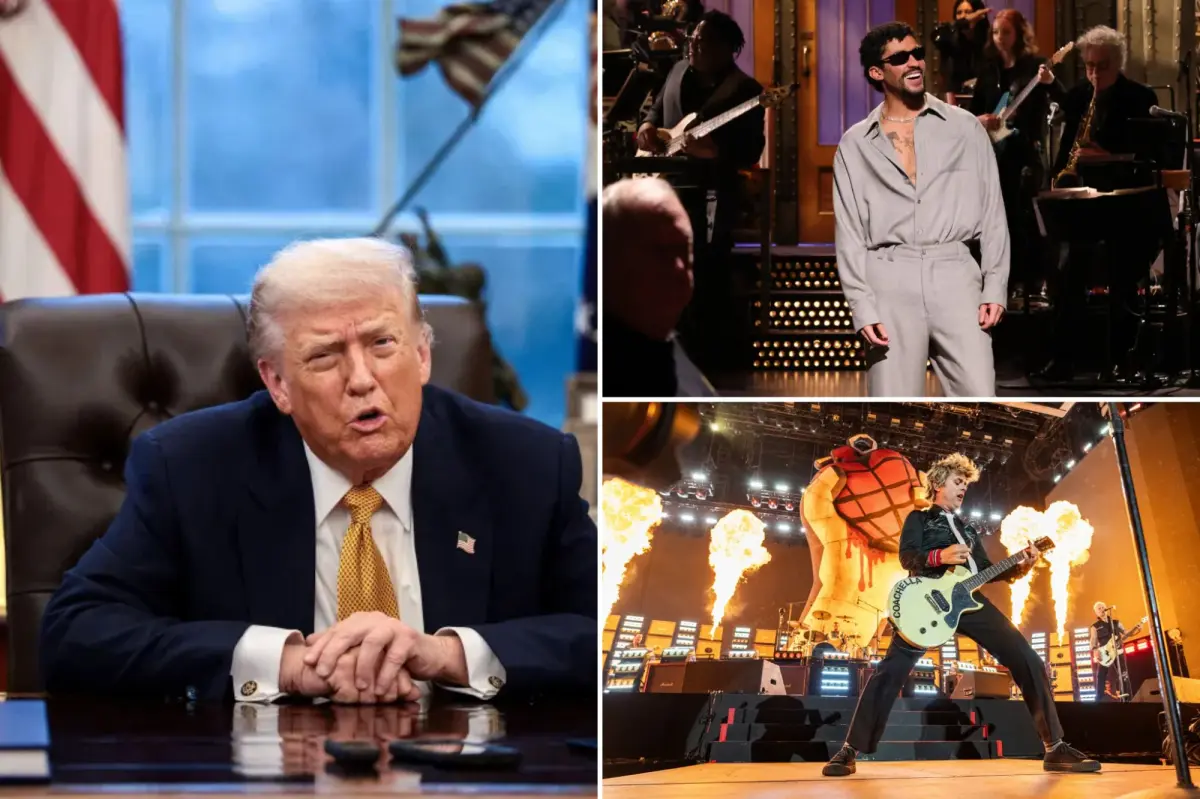
Trump Skips Super Bowl, Critiques Halftime Show Performers
In a candid Oval Office interview with The Post, President Trump revealed he won’t be attending this year’s Super Bowl in San Francisco. During the conversation, Trump expressed his displeasure with the selection of halftime show performers Bad Bunny and Green Day, both of whom have been openly critical of him in the past. “I’m anti-them. I think it’s a terrible choice. All it does is sow hatred. Terrible,” Trump stated firmly. Despite his strong views on the entertainment lineup, the president clarified that the performers weren’t his primary reason for missing the championship game on February 8th. Instead, he cited the practical challenge of distance: “It’s just too far away. I would. I’ve gotten great hands for the Super Bowl, they like me,” adding that he would attend “if it was a little bit shorter” of a journey.
The president’s criticism of the halftime performers comes as no surprise given the artists’ history of political statements directed at him. Bad Bunny, the Puerto Rican-born Latin trap superstar who has amassed an enormous Spanish-language following, has previously used his platform to critique Trump’s policies and rhetoric. Most notably, in his 2023 song “Nuevayol,” Bad Bunny incorporated an imitated Trump voice saying: “I want to apologize to the immigrants in America… This country is nothing without the immigrants. This country is nothing without Mexicans, Dominicans, Puerto Ricans, Colombians, Venezuelans, Cubans.” This direct challenge to Trump’s immigration stance likely contributed to the president’s unfavorable view of the artist’s selection for the high-profile performance.
Green Day, the second announced halftime performer, has also positioned itself in opposition to Trump’s politics. Just recently, the band’s lead singer Billie Joe Armstrong publicly supported anti-deportation protesters in Minnesota, declaring: “I’m not part of a redneck agenda. I’m not a part of the MAGA agenda.” These explicit political statements from both acts stand in stark contrast to Trump’s vision and policies, creating what the president perceives as an entertainment lineup that could “sow hatred” rather than unite viewers during America’s most-watched sporting event. The NFL’s selection of these particular artists for the San Francisco-hosted championship game reflects the inevitable intersection of entertainment, sports, and political expression in today’s cultural landscape.
Trump’s decision to skip the event marks a departure from his attendance at last year’s Super Bowl in New Orleans, where he watched the Philadelphia Eagles defeat the Kansas City Chiefs. That game gained additional attention due to pop superstar Taylor Swift’s presence cheering for the Chiefs, as her boyfriend Travis Kelce serves as the team’s tight end. The president’s absence from this year’s championship game removes what could have been an interesting dynamic, especially considering the political undertones already established by the halftime performers and the historically liberal host city of San Francisco.
The tension between Trump and the selected performers highlights the broader cultural divisions in America that often play out on national stages like the Super Bowl. With an estimated audience of over 100 million viewers, the halftime show represents one of the most-watched musical performances of the year and inevitably carries political significance regardless of who performs. Trump’s characterization of Bad Bunny and Green Day’s selection as “terrible” reflects his awareness of how such platforms can shape public discourse and perception. For their part, the artists have used their artistic voices to advocate for positions that directly challenge the former president’s policies, particularly regarding immigration and social justice issues.
While the Super Bowl is primarily a sporting event, this situation demonstrates how it has evolved into a cultural phenomenon that reflects America’s political climate. The president’s decision to skip the game due to distance rather than in direct protest of the performers suggests a practical consideration rather than a political statement, though his critical comments about the entertainment lineup reveal his awareness of the cultural messaging at play. As the event approaches, the absence of the former president coupled with performers who have openly opposed his agenda creates an interesting subtext to what is already one of America’s most significant cultural gatherings. Whether viewers tune in for the football, the commercials, or the controversial halftime show, this year’s Super Bowl will undoubtedly reflect the complex interweaving of sports, entertainment, and politics that characterizes contemporary American life.