


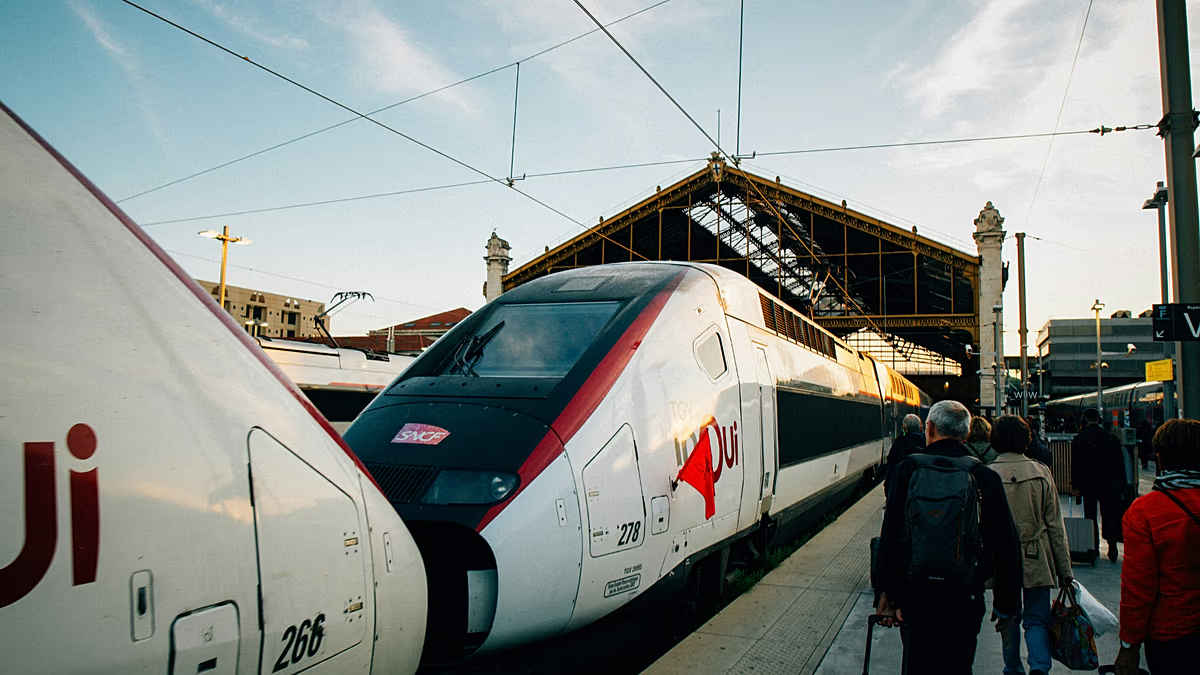
A Quiet Space vs. Family Access: France’s Railway Introduces Child-Free First Class
In a move that has sparked both support and outrage across France, SNCF, the country’s state railway operator, has introduced a new premium first-class service called “Optimum Plus” that explicitly excludes children under 12 years old. Launched in January as a replacement for the existing Business Première class, this service offers what SNCF describes as “a quiet dedicated space” primarily aimed at business travelers seeking a more focused environment for work or relaxation. The service currently operates only on the busy Paris-Lyon route, representing just 8% of available seating on weekday trains, but its child-free policy has ignited a broader conversation about family inclusion in public spaces and France’s declining birth rate.
The controversy erupted when podcast “Les Adultes de demain” (The Adults of Tomorrow) highlighted the policy on social media, declaring “a red line has been crossed and nobody is talking about it.” Their Instagram post accused France’s leading public transport company of “giving in to the ‘no kids’ policy,” suggesting that “instead of creating carriages for children, the SNCF Group is excluding them.” This criticism resonated with many who view the policy as symptomatic of a broader societal shift away from child-friendly environments. Economist Maxime Sbaihi connected the dots to France’s demographic challenges, writing on social platform X that the policy is “proof that the declining birth rate is also cultural; it makes children scarce to the point of making us intolerant of their presence.” Adding fuel to the controversy was the observation that while children are banned from these premium carriages, pets are permitted for a €10 fee per trip, creating what some see as a troubling prioritization.
France’s Children’s Commissioner Sarah El Haïry joined the chorus of criticism, expressing concern about the message such policies send. In a television interview, she articulated the apparent contradiction in France’s approach to its demographic future: “We can’t say, ‘Look out, we’re having fewer children, we’ve got demographic problems’ and send out such blunt signals.” Her statement highlighted the disconnect between national concerns about falling birth rates and policies that seem to marginalize families and children in public spaces. El Haïry’s pointed observation that “when you give the impression that adult comfort depends on the absence of children, it’s shocking” cuts to the heart of the debate about what kind of society France wants to be – one that accommodates families or one that increasingly segregates them from adult-oriented spaces.
In response to the growing backlash, SNCF has defended its policy by emphasizing the limited scope of the Optimum Plus offering. A spokesperson for the railway company told Euronews Travel that the restriction applies to only 8% of seats during weekdays and none on weekends, meaning “92% of seats during the week and 100% at weekends are open to everyone.” The company also pointed out that a similar policy had been in place for years with their previous Business Première service “without any negative feedback,” suggesting the controversy is more about perception than actual practice. SNCF further noted that despite “numerous requests” from customers asking for entirely child-free first-class carriages on TGV INOUI trains, the company has consistently refused to implement such broad restrictions, limiting the child-free policy only to this specialized business service.
To counter the narrative that they’re unfriendly to families, SNCF highlighted their extensive family-oriented services. “Children are welcome on board our trains. We offer very attractive family fares and family areas,” the spokesperson emphasized, pointing to features like nursery areas on TGV trains and their Junior & Compagnie program, which serves approximately 300,000 children annually. This response aims to position the Optimum Plus service not as anti-family but as one specialized option among many, designed for business travelers who need guaranteed quiet space for work during their journey. The railway operator appears to be walking a fine line between accommodating the needs of diverse passenger groups while trying not to alienate families who represent a significant customer base.
The debate over SNCF’s Optimum Plus service transcends a simple policy decision about train seating arrangements. Instead, it has become a lightning rod for broader social concerns about how public spaces accommodate – or exclude – children and families. In a country facing declining birth rates and demographic shifts, policies that explicitly exclude children, even in limited contexts, can take on symbolic significance beyond their practical impact. The controversy reflects tensions between competing social values: the right of business travelers and adults to quiet, distraction-free environments versus the importance of creating inclusive public spaces where families feel welcome. As France continues to navigate these competing demands, the SNCF controversy highlights how transportation policies can unexpectedly become proxies for larger debates about social priorities, demographic challenges, and what it means to create truly inclusive public services in a changing society.