



Winter Weather Woes: How Extreme Cold Grounded Flights in Finland
In a rare turn of events, thousands of tourists found themselves stranded in northern Finland last week when Kittilä airport had to cancel flights due to brutally cold temperatures. This situation was particularly noteworthy because Finland, with its long history of harsh winters, typically handles winter weather with remarkable efficiency. Finnish airports rarely shut down for snow or cold, making this event an unusual exception that left many wondering what exactly went wrong. While runways blanketed in snow might seem like the obvious culprit for flight cancellations, the reality is far more complex. The extreme temperatures at Kittilä, which plunged to minus 37 degrees Celsius on January 11th after several similarly frigid days, created challenges that went beyond what even Finland’s well-prepared airports could handle.
Finland’s expertise in winter airport management is legendary throughout Europe. Helsinki Airport exemplifies this winter-readiness with its impressive snow removal system that combines daily maintenance with targeted operations during heavy snowfall. Their approach is methodical and precise: airport staff draw up aircraft parking plans 12 hours in advance, strategically leaving several adjacent aircraft stands vacant to allow maintenance crews to focus their efforts on plowing large sections at once. This coordinated dance between flight operations and snow removal continues throughout the winter months, with aircraft stands being freed up in sections to maximize efficiency. For runway clearance, Helsinki Airport maintains a fleet of 200 specialized vehicles, including chemical sprayers and massive Vammas PSB 5500 sweeper blowers—31-tonne machines capable of clearing a 5.5-meter span of runway in just 11 minutes. These impressive machines can log up to 800 hours of operation during a typical winter season, forming the backbone of Finland’s winter airport operations.
The efficiency of Finland’s winter airport management extends beyond just having the right equipment—it’s also about having skilled personnel and finely tuned procedures. Helsinki Airport employs 135 trained maintenance workers, with 75 of them hired specifically for the winter season. Their runway-clearing process is remarkably streamlined: the standard window for clearing Helsinki’s 3,500-meter-long, 60-meter-wide runways is just 13 minutes, though crews typically accomplish this feat in 11 minutes through carefully planned sweeping patterns and the strategic application of anti-icing agents. The system is so effective that when one runway is being cleared, operations can continue normally on the airport’s other two runways. Even airports beyond the Arctic Circle rarely close due to winter conditions. For perspective, Ivalo Airport experienced temperatures dropping to minus 35 degrees Celsius in 2023, yet managed to cancel only a single flight while maintaining all other operations—a testament to Finland’s winter weather preparedness.
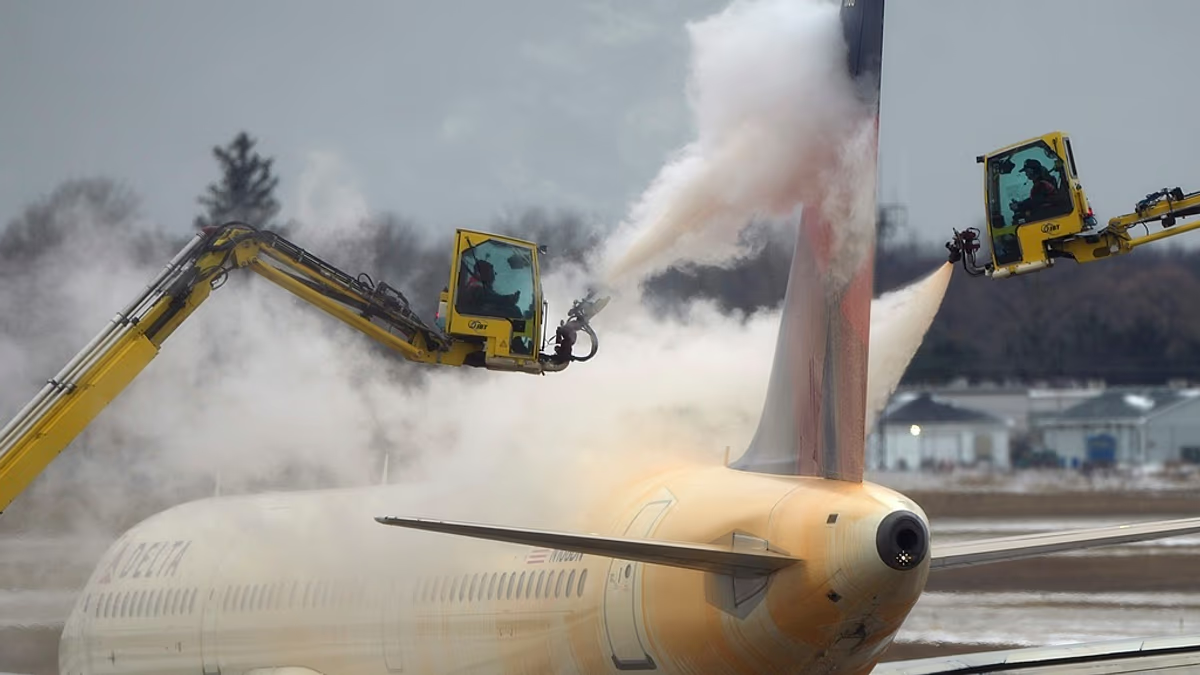
So what made the situation at Kittilä airport different? The extreme cold that settled over northern Finland created a perfect storm of challenges that overwhelmed even Finland’s well-prepared systems. While snow and icy conditions simultaneously can stretch resources thin, the bigger issue was the thick ice forming on the exterior of aircraft—coating mechanical parts and freezing wing flaps solid. As aerospace engineering expert Joris Melkert explained, “It is extremely dangerous to fly with ice on the wings. The airflow around the wing is disrupted. The aircraft then stalls and crashes.” This risk necessitates a thorough de-icing process before any flight can safely depart, involving first clearing ice with warm water and then applying a protective layer of antifreeze—a procedure that typically takes between 10 and 30 minutes per aircraft. In Kittilä’s case, the sustained extreme temperatures created conditions where ground equipment connectors and vehicle hatches froze solid during refueling operations, and the de-icing process itself became impossible to perform. Finavia, which manages Finland’s airport network, explained that “due to the extremely challenging conditions, airlines were forced to cancel flights to Kittilä on Friday, Saturday and Sunday,” leaving thousands of tourists stranded.
The situation in Finland echoes similar challenges faced by Amsterdam’s Schiphol airport earlier in January, though with key differences that highlight the varying levels of winter preparedness across European airports. At Schiphol, over 3,000 flights were cancelled as freezing weather moved in—not just because of snow-covered runways, but primarily due to aircraft de-icing complications. Unlike Finnish airports, Schiphol chose not to install de-icing facilities at every runway due to cost considerations, creating bottlenecks during severe weather as aircraft needed to taxi longer distances to reach de-icing areas. The prolonged freezing conditions strained KLM (which handles most de-icing operations at Schiphol), depleting their supply of de-icing fluid despite deploying all 100 specialized employees and 25 de-icing trucks. The situation became so dire that KLM had to send employees to Germany to source additional de-icing fluid—more than 100,000 liters—before operations could gradually resume. One KLM employee, speaking anonymously, lamented that “this domino effect causes Schiphol to completely seize up on days like these with snow. We are the laughingstock of Europe.”
The contrasting experiences of Finnish airports and Schiphol illustrate an important reality about winter air travel: even the most prepared airports have their breaking point when extreme conditions persist. Finland’s airports, with their specialized equipment, trained personnel, and well-rehearsed procedures, represent the gold standard in winter operations, yet even they were forced to cancel flights when temperatures dropped to exceptional lows. The Kittilä incident reminds us that air travel, for all its technological advancement, remains at the mercy of extreme weather. While Finland’s expertise in managing winter conditions is unmatched—allowing their airports to operate smoothly through conditions that would paralyze facilities in warmer countries—even these Arctic experts occasionally face weather that exceeds their considerable capabilities. As climate change potentially brings more extreme and unpredictable weather patterns, the resilience of aviation infrastructure worldwide will continue to be tested in new and challenging ways.