


Libya’s Tourism Revival: A Journey Through a Recovering Nation
In November 2025, after a 14-year hiatus, adventure travel pioneer James Wilcox of Untamed Borders led his first expedition to southern Libya, marking a significant moment in the country’s gradual return to the global tourism map. Libya’s journey back from a devastating six-year civil war and sporadic post-ceasefire conflicts represents one of the travel industry’s most remarkable recovery stories. Despite remaining on many governments’ “do not travel” lists, Libya is experiencing a tourism renaissance, with the government actively implementing measures to welcome international visitors again. The country has introduced an e-visa system in 2024, dramatically simplifying what was once a lengthy bureaucratic process. Where travelers previously faced embassy visits and months of waiting, they can now complete an online application typically approved within weeks. This policy shift is part of a deliberate two-year push to revitalize tourism, complemented by the reopening of key attractions like Tripoli’s National Museum after a 14-year closure, and extensive UNESCO-supported renovations to Tripoli’s Old City. Additional developments include resumed construction on the Al-Andalus Tourist Complex featuring hotels and a marina, hosting events like the Wadi al-Hayat desert rally, and creating a new national airline to improve international connectivity.
The results of these efforts are already evident in the numbers. According to Tourism Minister Nasr El-Din Al-Fezzani, the first half of 2025 saw a 60 percent increase in visitors compared to the previous year, with government reports indicating 282,000 people visited key archaeological sites like Sabratha and Leptis Magna. This visitor surge coincides with a period of relative stability that has opened previously inaccessible regions. Untamed Borders, for instance, has experienced a 200 percent increase in Libya bookings compared to 2024, with 2026 reservations already exceeding total bookings from two years ago. Their November expedition to southern Libya included UNESCO World Heritage sites in Jebel Acacsus, the Ubari Oases, and the desert town of Ghat, as well as Gadamis, the whitewashed desert city on the Tunisian border. They’ve also resumed private trips to eastern Libya, visiting Benghazi, the ancient remains of Apollonia, and UNESCO-listed Cyrene. This geographical expansion of tourism activities represents a significant milestone in Libya’s recovery, allowing visitors to experience the country’s extraordinary archaeological and natural treasures after years of inaccessibility.
Despite these promising developments, traveling in Libya still presents unique challenges that require preparation and flexibility. Tourists must navigate permit requirements, potential security risks, and logistical complications, especially in remote areas. Perhaps the most notable requirement is the mandatory government security officials or police escort for foreign visitors. While this might initially sound alarming, French lawyer Didier Goudant, who joined Wilcox’s tour to southern Libya, found the experience less restrictive than expected. “The policeman in the north, in Tripoli, was a really nice guy. He had never been to some of the places we went to, so he was very pleased and was taking pictures with us,” Goudant explained. He noted that their officer was unarmed and dressed in civilian clothes, primarily there to facilitate smooth passage through checkpoints rather than to monitor or restrict their movements. The main limitation is the need to adhere to pre-approved itineraries, as changes require submitting new applications, making spontaneous detours difficult. This structured approach to tourism reflects Libya’s cautious balance between opening its doors and maintaining security controls during its transition period.
Travel insurance presents another significant hurdle for potential visitors, as Libya remains on many governments’ advisories against travel. The UK’s Foreign, Commonwealth & Development Office, for example, advises against all travel to Libya except for the cities of Benghazi and Misrata. This necessitates finding specialized insurance providers willing to cover travel to regions under government warnings, as standard policies typically become invalid in such circumstances. Yet for adventurous travelers like Goudant, who has visited destinations including Afghanistan and Iraq, these administrative challenges rarely deter exploration. “Basically, when you say Libya, Iraq, Afghanistan, people think it’s still a war zone, still fighting, which is not the case. That’s the problem with how the news is managed and presented now,” he observes. Beyond administrative concerns, certain travelers face additional considerations. LGBTQ+ visitors should be aware that homosexuality is illegal in Libya, and public displays of affection should be avoided. Women travelers, while facing less restrictive dress codes than in some other conservative Muslim countries, are advised to avoid revealing or form-fitting clothing out of respect for local customs and to minimize unwanted attention.
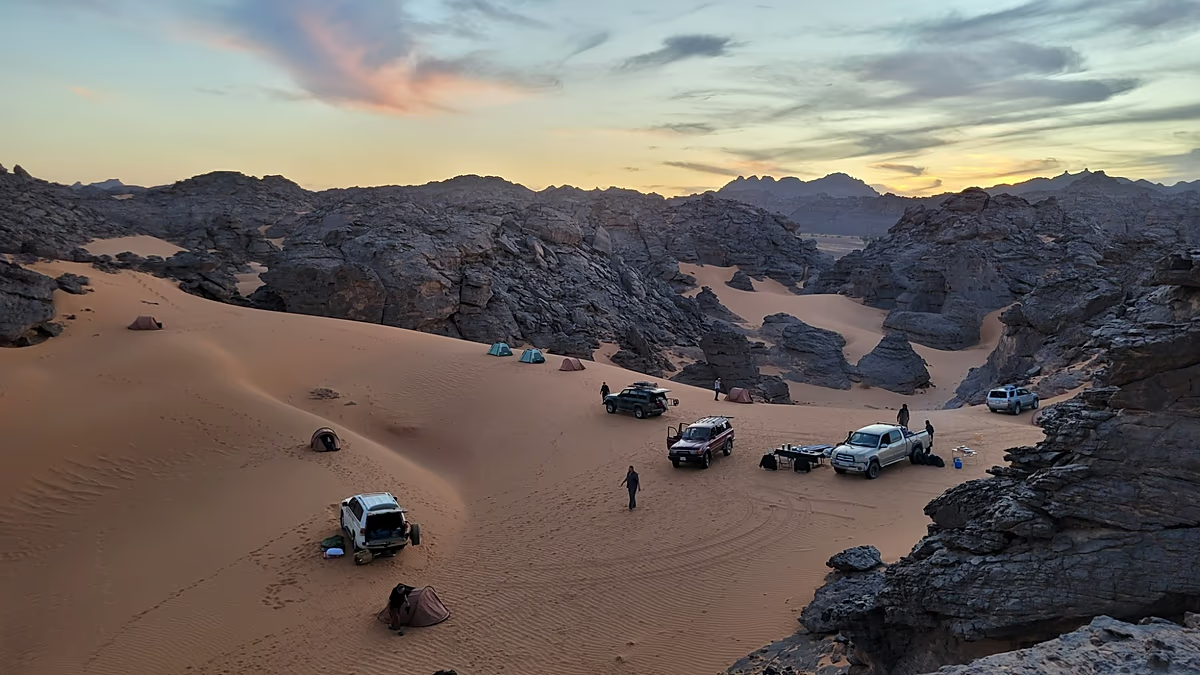
The revival of tourism infrastructure represents another vital component of Libya’s recovery story. After more than a decade of tourism standstill, accommodation and hospitality facilities are gradually being restored and expanded. In Tripoli, international-standard hotels like the Radisson Blu serve diplomatic and business travelers, though Wilcox’s groups typically opt for less conspicuous properties. “We always go to a less flashy hotel because of the cost, and also you’re less of a target, but the one in Tripoli was still really nice and modern,” notes Goudant. The situation differs significantly in the country’s south, where investment is flowing but at a more measured pace. Near Jebel Aqaqus, only one hotel has reopened, while in the border town of Ghat, several properties are undergoing renovation but weren’t yet available during Goudant’s visit. “We stayed in sort of a guest house. It used to be a school, I think, because there is no hotel fit for European standards,” he recalls. Wilcox adds that the desert was once dotted with popular campsites before the war, but these facilities remain largely disused today. For intrepid travelers like Goudant, however, this underdevelopment offered its own rewards, as their group free-camped among the dunes, with guides knowing precisely where to find spectacular, secluded spots.
For travelers willing to embrace Libya’s unique challenges and ongoing transition, the rewards are substantial—pristine archaeological sites without crowds, majestic desert landscapes, and interactions with people eager to welcome visitors after years of isolation. The Libyan people’s hospitality makes a particularly strong impression on visitors like Goudant: “I really like Muslim countries, I always have a very good experience. People are really nice, welcoming and friendly.” This sentiment is echoed by those who traveled to Libya in earlier decades, before the war, who consistently describe it as a “great country” worth experiencing. As Libya cautiously reopens to the world, it offers a rare opportunity for cultural exchange in a nation actively rebuilding itself. “They’re not used to having tourists in Libya, especially in the provinces in the south, but people are really welcoming. The landscape is stunning and the dunes in the Sahara are incredible. I’d like to return,” concludes Goudant. This emerging tourism narrative represents more than just a travel trend—it symbolizes Libya’s gradual reintegration into the global community, with each visitor contributing to the economic and social recovery of a country working to redefine itself after years of conflict and isolation.