


Riley Gaines: A Mother’s Courage in the Midst of Controversy
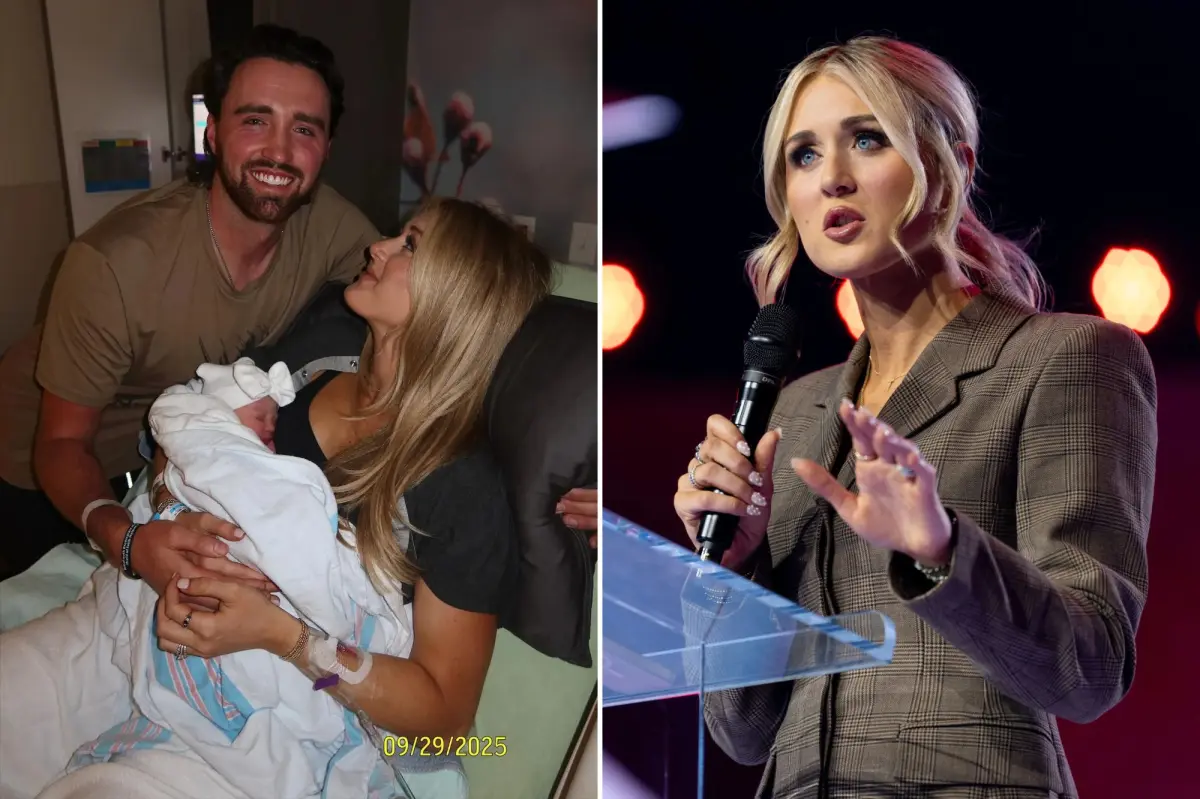
In a world where standing up for what you believe can come with significant personal costs, former collegiate swimmer Riley Gaines has found herself navigating not only the complexities of new motherhood but also serious threats to her safety. The 25-year-old women’s rights advocate recently revealed that death threats against her have become so severe that she’s been forced to wrap her 3-month-old daughter, Margot, in a bulletproof blanket—a stark illustration of the price she’s paying for her high-profile stance on transgender athletes in women’s sports. This protective measure came to light following her attendance at Tuesday’s Supreme Court arguments in a pivotal case that could determine whether transgender women can compete in female sports categories. Speaking candidly to Fox News’ “Outnumbered” the day after the hearing, Gaines shared her emotional reality: “There’s a level of emotion to it, especially when you have to consider the fact that you have a 3-month-old baby that you have to wrap in a bulletproof blanket because of the threats that were present there yesterday.” Such bulletproof protection doesn’t come cheap, with blankets marketed for infants typically costing between $500 and $2,000, depending on the level of protection provided—a sad reflection of the increasing demand for such products in an era marked by mass shootings and political violence.
Despite these challenges, Gaines has not allowed threats to deter her from her advocacy work or from including her daughter in her journey. With a touch of maternal pride, she mentioned that little Margot “goes everywhere” with her, having already traveled to 16 states and even met former President Trump in her short life. “She’s gonna be super dangerous at two truths and a lie one day,” Gaines quipped, finding a moment of levity amidst serious circumstances. But this light-hearted comment belies the gravity of her situation—a young mother who feels compelled to take extraordinary measures to protect her infant while continuing her advocacy work. Gaines’s decision to bring her daughter to the Supreme Court steps was both a personal choice and a powerful symbol of what she believes is at stake in these legal battles. “The past three months now, it’s shifted my perspective on everything,” she explained. “The things you thought you would never care about, they feel critical… My daughter—she’ll be right here with me tomorrow on the Supreme Court steps, because that’s who we’re fighting for.”
The Supreme Court cases at the heart of this controversy—Little v. Hecox and West Virginia v. B.P.J.—represent a significant legal crossroads in the debate over transgender athletes’ participation in women’s sports. The cases challenge laws in Idaho and West Virginia, which are among nearly 30 states that have enacted legislation barring transgender students from competing on girls’ sports teams. These laws were previously blocked in court following successful legal challenges brought by transgender athletes in 2020 and 2021. During the hearing, the justices examined whether Title IX—the landmark federal law banning sex discrimination in education—applies to these inclusion cases. For Gaines, the legal battle transcends policy arguments; it’s deeply personal. She rose to national prominence after criticizing the NCAA for allowing former transgender University of Pennsylvania swimmer Lia Thomas to compete in women’s sports and has since become one of the leading voices against transgender athletes in women’s and girls’ competitions.
In her Fox News appearance, Gaines didn’t mince words about where she stands politically on this issue. “All these Democrats and their insane policies and the things they support—I think 130 Democrats signed a brief supporting the boys in the case,” she said with evident frustration. “They think they are giving the middle finger to President Trump. That’s not who they are giving the middle finger to. They are giving the middle finger to my little baby girl.” This statement highlights how deeply intertwined the transgender sports debate has become with broader political divides in America, with both sides claiming to protect vulnerable populations. The transgender athletes in these cases are represented by the American Civil Liberties Union, which has framed the bans as discriminatory violations of civil rights, while advocates like Gaines argue they’re necessary protections for women’s and girls’ athletic opportunities.
For Gaines, becoming a mother has clearly intensified her commitment to this cause. Her experience illustrates how political advocacy can become more personal—and potentially more dangerous—when viewed through the lens of parenthood. Her choice to bring her infant daughter to a high-profile, contentious Supreme Court hearing makes a powerful statement about her convictions, while simultaneously highlighting the personal risks she’s taking. The image of a mother wrapping her baby in bulletproof material before heading to the Supreme Court is jarring in a nation that prides itself on freedom of expression and peaceful political discourse. It raises questions about the state of public debate on contentious social issues and the real-world consequences for those who step into the spotlight as advocates.
As the Supreme Court deliberates on these cases that could reshape the landscape of women’s sports across America, Riley Gaines continues to navigate her dual roles as a new mother and a public figure at the center of a heated national debate. Her story reflects the deeply personal nature of what might otherwise be viewed as abstract policy discussions—reminding us that behind every political argument are real people with real lives at stake. Whatever one’s position on transgender athletes in women’s sports, the fact that a young mother feels compelled to use bulletproof protection for her infant while exercising her right to political expression should give us all pause. As our society continues wrestling with questions of inclusion, fairness, and rights, Gaines’s experience highlights the human costs of these debates and the importance of finding ways to discuss our differences without resorting to threats or violence.