


Senate Hearing Reveals Deep Divisions on Abortion and Gender
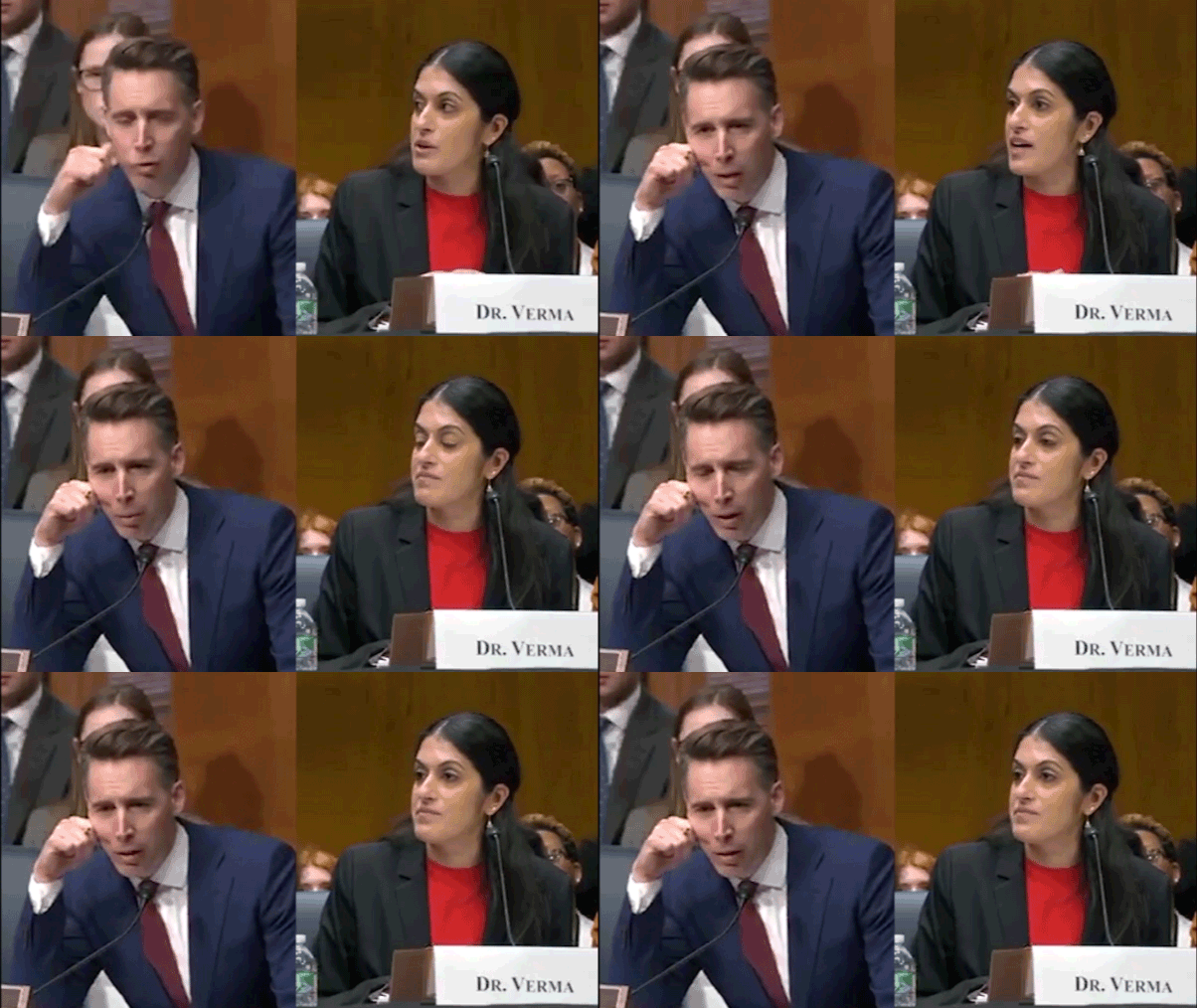
In a tense Senate Health, Education, Labor and Pensions Committee hearing titled “Protecting Women: Exposing the Dangers of Chemical Abortion Drugs,” Republican Senators Josh Hawley of Missouri and Ashley Moody of Florida sparked controversy during their questioning of OB-GYN Dr. Nisha Verma. The exchange, which quickly went viral on social media, centered around a seemingly straightforward question: “Can men get pregnant?” What followed illustrated the profound cultural and political divides that continue to shape American discourse on gender, biology, and reproductive rights. The hearing, intended to examine the safety of abortion medication, instead became a flashpoint in the ongoing national debate about gender identity and biological definitions.
The confrontation began when Senator Moody posed the question to Dr. Verma, who responded with caution, explaining that she treats patients with various gender identities and was uncertain about the direction of the questioning. Senator Hawley then intervened, repeatedly pressing for a direct yes-or-no answer, insisting, “The goal is to establish a biological reality.” Dr. Verma pushed back against the framing, suggesting that reducing the complex issue to a binary question was inherently political and risked further polarizing an already divisive topic. Despite continued pressure, she maintained her position, expressing a preference for a more nuanced conversation rather than the simplified response the senators demanded. Hawley eventually concluded the exchange by asserting, “For the record, it’s women who get pregnant, not men,” before attempting to redirect attention to the stated purpose of the hearing: examining the safety of abortion medication.
Following the hearing, both senators took to social media to amplify their positions. Hawley posted on X (formerly Twitter), “SPOILER ALERT: Men cannot get pregnant,” later adding, “Can men get pregnant? Not a difficult question.” Senator Moody similarly shared a clip of the exchange with the simple caption, “Can men get pregnant?” In a statement to Fox News Digital, Moody criticized what she characterized as “agenda driven and radicalized Democrats” who “will overlook not only scientific fact but the harsh and dangerous consequences of their mission to ensure there are absolutely no restrictions to abortion on demand.” The senators’ framing of the exchange sought to position their questioning as a straightforward matter of biological reality, while implicitly criticizing perspectives that acknowledge gender as distinct from biological sex.
The hearing itself, which featured testimony from Louisiana Attorney General Liz Murrill, Dr. Verma, and Dr. Monique Chireau Wubbenhorst, was ostensibly organized to discuss chemical abortion drugs and their regulation. However, the viral exchange reveals how discussions of reproductive health are increasingly entangled with broader cultural conflicts about gender identity. For conservative lawmakers, emphasizing traditional biological definitions serves multiple purposes: it aligns with their constituencies’ values, challenges progressive frameworks of gender, and provides a foundation for their arguments about abortion regulation. By contrast, medical professionals like Dr. Verma often find themselves navigating complex terrain where clinical practice, patient respect, and polarized politics intersect, making even seemingly simple questions fraught with implications.
This confrontation exemplifies how congressional hearings increasingly function as stages for performative politics rather than forums for substantive policy discussion. Both senators quickly leveraged the exchange on social media, where simplified versions could circulate among supporters. The hearing’s original purpose – examining abortion medication safety – was temporarily overshadowed by the gender identity discussion, highlighting how reproductive rights debates have expanded beyond traditional pro-choice versus pro-life frameworks to encompass questions about gender, biology, and medical authority. In this environment, medical experts like Dr. Verma must navigate between providing accurate information and avoiding political traps designed to generate viral content rather than inform policy.
The timing of this hearing is particularly significant as abortion remains a central political issue following the Supreme Court’s overturning of Roe v. Wade in 2022. Access to abortion medication has become a crucial battleground, with some states seeking to restrict these drugs while the federal government has worked to preserve access. Chemical abortion medications now account for a majority of abortions in the United States, making their regulation a high-stakes issue. For Republicans like Hawley and Moody, linking abortion access to broader cultural issues around gender helps solidify support among conservative voters concerned about both topics. Democrats, meanwhile, have emphasized medical autonomy and access to healthcare, including abortion medication, as essential rights that should be protected from political interference.
As the 2024 presidential election approaches, this Senate hearing foreshadows how reproductive rights and gender issues will likely remain intertwined in American politics. The viral exchange between the senators and Dr. Verma demonstrates the difficulty of conducting nuanced policy discussions in an environment where political positioning often takes precedence over substantive debate. Medical professionals caught in these crossfires face particular challenges: maintaining scientific accuracy while respecting diverse patient identities, avoiding politically charged language while still communicating clearly, and preserving their professional credibility in highly partisan contexts. As lawmakers continue to debate abortion access and gender definitions, these tensions are likely to persist, making the path toward consensus or compromise increasingly difficult to navigate in America’s polarized political landscape.