


Webb Telescope Discovers Atmosphere on a Hellish Exoplanet
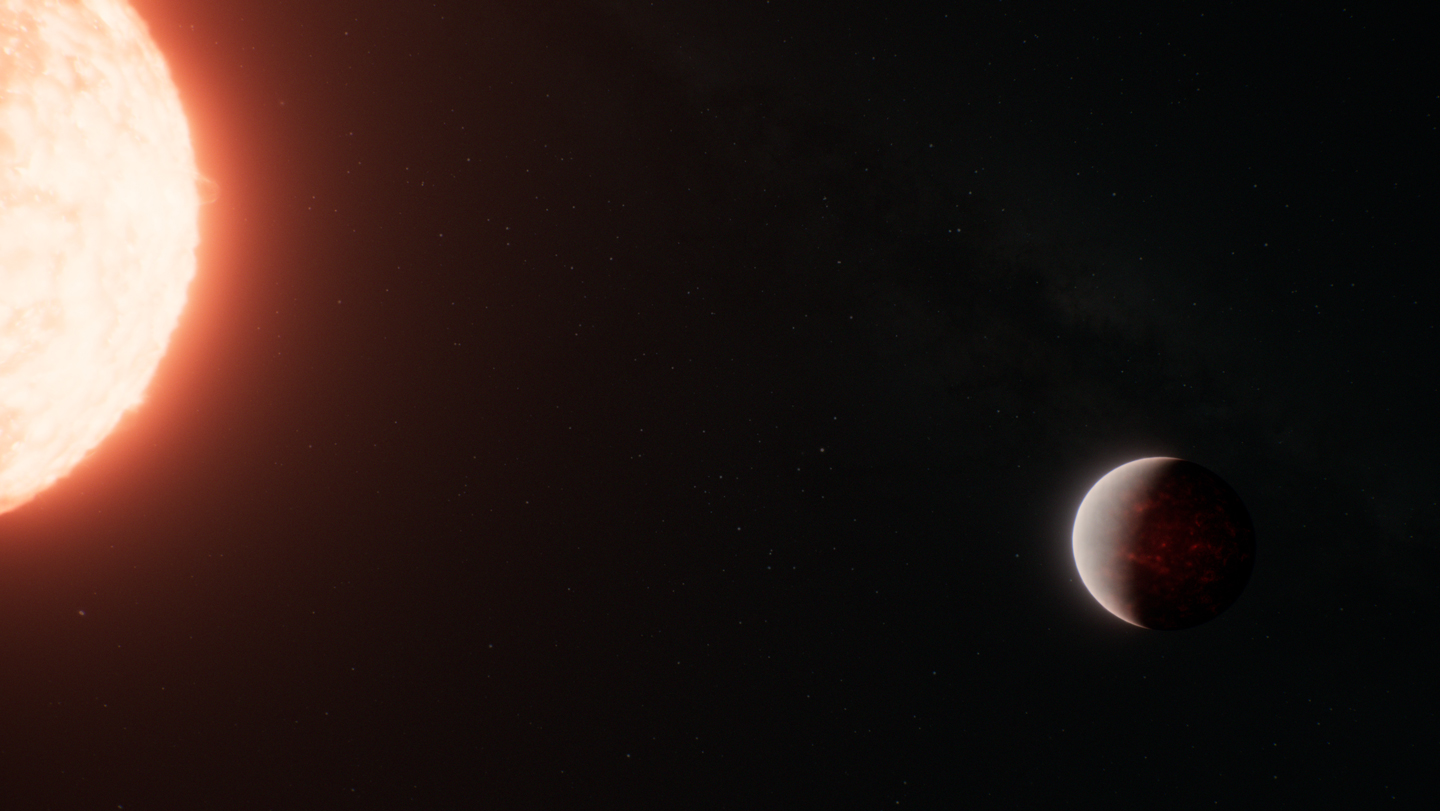
In a groundbreaking discovery that pushes the boundaries of our understanding of planetary systems, the James Webb Space Telescope (JWST) has detected an atmosphere surrounding a scorching exoplanet covered in molten lava. This remarkable finding challenges previous assumptions about small planets orbiting close to their host stars, suggesting that these worlds might retain atmospheres despite their extreme environments. Scientists had long theorized that intense stellar radiation would strip away any atmosphere from planets in such proximity to their stars, but this discovery opens up new possibilities about the diversity of worlds across our galaxy.
The exoplanet in question exists in conditions that defy imagination – its star-facing surface likely hosts oceans of molten rock that flow across a landscape bathed in searing heat. Despite these hellish conditions, the Webb telescope’s sensitive instruments detected the unmistakable signatures of an atmosphere, allowing scientists to analyze its composition using spectroscopy. This technique, which breaks down light into its component wavelengths, revealed elements and compounds present in the atmosphere, providing valuable insights into this alien world. The discovery required the Webb telescope’s unprecedented infrared sensitivity, which can detect subtle atmospheric signals that previous instruments simply couldn’t observe.
This finding has profound implications for our search for habitable worlds. While this particular lava planet is certainly inhospitable to life as we know it, the fact that it maintains an atmosphere suggests that other small rocky planets might similarly retain their atmospheric envelopes, even when orbiting relatively close to their stars. This dramatically expands what astronomers call the “retention zone” – the range of planetary conditions where atmospheres can persist over long timescales. Understanding atmospheric retention helps scientists refine models of planetary formation and evolution, potentially guiding future exoplanet searches toward the most promising candidates for hosting life.
The research team behind this discovery employed innovative observational techniques and data analysis methods to distinguish the atmospheric signals from background noise. Multiple observations across different wavelengths helped confirm the detection, ruling out potential instrumental artifacts or misinterpretations. The composition of this atmosphere provides clues about the planet’s formation history and subsequent evolution under extreme conditions. Scientists are particularly interested in understanding what mechanisms allow this atmosphere to persist despite the intense stellar radiation that should theoretically strip it away. This puzzle points to complex physical processes that weren’t previously incorporated into models of planetary atmospheres.
This discovery exemplifies the transformative capabilities of the James Webb Space Telescope, which continues to revolutionize our understanding of the cosmos since its launch and deployment. As the most powerful space telescope ever built, Webb was specifically designed to study exoplanet atmospheres, with specially calibrated instruments capable of detecting the faintest atmospheric signatures across vast cosmic distances. The telescope’s ability to observe in infrared wavelengths gives it unique advantages for studying exoplanets, as many atmospheric components absorb and emit strongly in this part of the electromagnetic spectrum. This technical achievement represents the culmination of decades of astronomical innovation and international scientific collaboration.
Looking ahead, astronomers plan to expand this research to other exoplanets, building a more comprehensive understanding of atmospheric dynamics across different planetary types and orbital configurations. This discovery of an atmosphere on a lava world is just the beginning of Webb’s contributions to exoplanet science. The telescope’s ongoing mission promises to reveal more diverse worlds with unique atmospheric compositions, potentially including rocky planets with conditions more suitable for life. Each new atmospheric detection adds another piece to the puzzle of planetary formation and evolution, helping scientists understand our own solar system in the broader context of the galaxy’s planetary diversity. The Webb telescope continues to push the frontiers of human knowledge, revealing that even in the most extreme cosmic environments, nature finds surprising ways to challenge our expectations.