


A Life Saved: Quick Action and Compassion on a Tennessee Bridge
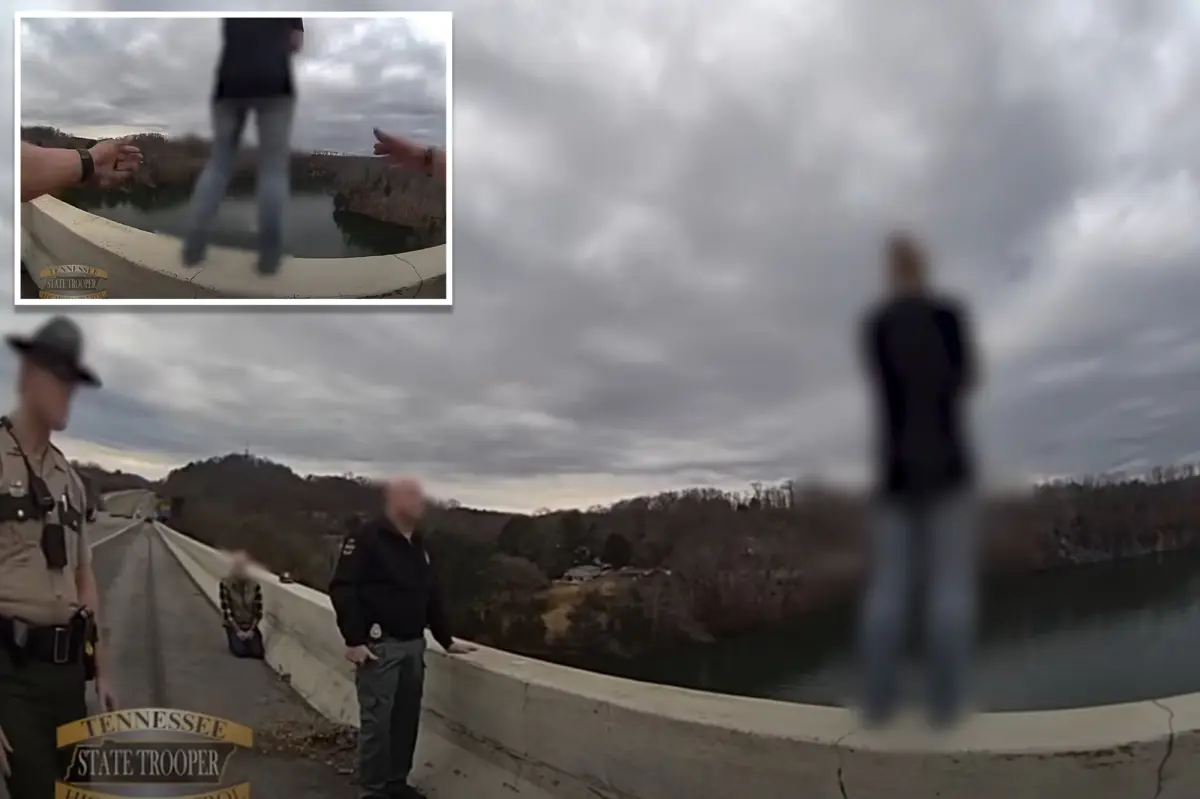
In a powerful demonstration of human connection and swift response, a Tennessee Highway Patrol officer saved a woman’s life the day after Christmas by pulling her to safety from the edge of the Holston River bridge on Interstate 81. The dramatic rescue, captured on bodycam footage, stands as a poignant reminder of both the dark places our minds can take us and the profound impact of compassionate intervention during moments of crisis.
The incident began when emergency services responded to reports of a distressed woman on the bridge. Upon arrival, they encountered a scene that has unfortunately become all too familiar in our modern world – a fellow human being standing precariously on a ledge, contemplating ending her suffering in the most permanent way. As officers and EMS personnel attempted to engage with her through conversation, one quick-thinking highway patrol officer recognized a critical moment and took decisive action, lunging forward to pull the woman from the precipice and back to safety. In that split-second decision, a life hung in the balance, and through human connection and courage, it was preserved.
The Tennessee Highway Patrol later shared this story on social media, highlighting not just the dramatic rescue but the deeper meaning behind it: “A woman was in a dark place and was considering jumping. Because people showed up and worked together, she is alive tonight. Today ended with a life saved. That matters.” These simple yet profound words cut to the heart of why such incidents deserve our attention – not as spectacle, but as testament to our collective responsibility toward one another. Following the rescue, the woman, whose identity remains protected, received medical attention and was transported for further evaluation and care, beginning what will hopefully be a journey toward healing.
The timing of this incident – during the holiday season – adds an additional layer of significance that the Highway Patrol acknowledged in their statement: “This time of year can be especially hard. Many people are carrying things no one else can see. Stress, grief, loneliness and fear can pile up fast. That doesn’t mean someone is weak. It means they are human.” This recognition speaks to a universal truth that transcends this specific incident. The period between Thanksgiving and New Year’s, often portrayed as exclusively joyful in media and advertising, can actually intensify feelings of isolation, loss, and despair for many. Financial pressures, family complications, and the contrast between idealized holiday narratives and one’s personal reality create a perfect storm that can push vulnerable individuals toward crisis points.
What makes this story particularly meaningful is not just the dramatic rescue itself, but what it represents about our interconnected humanity. In a fraction of a second, the responding officer made a choice that affirmed the fundamental value of a stranger’s life. Without hesitation, without calculation, they acted on the belief that this person – regardless of what brought her to that bridge – deserved another chance, another tomorrow, another opportunity to find light amid darkness. The bodycam footage, while intense, serves as a visual testament to what happens when we recognize ourselves in others and respond accordingly. It demonstrates how the decision to intervene – to literally reach out – can alter the trajectory of a human life in ways we may never fully comprehend.
This incident also highlights the crucial importance of mental health awareness and suicide prevention resources. While the woman received immediate help because she was visibly in crisis in a public place, countless others struggle silently each day. Mental health professionals consistently emphasize that suicidal thoughts should always be taken seriously and that reaching out for help is an act of courage, not weakness. Resources such as the 988 Suicide and Crisis Lifeline (formerly known as the National Suicide Prevention Lifeline) provide 24/7 support for anyone experiencing emotional distress or suicidal thoughts. In New York City, residents can access NYC Well at 1-888-NYC-WELL for free, confidential crisis counseling. These services represent lifelines similar to the physical one extended by that highway patrol officer – connections that bridge the gap between despair and hope.
As we reflect on this story from a Tennessee bridge, perhaps its greatest value lies in what it asks of each of us. While few will find themselves in position to physically pull someone from a ledge, we all encounter people carrying invisible burdens. The Highway Patrol’s message that people “carrying things no one else can see” are not weak but simply human invites a profound shift in perspective. It challenges us to approach others with generosity of spirit, to recognize that behind every face is a complex story, and to understand that sometimes the most important thing we can do is simply show up – for family members, friends, colleagues, or even strangers. In a world that often feels increasingly disconnected despite our digital connections, this rescue on the Holston River bridge stands as a powerful reminder that being present for one another in moments of crisis isn’t just a professional duty for first responders – it’s a fundamental aspect of our shared humanity.