



China’s Nuclear Expansion Accelerates as Arms Control Talks Stall
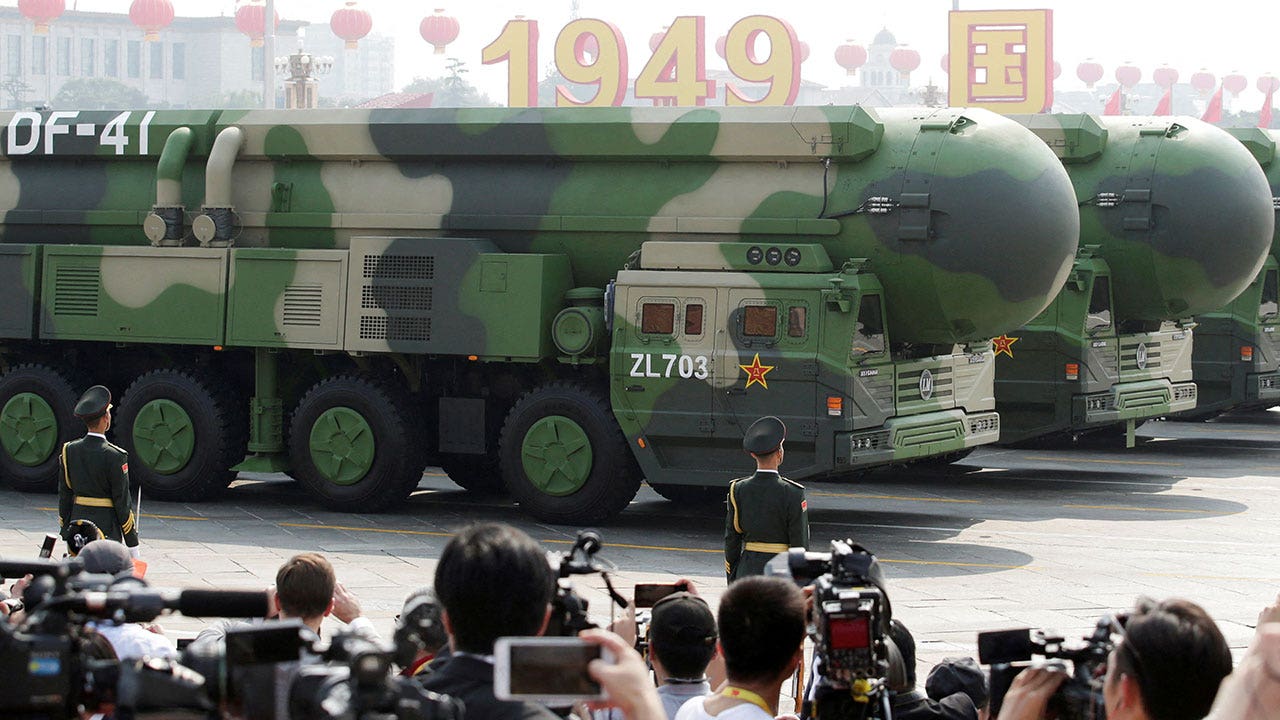
In a concerning development that highlights the shifting dynamics of global nuclear powers, China has reportedly loaded more than 100 intercontinental ballistic missiles (ICBMs) into three newly constructed silo fields near its Mongolian border, according to a draft Pentagon report recently obtained by Reuters. This military buildup reflects Beijing’s broader strategy to expand and modernize its nuclear arsenal at a pace unmatched by any other nuclear power. Despite repeated dismissals from Chinese officials, who characterize such assessments as attempts to “smear and defame China,” the evidence points to an increasingly assertive nuclear posture that contrasts with China’s stated policy of maintaining a minimal nuclear deterrent. The Pentagon has declined to comment directly on these findings, but the report’s details align with previous U.S. military assessments about China’s growing military capabilities and ambitions.
The acceleration of China’s nuclear program comes at a particularly sensitive time in international relations, with arms control frameworks under significant strain. While former U.S. President Donald Trump had expressed interest in pursuing denuclearization discussions with both China and Russia, the Pentagon report suggests Beijing shows little interest in engaging in such negotiations. “We continue to see no appetite from Beijing for pursuing such measures or more comprehensive arms control discussions,” the report states. This reluctance is especially problematic as the New START treaty—the last remaining nuclear arms agreement between the United States and Russia, which limits both nations to 1,550 deployed strategic nuclear warheads—approaches its expiration. Without Chinese participation in future arms control frameworks, security experts warn that meaningful constraints on nuclear arsenals will become increasingly difficult to achieve, potentially triggering a new arms race.
Technical details from the draft report provide a clearer picture of China’s nuclear ambitions and capabilities. The newly loaded missiles are reportedly solid-fueled DF-31 ICBMs, positioned in silo fields near the Mongolian border—a strategic location that offers certain advantages for China’s nuclear posture. While China’s current nuclear warhead stockpile remains in the low 600s—reflecting what the report describes as a slower production rate compared to previous years—Beijing appears on track to exceed 1,000 nuclear warheads by 2030. This trajectory represents a significant expansion from China’s historically modest nuclear arsenal and suggests a fundamental shift in its nuclear doctrine. Though Chinese officials maintain that the country adheres to a nuclear strategy of self-defense with a no-first-use policy, security analysts note that Beijing’s public messaging and military developments increasingly contradict these claims of restraint.
The implications of China’s nuclear buildup extend beyond mere numbers to affect regional security dynamics, particularly regarding Taiwan. According to the Pentagon assessment, China expects to develop the capability to fight and win a war over Taiwan by the end of 2027—a timeline that aligns with previous U.S. intelligence estimates. The report warns that Beijing is refining options to seize the self-governed island by “brute force,” including developing long-range strike capabilities that could reach up to 2,000 nautical miles from the mainland—potentially disrupting U.S. military operations throughout the Asia-Pacific region. This military preparation occurs against the backdrop of increasing diplomatic and economic pressure on Taiwan, which China claims as its sovereign territory despite Taiwan’s democratic governance and de facto independence since 1949.
Defense analysts offer varied interpretations of these developments, with some suggesting that China’s nuclear expansion reflects its perceived place in the global order. “China has no interest in locking in a long-term strategic disadvantage, and every intention of building an arsenal on par with its perceived place in the world, alongside and potentially eventually ahead of the United States,” notes Jack Burnham of the Foundation for Defense of Democracies. Other experts point to the still-incomplete nature of China’s nuclear buildup, with Gordon Chang observing, “What is surprising is that China has now loaded only about 100 of the silos it has built recently. That’s an indication money is tight in the People’s Liberation Army.” This assessment suggests potential economic constraints on China’s military ambitions, despite the country’s significant investments in defense modernization.
The international community now faces difficult choices in responding to China’s nuclear expansion. Traditional arms control approaches that worked during the Cold War may prove inadequate in a multipolar nuclear environment where rising powers like China reject participation in existing frameworks. Some experts warn against extending agreements like New START without Chinese involvement, with Chang arguing, “Without China in a deal—Beijing has flatly rejected every nuclear arms-control initiative of the U.S.—no treaty can be in America’s interest.” Meanwhile, regional allies like Taiwan are responding with their own defense preparations, recently unveiling a $40 billion defense spending plan to counter China’s military threat over the next decade. As tensions rise and nuclear arsenals grow, the risk of miscalculation increases, underscoring the urgent need for diplomatic engagement despite the significant challenges in bringing China to the negotiating table on arms control issues.