

The Last Dive Bar in Times Square Fights for Survival
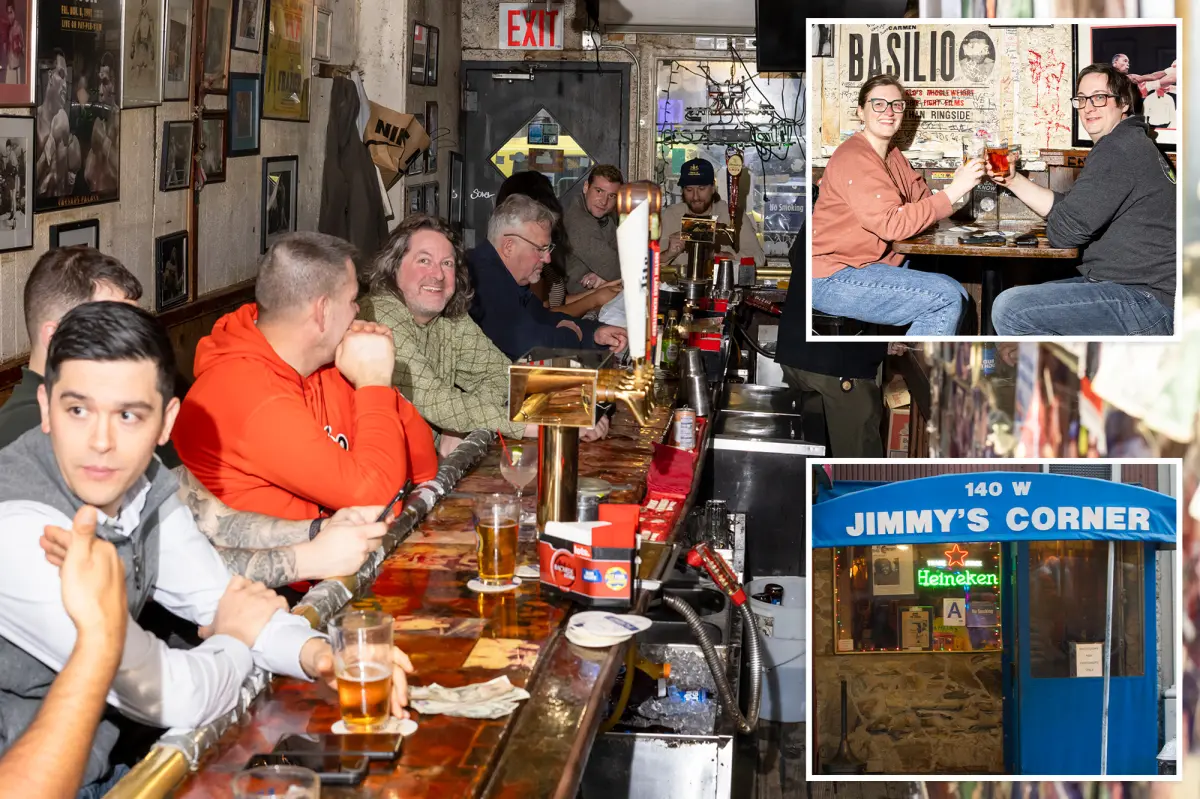
In the heart of Times Square, where glittering billboards and commercial excess have long since replaced the gritty character of old New York, Jimmy’s Corner stands as a defiant holdout from another era. This narrow, boxing-themed watering hole has served up $3 beers and authentic New York camaraderie for over half a century. Now, in a David versus Goliath legal battle, Adam Lee Glenn is fighting to preserve the legacy of his father, Jimmy Glenn, against the formidable Durst Organization, which seeks to evict the beloved establishment. The conflict has transformed from a real estate dispute into something far more personal—a struggle to maintain a vital piece of New York’s cultural fabric in an increasingly homogenized urban landscape.
Jimmy Glenn, a Hall of Fame boxing trainer, opened his eponymous bar in the early 1970s, during what many New Yorkers remember as the “Bad Old Days.” Times Square then was notorious for its seediness—populated by sex shops, prostitutes, and dangerous elements—but Jimmy’s Corner provided a safe haven amid the chaos. “I’m proud that I still get people who come, who used to live in the building next door,” Adam Glenn recalls with evident emotion. “They tell me, ‘I lived in Times Square in the 80s and the only reason I felt safe was because I knew Jimmy was here. The only reason this block felt okay was because your family watched out for us.'” As Times Square underwent its controversial transformation from dangerous to Disney-fied, Jimmy’s remained steadfast—its walls adorned with boxing memorabilia, its spirit unchanged, a living museum where locals and travelers could escape the commercial excesses just outside its door.
The bar’s significance extends beyond nostalgia or cheap drinks. For many patrons, Jimmy’s represents something essential about New York’s identity. “Jimmy’s Bar is one of the last legs that represent New York,” explains Clarence Sessoms III, a 36-year-old regular from the Bronx. “You take Jimmy’s out of New York, you take the foundation from New York.” This sentiment is echoed by long-time visitor Dan Dion, who has been frequenting the establishment during his trips from Nashville for a quarter-century: “Everybody’s welcome here, everybody feels comfortable here, and in the world of Times Square that has changed so much in 25 years, this place hasn’t changed at all. It should have landmark status as far as I’m even concerned.” In a city perpetually reinventing itself, sometimes at the cost of its soul, Jimmy’s offers a rare continuity—a place where the past isn’t just remembered but lived.
The current dispute has deep historical roots, intertwining two New York families’ legacies across generations. According to the lawsuit, Jimmy Glenn initially rented from real estate magnate Seymour Durst, with whom he developed a friendship. After Seymour’s death in 1995, his son Douglas—another friend of Jimmy’s—took over the family business, while the infamous Robert Durst (later the subject of HBO’s “The Jinx”) was sidelined from the family empire. The lawsuit contends that both fathers spoke of their desire to see their respective businesses passed down to their children, creating a verbal understanding that transcended formal contracts. However, this understanding appears to have fractured following Jimmy Glenn’s death from COVID-19 in 2020, when Adam stepped in to preserve his father’s legacy. The lawsuit alleges that the Durst Organization exploited Jimmy’s advanced age and the friendship between the families when negotiating a 2019 lease that contained terms they’re now using to justify eviction.
The relationship between landlord and tenant took a troubling turn in 2023 when, according to the lawsuit, Durst attempted to terminate the lease because many bar patrons—predominantly Black men—would step outside to smoke, an action the lawsuit characterizes as racially motivated. Though that particular conflict subsided, the Durst Organization subsequently informed Adam Glenn that they considered the lease void following his father’s death, despite its stated expiration date of 2029. The lawsuit contends that Jimmy Glenn would never have signed a lease modification that would effectively erase his family’s legacy. The Durst Organization, for its part, claims they’ve been generous, offering $250,000 and extended time in the space as they prepare to sell the building. “We have done our best to be good neighbors, and we regret it has come to this. This is truly the story of no good deed goes unpunished,” a spokesperson stated, framing their actions as accommodations rather than obligations.
Despite the uncertainty surrounding Jimmy’s Corner’s future in its current location, Adam Glenn remains resolute in his commitment to preserving what his father built. “I sort of always knew that one day—and I hoped it was far away—progress is going to come,” he acknowledges with pragmatic resignation. “But I hoped that when it did, it would come in the right way and that they would sort of have the grace and the decency to do this in a way that works for all of us.” His determination transcends the physical space; it’s about maintaining the spirit and purpose of Jimmy’s Corner. “There will always be a Jimmy’s Corner in New York and I will find a forever home,” Glenn promises, his voice reflecting both determination and hope. “But in the meantime, I’m not going to stop fighting to be here. We’re still a slice of old New York. People come in and they feel a little touch of, ‘Oh, this is what New York used to be.’ And I like giving people a real New York experience.” In this spirit of resilience and authenticity, Jimmy’s Corner continues to pour drinks and welcome patrons, standing as perhaps the last true dive in a Times Square that has long since surrendered to the forces of commercial transformation.