


Microsoft’s Internet Revolution: Lessons for the AI Age
In December 1995, on a chilly Seattle day, Bill Gates stood before more than 200 journalists and analysts at Seattle Center to make an announcement that would reshape the tech landscape: Microsoft was going “all-in” on the internet. This pivotal moment, now three decades old, carries striking parallels to Microsoft’s current AI ambitions. As the managing editor for Microsoft Magazine at the time, I witnessed firsthand how Gates’ declaration that “the internet is the primary driver of all new work we are doing throughout the product line” sent shockwaves through the industry. The changes announced that day—the release of Internet Explorer 2.0 as a free browser, internet-enabled Microsoft Office, revamping the MSN online service, licensing Java from Sun Microsystems, and exploring commercial internet applications—laid the groundwork for the dot-com boom and, arguably, the eventual rise of cloud computing. Today, if you replace the word “internet” with “AI” in Gates’ declaration, you’d have a statement perfectly aligned with current CEO Satya Nadella’s vision, who recently wrote: “Fifty years after our founding, Microsoft is once again at the heart of a generational moment in technology as we find ourselves in the midst of the AI platform shift.”
The similarities between Microsoft’s 1995 internet pivot and today’s AI revolution are striking in terms of strategic challenge. While Microsoft was smaller then, it was already the dominant force in software when Windows 95 launched in August 1995. Within just four months, the company had to rapidly evolve its newly released products to meet the internet challenge—a race it couldn’t afford to lose. Gates’ famous “internet tidal wave” memo from May 1995 described the internet as “the most important single development to come along since the IBM PC was introduced in 1981,” while acknowledging Microsoft’s weaknesses in competing with direct website publishing. Similarly, in March 2023, Nadella described AI as something that “will radically transform how computers help us think, plan, and act.” Both moments represent enormous corporate pivots requiring rapid organizational transformation, though today’s Microsoft leaders have learned to be more guarded about publicly acknowledging weaknesses. The urgency expressed by both CEOs, separated by nearly three decades, highlights how revolutionary technologies demand swift and decisive action even from industry giants.
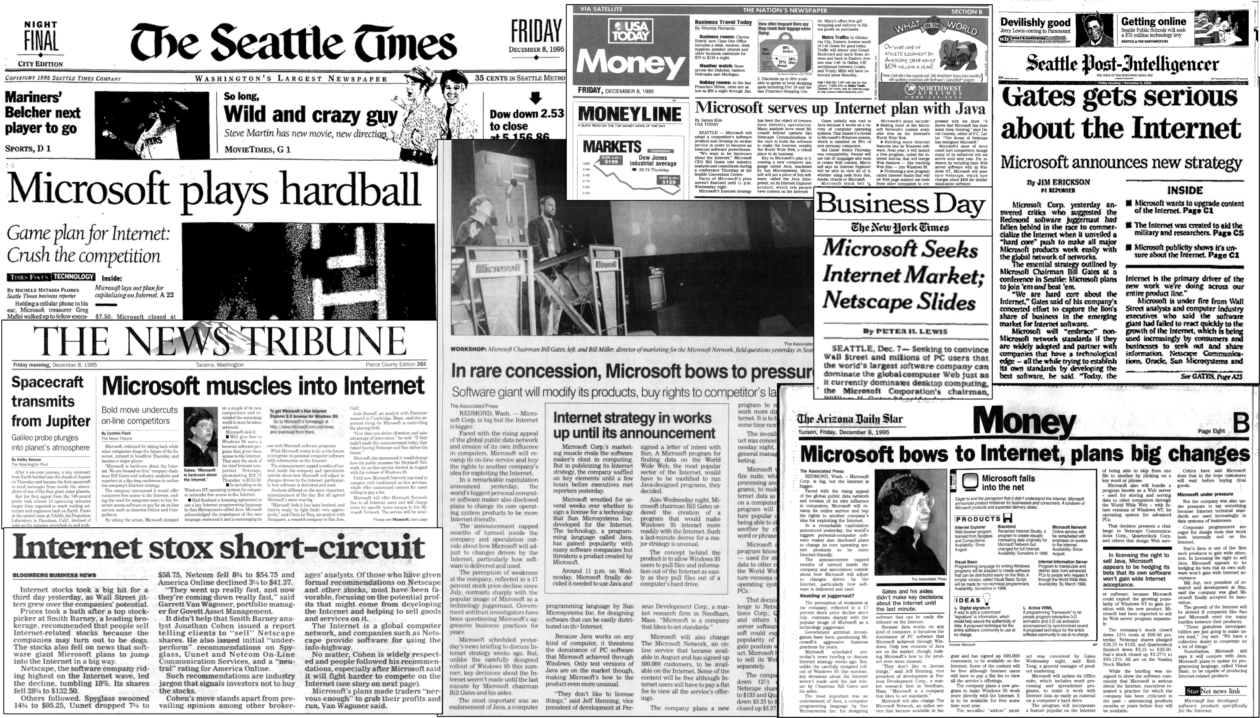
The competitive landscape, however, has transformed dramatically since 1995. Back then, Microsoft reigned supreme in PC operating systems and software with few serious competitors, allowing it to make its internet pivot from a position of tremendous strength. The narrative was clear: Microsoft as Goliath battling Netscape and other internet startups as Davids. Headlines from The New York Times and The Seattle Times framed the story as “Microsoft Seeks Internet Market; Netscape Slides” and “Microsoft plays hardball — Game plan for the Internet: Crush the competition.” I remember sitting beside Gates at lunch during that press event, where he seemed irritated by questions about the Java licensing deal with Sun and the media’s focus on the Microsoft-Netscape rivalry. He dismissed the Java licensing as something Microsoft could “recreate trivially” and wanted to focus on the broader implications of the internet integration across Microsoft’s products. Today’s AI landscape is far more complex, with Microsoft operating in an ecosystem that includes formidable competitors and partners like Amazon, Google, Nvidia, OpenAI, and Anthropic.
The scale difference between 1995 and today is staggering. In my January 1996 Microsoft Magazine cover story, Gates spoke about how “150 million users of Windows” would benefit from internet integration across 20 new products and technologies. Those numbers seem quaint now. Microsoft executive Yusuf Mehdi recently noted that Windows powers more than 1.4 billion monthly active devices—and that doesn’t include Microsoft’s massive cloud computing business, Microsoft 365, LinkedIn, Xbox, or its growing AI revenue from Copilot. The financial investment gap is even more dramatic: Microsoft spent more than $88 billion on capital expenditures last fiscal year, largely on AI infrastructure, while in 1995, the company’s $220 million deal with NBC to launch MSNBC seemed substantial. Beyond the numbers, there’s another crucial distinction: in 1995, no one really knew where the internet was heading or which business models would succeed online. As Tim Bajarin, CEO of Creative Strategies, points out, Microsoft is better positioned for the AI revolution because “we already have the underlying architecture for useful AI applications,” unlike the early internet days when “we didn’t see the value proposition until we saw the role of applications built on a web-based architecture.”
The lessons from Microsoft’s internet pivot apply directly to its AI push. Success will depend on delivering genuine value—AI implementations that solve real problems and demonstrate clear return on investment. Recent headlines suggest skepticism remains: “No one asked for this: Microsoft’s Copilot AI push sparks social media backlash,” declared Germany’s PC-WELT magazine, echoing the same fundamental question Gates couldn’t answer about MSN in 1995: Why should anyone use this? Perhaps the most sobering lesson from the 1990s internet era is that technological relevance is never guaranteed. Of all the competitors mentioned in that December 1995 New York Times story, only IBM remains—and as a vastly different company than it was then. And finally, there’s the cautionary tale about the cost of success: Microsoft’s aggressive internet strategy worked brilliantly, but it also triggered a Department of Justice antitrust investigation that lasted from 1998 to 2001. Competing vigorously is essential; competing too aggressively can have lasting consequences. As Microsoft navigates the AI era, balancing innovation with responsibility may prove its greatest challenge—a lesson hard-learned from its internet revolution thirty years ago.
As Microsoft celebrates its 50th anniversary and embraces AI as thoroughly as it once did the internet, the historical parallels offer both encouragement and caution. The company has proven it can pivot at scale, transforming itself to meet technological revolutions. Yet the landscape is more complex now, with greater competition, higher stakes, and increased scrutiny. The AI features now embedded across Microsoft’s product line—from Azure to Windows 11, LinkedIn to Microsoft 365—represent an all-in bet similar to the one Gates made in 1995. But unlike then, Microsoft isn’t playing catch-up; through strategic partnerships and investments, particularly with OpenAI, it has positioned itself at the forefront of the AI revolution. As we look back at that pivotal December day thirty years ago, the most valuable insight may be that technology transformations require both boldness and humility—the courage to make big bets and the wisdom to learn from past missteps. In both the internet and AI eras, Microsoft’s success ultimately depends not on declarations or investments alone, but on creating tools that genuinely improve how people work, communicate, and create.