



NASA’s Sweet Discovery: Asteroid Bennu’s Life-Building Ingredients Offer Clues to Our Origins
In a remarkable scientific breakthrough, NASA has potentially moved closer to answering one of humanity’s most profound questions: how did life on Earth begin? The space agency has discovered essential sugars on asteroid Bennu, a 500-meter-wide space rock orbiting approximately 200 million miles from Earth. This finding represents a significant step in understanding the chemical building blocks that may have seeded life on our planet billions of years ago.
The discovery centers around ribose—a five-carbon sugar that forms the backbone of RNA (ribonucleic acid)—and glucose, the six-carbon sugar that powers human cells. While glucose provides the energy that fuels our existence, ribose holds particular significance as this marks the first confirmed detection of this crucial sugar in a sample collected directly from an asteroid. “All five nucleobases used to construct both DNA and RNA, along with phosphates, have already been found in the Bennu samples brought to Earth by OSIRIS-REx,” explained study leader Yoshihiro Furukawa of Tohoku University in Japan. “The new discovery of ribose means that all of the components to form the molecule RNA are present in Bennu.” This comprehensive collection of life’s building blocks supports the hypothesis that asteroids may have delivered the essential ingredients for life to Earth during our planet’s formative years. While modern life relies on the intricate interplay between DNA, RNA, and proteins, Furukawa suggests that early life likely maintained simpler biochemistry—with RNA potentially serving as nature’s original multitool, capable of both storing genetic information and catalyzing crucial biological reactions without additional assistance.
Beyond these sugars, Bennu has revealed another extraordinary discovery: a previously unknown “space gum” substance that might have played a role in life’s emergence on Earth. This material—originally pliable but now hardened—contains nitrogen and oxygen-rich polymers believed to have formed as Bennu’s parent body underwent heating processes in the early solar system. Researchers theorize this cosmic substance developed from carbamate compounds that managed to form complex chains before being altered by subsequent aqueous processes on the asteroid. Scott Sandford of NASA’s Ames Research Center, who led another study examining Bennu’s samples, described this peculiar material as potentially representing “one of the earliest alterations of materials that occurred in this rock,” adding that “we’re looking at events near the beginning of the beginning.” This ancient gummy substance may preserve chemical signatures from the solar system’s infancy, offering a glimpse into the primordial soup from which life eventually emerged.
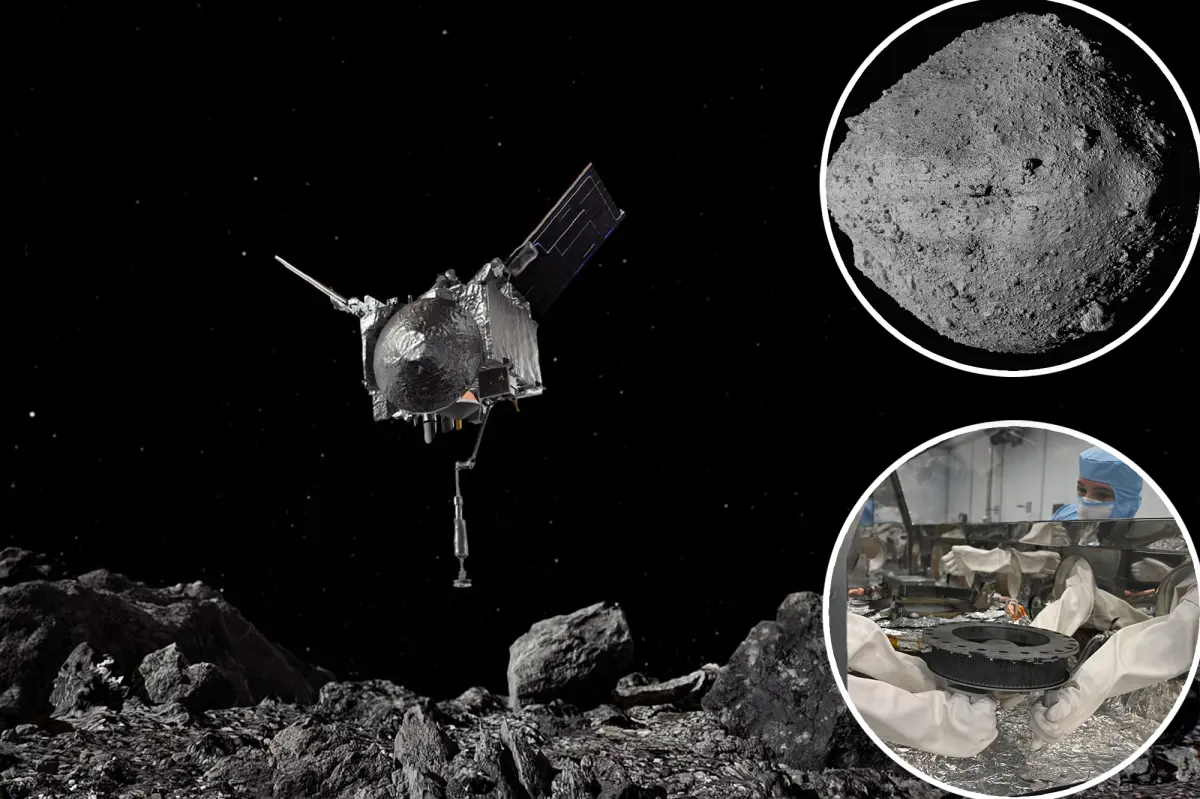
The analysis of Bennu’s samples has yielded another surprising revelation: the asteroid contains six times more supernova dust than any previously studied space rock. This ancient stardust predates our solar system, indicating that Bennu’s parent body formed in a region particularly enriched with material from dying stars. This extraordinary concentration provides scientists with a rare opportunity to study the original ingredients that went into forming our cosmic neighborhood. Bennu itself is no distant stranger—it formed approximately 4.6 billion years ago and makes relatively close approaches to Earth every six years, sometimes passing closer than our Moon. NASA’s OSIRIS-REx mission successfully collected samples during a 2020 rendezvous with the asteroid and returned them to Earth in September 2023, where they’ve undergone intensive laboratory analysis revealing these groundbreaking findings.
The discoveries strongly support the “RNA world” hypothesis—a prevailing scientific theory suggesting that before DNA became life’s primary genetic storage molecule, RNA likely performed dual duties, both carrying genetic information and facilitating the chemical reactions necessary for primitive life forms. The presence of complete RNA building blocks on Bennu provides compelling evidence that the early solar system contained ready-made ingredients for life’s emergence. Additionally, the discovery of glucose demonstrates that even the energy sources needed to power early biological processes were available in space and could have been delivered to Earth through asteroid impacts. This combination of information storage molecules and energy sources presents a more complete picture of how the chemistry of life might have been established on our young planet.
While Bennu is helping scientists unravel the mystery of our origins, it also presents a potential future threat. Researchers calculate there’s approximately a one-in-2,700 chance that Bennu could impact Earth in the year 2182. This remote possibility adds a thought-provoking dimension to our relationship with this ancient space traveler—the very object helping us understand how life began might one day pose a challenge to life’s continuation. Nevertheless, the immediate scientific value of Bennu far outweighs its distant potential hazard. The sugars, nucleobases, phosphates, and mysterious “space gum” found within its samples represent a treasure trove of prebiotic chemistry, preserving snapshots of the conditions that existed before life emerged on Earth. As scientists continue analyzing these precious samples, we may come ever closer to understanding the cosmic recipe that cooked up life on our planet—a sweet discovery indeed in humanity’s quest to understand our deepest origins.