


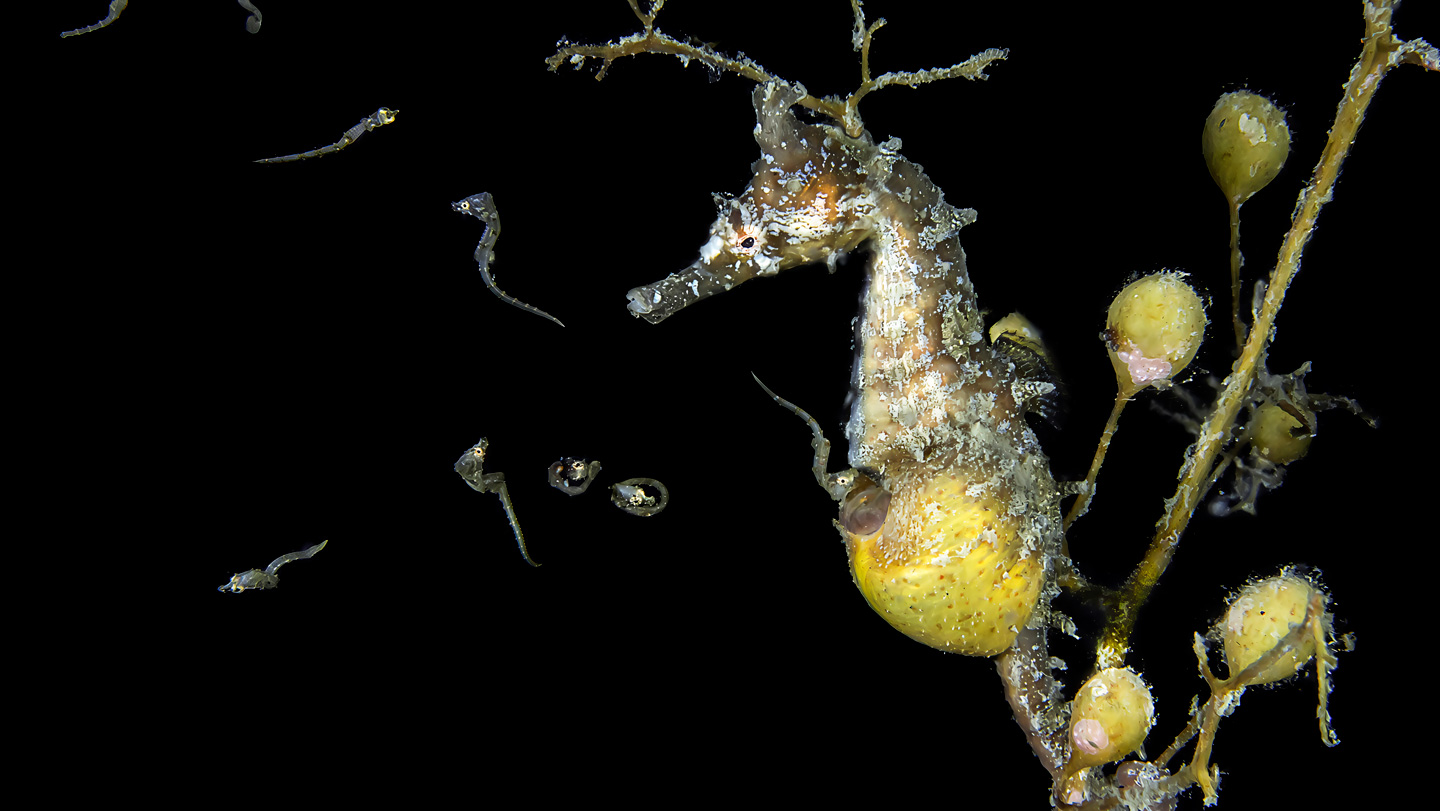
The Incredible Role Reversal of Seahorse Fatherhood: A Scientific Wonder
In the vast animal kingdom, the seahorse stands as a remarkable exception to traditional parenting roles. If there were a competition for “Best Dad,” seahorses would undoubtedly take home the trophy. These extraordinary marine creatures have evolved a unique reproductive strategy where males, not females, carry and nurture their young to term—a fascinating reversal that has captivated scientists for decades.
Unlike most animals where mothers bear the responsibility of pregnancy, male seahorses possess specialized “brood pouches” that function remarkably similar to a mother’s womb. When seahorses mate, the female deposits her eggs into the male’s pouch, where he fertilizes them and provides nourishment until birth. This peculiar reproductive strategy has prompted researchers to investigate the biological mechanisms behind this male pregnancy phenomenon. Recent groundbreaking research published in Nature Ecology and Evolution has revealed something truly unexpected: while male seahorses utilize many of the same genetic pathways as pregnant females of other species, their pregnancy is triggered by male hormones rather than female ones. This discovery represents a fundamental shift in our understanding of how pregnancy can evolve across different sexes.
The evolutionary journey toward male pregnancy in seahorses appears to have occurred gradually over time. Examining the family tree of related species reveals a progressive enhancement of male parenting roles. Some primitive relatives of seahorses simply provide a sticky surface for eggs to attach to their bodies. Others have evolved open-faced shelters on their tails or bellies. But seahorses represent the pinnacle of this evolution with their fully enclosed brood pouches that supply developing embryos with oxygen and nutrients. Axel Meyer, an evolutionary biologist from the University of Konstanz, notes that this represents perhaps the most extreme example of sex role reversal known in the animal kingdom—making seahorses an invaluable model for understanding how complex biological functions can evolve in unexpected ways.
To uncover the genetic basis of male pregnancy, researcher Yali Liu from the Chinese Academy of Sciences examined cells from the bellies of lined seahorses (Hippocampus erectus) at various developmental stages. Her team discovered that specialized skin cells in male seahorses activate many of the same genes that female animals use during pregnancy. However, there was one crucial difference: instead of being triggered by female hormones, these pregnancy-related genes in seahorses respond to male hormones, likely testosterone or another androgen. The team even demonstrated that when female seahorses were exposed to testosterone—the hormone that typically promotes male characteristics in humans—they too developed brood pouches, confirming the hormone’s role in this unique reproductive adaptation.
What makes this discovery particularly fascinating is that the male seahorse’s brood pouch functions much like a placenta, providing oxygen and nutrients to developing embryos. However, while placentas in female animals develop from reproductive tissue, the seahorse’s version derives entirely from skin cells. This represents what scientists call “convergent evolution”—different biological pathways evolving independently to serve similar functions. Thomas Boehm from the Max Planck Institute describes this as “a phenomenal example of how genetic networks can be rewired to achieve the same end.” This rewiring demonstrates nature’s remarkable flexibility in solving reproductive challenges.
The seahorse’s unique reproductive strategy isn’t just a biological curiosity—it offers broader insights into how pregnancy itself has evolved. While pregnancy seems like a unified biological concept, research shows it has evolved independently more than 150 times across the animal kingdom, almost exclusively in females. Camilla Whittington, an evolutionary biologist at the University of Sydney, discovered similar patterns when comparing pregnancy genes across mammals, reptiles, and sharks. Her research revealed that while some genes are shared across these diverse pregnant species, others are unique to each lineage. As Bill Cresko, an evolutionary geneticist not involved in the seahorse study, aptly puts it, the evolution of pregnancy wasn’t created “from whole cloth” but was “built like a quilt with different patches of genes and cells” that function similarly across different animals. The seahorse’s male pregnancy represents perhaps the most extraordinary patch in this evolutionary quilt—a testament to nature’s endless capacity for innovation and adaptation.