



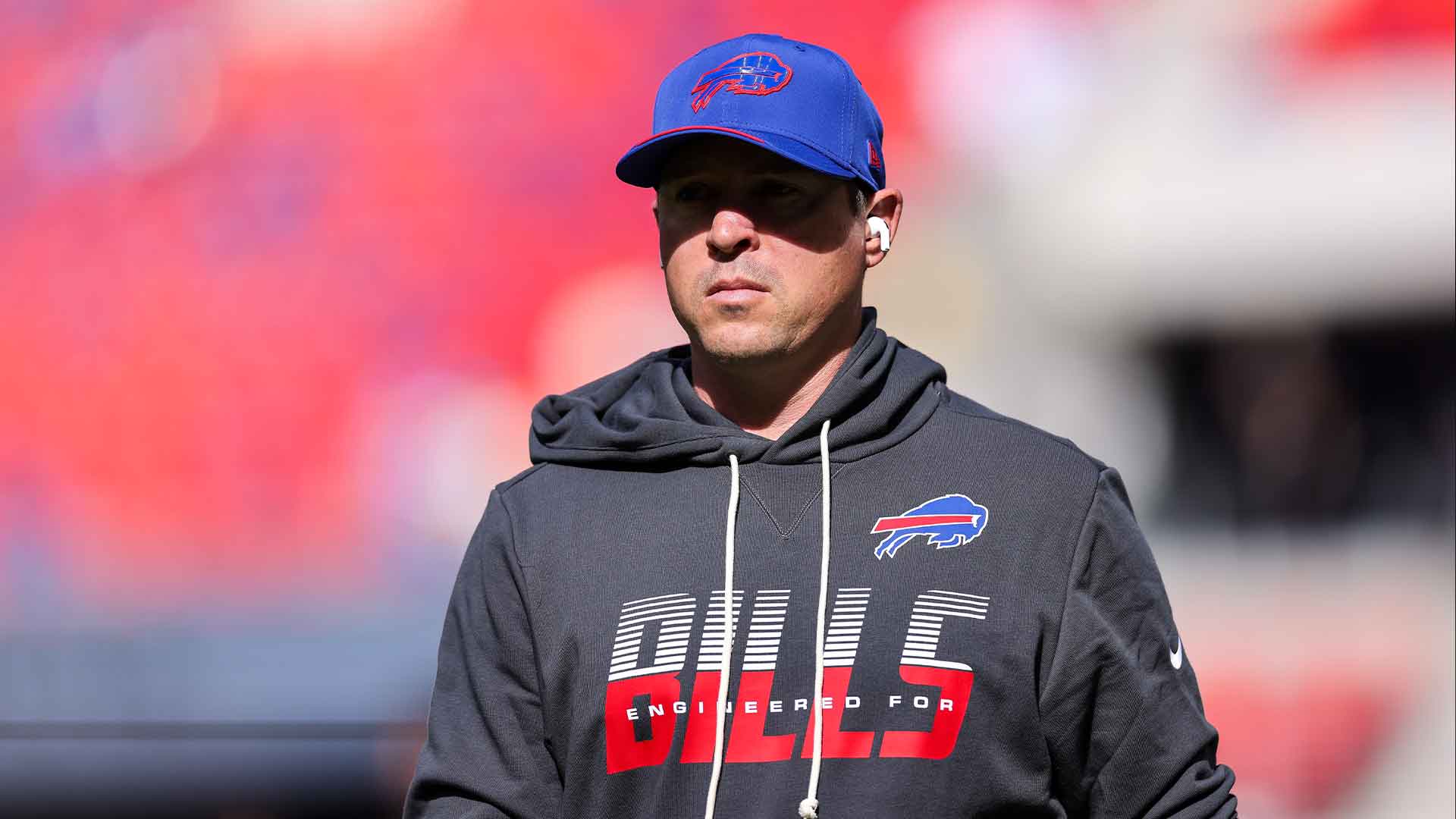
Jim Leonhard, the first-year defensive coordinator of the Buffalo Bills, is a man whose patience has evaporated. Standing before a virtual room of reporters on a Tuesday afternoon, his voice carried the weight of a season teetering on the edge of unfulfilled promise. The defense he was hired to transform has instead become a sieve—porous, undisciplined, and alarmingly soft in the moments that matter most. After five weeks, the Bills are somehow 4-1, but that record feels more like an accident than a testament to their defensive prowess. Leonhard, a former safety who built his reputation on relentless preparation and an almost obsessive attention to detail, refused to sugarcoat the reality. “It’s time to be good at something,” he said, his words sharp and unyielding, “and that’s our struggles right now. It’s too inconsistent to pretend that we’re building and working and making improvements. Everything’s being evaluated.” This is not the voice of a coach offering platitudes about progress and trust in the process. It is the voice of a man who sees the film every night, who notices every blown assignment, every missed tackle, every fourth-down conversion surrendered, and who knows that in the NFL, excuses are a luxury no one can afford. The confidence he still holds in his players is real, but it is now tempered by a stark, unspoken threat: if the answers aren’t on the roster, the roster will change. This is professional football, and Leonhard knows that well-intentioned struggles are still failures.
The numbers paint a damning picture of a defense that cannot get off the field, and the statistics read like a list of recurring nightmares. Buffalo allowed 33 first downs against the Los Angeles Rams, a number that tied the franchise’s worst mark since 1991—and a staggering feat given that the game went to overtime, meaning the defense had even more chances to force a stop and simply couldn’t. More troubling is the consistency of the collapse: the Bills have allowed 20 or more first downs in every single game this season, a mark they reached only once in all of the previous year. Opponents are converting fourth downs with a chilling 89 percent success rate, turning gambles into inevitabilities. The Rams went 2-for-2, and both conversions extended drives that led to points. Buffalo’s defense is giving up the third-most yards per game in the NFL at 389, and only four teams have allowed more points. But perhaps the heaviest toll is physical. The unit has played 350 snaps, the second-highest total in the league, and on Monday night they endured 78 snaps of sheer exhaustion—the most by a Bills defense in two years. By the fourth quarter, the players were running on fumes, their legs heavy, their reactions a split-second too slow. Leonhard understands this intimately. “You play that many snaps, it’s hard to sustain,” he admitted. He knows the solution is not simply effort; it’s winning the early downs, getting off the field on third and fourth, and giving the offense a chance to breathe. But as of now, the defense is a leaky ship, and Leonhard is desperately trying to plug the holes before the whole thing sinks.
The saving grace, of course, has been Josh Allen, the Bills’ quarterback who single-handedly dragged his team to a 37-34 overtime victory over the Rams. In that game, Allen played the role of Superman—throwing, running, scrambling, and willing the offense to score again and again, just to keep pace with a defense that couldn’t stop anything. Leonhard acknowledged the heroics with a sense of gratitude, but also with a clear-eyed recognition that this is no way to live. “It has to change. It has to get better,” he said, not as a plea, but as a demand. He knows that leaning on the offense to produce 37 points every week is a formula for disaster, especially when the schedule ahead features more potent offenses and playoff-caliber quarterbacks. “We plan on being in a lot of big games,” he explained, “and it’s our job as a defense to go close them out for wins.” That is the heart of the matter: a great defense doesn’t just prevent points; it delivers the final blow, it seals the victory, it gives the offense the confidence to take risks. Right now, the Bills’ defense does none of that. Instead, it puts the team in a constant state of crisis, forcing Allen to be perfect while the defense merely hopes to survive. Leonhard knows that this dependence is unsustainable, and his frustration is compounded by the fact that the issues are not mysterious or new—they are recurring, familiar, and deeply maddening.
At the center of the problem lies a secondary that has been anything but settled. The Bills entered the season with a reshuffled cornerback group, and five weeks in, the position remains a revolving door. Christian Benford has been a steady presence on one side, but the other cornerback slot has been a source of instability. Second-year player Maxwell Hairston started the first four games, only to be benched for rookie Davison Igbinosun in the Rams game. The change, however, did little to solve the deeper issue: players were out of sync, missing assignments, and failing to communicate. Matthew Stafford, a wily veteran, picked them apart for 383 yards, exploiting mismatches and confusion that looked like a rookie mistake, except it was happening in Week 5. The Bills have allowed 250 or more passing yards in four of their five games, which is twice as many times as they did all of last season. The depth is thin, with only five cornerbacks on the roster, and when injuries creep in—as they inevitably do—the seams start to show. But Leonhard sees something beyond the physical mistakes. He sees players who are trying too hard, attempting to do too much, and in the process, losing the very discipline that makes a defense function. “There’s a fine line of trying harder and trying smarter,” he said, his voice softening for just a moment. “I have that tendency. You want to do more, you want to do extra. Sometimes, it’s just relax, take a step back and simplify. Slow down.” It is a poignant admission from a coach who knows that in the heat of battle, the mind can become the greatest enemy.
The context of all this chaos is a defensive transformation that was always going to be a challenge, but perhaps a bigger one than anyone anticipated. When Sean McDermott was fired, Leonhard was handed the keys to a unit that was switching to a 3-4 scheme, a fundamental philosophy change that requires new personnel, new alignments, and new instincts. Four new starters were brought in, and the expectation was that the learning curve would be steep but manageable. Instead, the curve has been vertical, and the defense has fallen behind. Injuries have certainly played a role—having a new player in the lineup every week makes cohesion nearly impossible—but Leonhard refuses to use that as a crutch. He knows that in the NFL, no one cares about your injuries or your transition year. The scoreboard doesn’t lie, and the film doesn’t forgive. The challenge is not just schematic but psychological: how do you instill confidence in a group that has been beaten down by its own mistakes? How do you tell a young cornerback to trust his technique when he’s been burned on the previous drive? Leonhard believes the answers are there, somewhere, but finding them requires a cold, hard look at everything. He has already made one change in the secondary, and he has warned that more could follow. This is not a coach who is panicking; it is a coach who is simplifying, stripping away the noise, and getting back to the fundamentals that defined him as a player and now as a coordinator. He knows that this is the moment where seasons are saved or lost, where a defense either finds its identity or gets exposed in the playoffs.
As the Bills remain in Southern California before flying to Las Vegas for a matchup against the Raiders, Leonhard’s message is one of fierce accountability, but also a glimmer of hope. He is not giving up on this group; he is challenging it. He is demanding something better, not just because the team needs wins, but because the season has larger ambitions. The AFC is wide open, and the Bills have the talent to make a deep run—but not if the defense continues to give up 30-plus points and 400-plus yards on a weekly basis. Leonhard knows that the answers may not come overnight, but he is determined to find them. He spoke about the need to be more aggressive early in games, to manufacture stops, to give his players a chance to succeed rather than asking them to hold on while exhausted. He also spoke with a quiet confidence that this defense has the pieces to turn it around, if only they can slow down, trust each other, and execute. “Everything’s being evaluated,” he reiterated, and that is the truth. Every player, every call, every technique is on the table. But in that evaluation lies an opportunity—for a young defense to grow up quickly, for a new coordinator to make his mark, and for a team to learn that adversity, while painful, can forge the kind of toughness that championships demand. Leonhard’s patience may be running thin, but his resolve is not. The next chapter of this season will reveal whether all that frustration becomes fuel for a resurgence or another heartbreaking collapse. For now, all he can do is demand better—and wait for his players to answer the call.